Get Full Government Meeting Transcripts, Videos, & Alerts Forever!
Get email alerts on the Data Privacy Wildlife topic
No spam. Unsubscribe anytime.
Bill would limit release of precise wildlife GPS data for one year to protect fair chase and research integrity
Summary
Representative Jonathan Karlen proposed a one-year delay on public release of precise wildlife location data collected for research to protect fair chase, research integrity and landowner trust, with exceptions for environmental permitting and designated project partners.
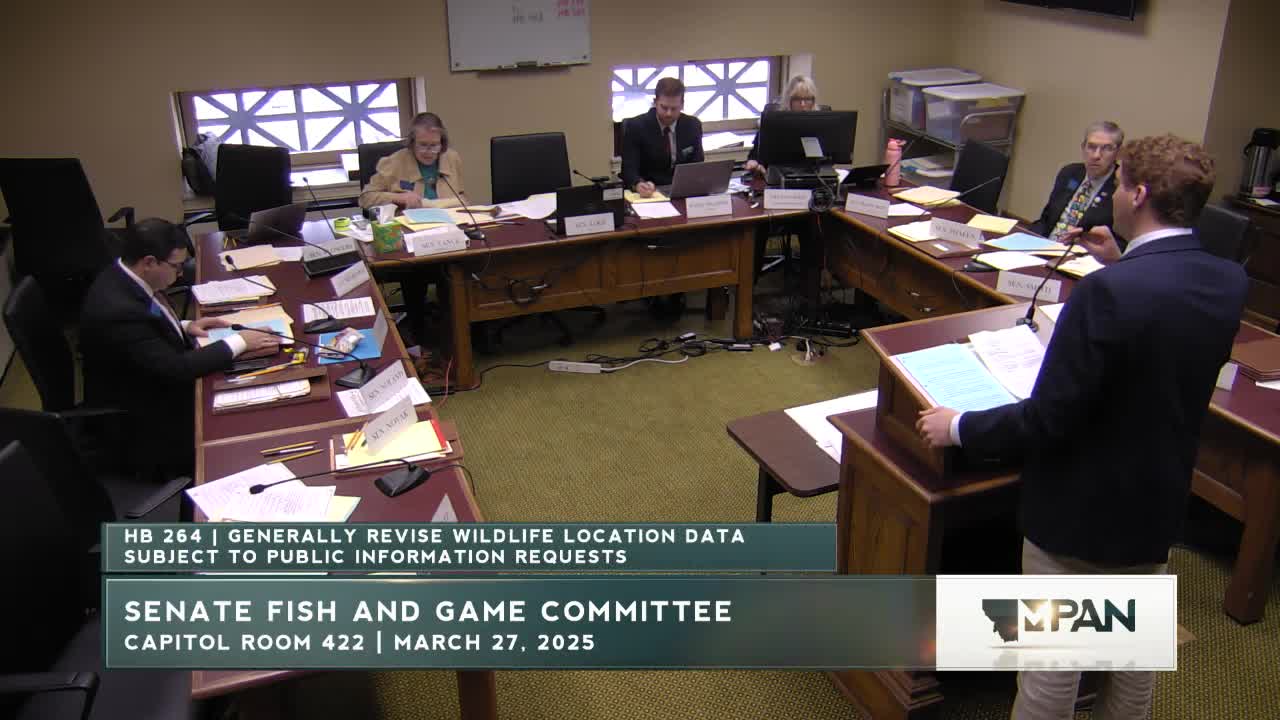
Representative Jonathan Karlen opened a hearing on House Bill 264, describing a proposal to protect precise wildlife location data — for example, GPS coordinates from collared deer, elk or pronghorn — by placing a one-year buffer before the department can release exact locations in response to public records requests. Karlen said the bill preserves access to generalized or spatially buffered data within the one-year window and allows full data release after one year, with specific exceptions for environmental permitting and the state library’s existing data flows.
Karlen and multiple proponents argued the measure addresses growing concerns that near-real-time location data can be used to locate and hunt animals, undermining fair chase and harming landowner relationships used for research access. Joshua Millspaugh, director of the Boone and Crockett program at the University of Montana, testified that researchers often spend years collecting data and that premature public release can allow others to publish or draw conclusions from incomplete data sets. He said the bill would not prevent legitimate conservation partners from accessing data where needed.
Multiple hunters and organizations — including Montana Sportsman's Alliance, the Montana Wildlife Federation and individual hunters — testified in support, framing the change as protecting fair chase and preventing commercial apps or third parties from monetizing live-animal locations. The Montana State Library’s digital library administrator and FWP officials provided informational testimony and answered committee questions. The sponsor said he coordinated an amendment with staff to preserve the state library’s data flow and suggested changing “research partners” to “project partners” to ensure access for infrastructure and conservation projects such as wildlife-crossing planning.
The Greater Yellowstone Coalition registered soft opposition, asking the committee to ensure trusted project partners retain access to data for infrastructure and highway-wildlife mitigation work; witnesses and sponsor discussed data-sharing agreements and contractual prohibitions on re-dissemination as implementation mechanisms. FWP said the bill is implementable and that prohibitions would carry forward to receiving partners under data-sharing agreements.
Sponsor Karlen closed noting the one-year buffer is milder than some other states’ approaches and said the bill aims to balance public access with protection of wildlife, research integrity and landowner trust. The transcript records detailed testimony and informational exchanges; no committee vote was recorded.