Get Full Government Meeting Transcripts, Videos, & Alerts Forever!
Get email alerts on the Employment Enforcement topic
No spam. Unsubscribe anytime.
Committee hears bill to let DLI check I‑9s, use E‑Verify as option to curb illegal employment
Summary
HB 226 would allow Montana's Department of Labor and Industry to check employers' I‑9 or E‑Verify records during inspections and assess graduated penalties; supporters said it protects law‑abiding businesses and vulnerable workers, while opponents raised concerns over unequal liability and preference for E‑Verify.
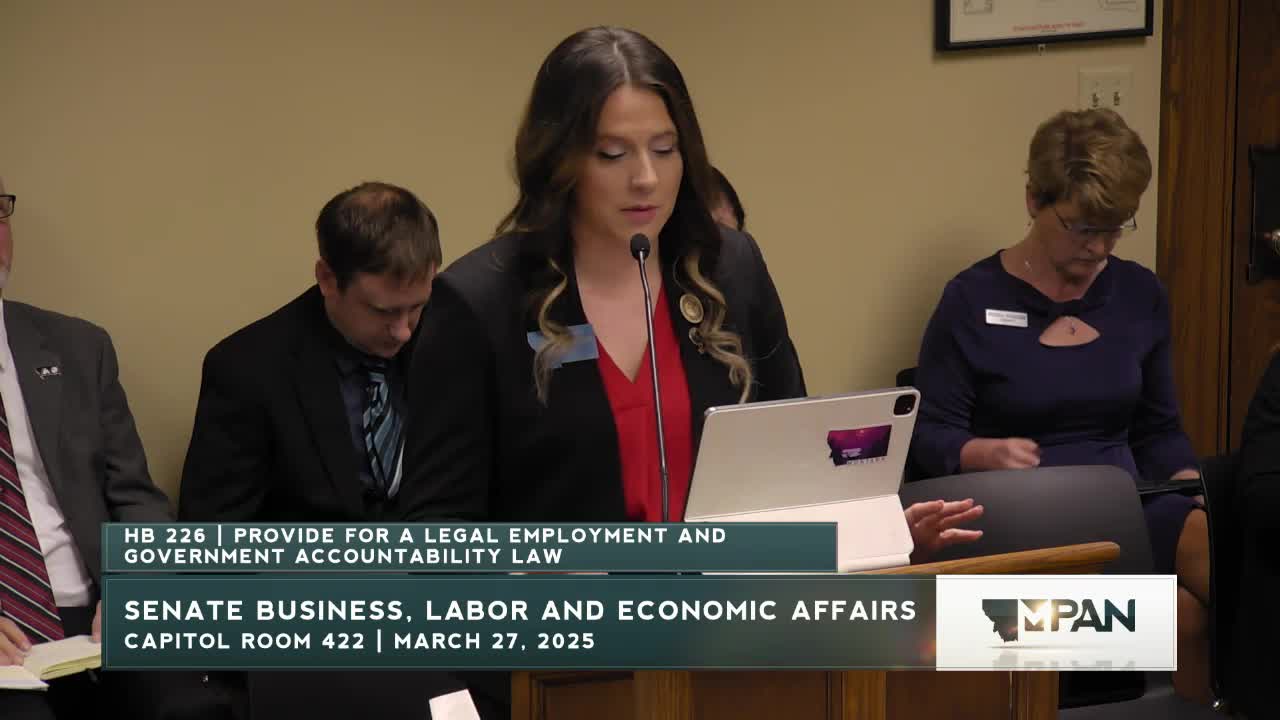
Representative Courtney Sprunger (House District 7) presented House Bill 226, the "Legal Employment and Government Accountability" (LEGAL) Act, proposing to give the Montana Department of Labor and Industry (DLI) authority during employer inspections to review I‑9 records or, optionally, E‑Verify results and to assess civil penalties for repeated violations.
Proponents including trade unions, construction industry groups and the Montana Chamber of Commerce told the committee the measure is intended to protect law‑abiding employers from unfair competition and to deter labor trafficking and the employment of ineligible workers. Jay Reardon of the Montana State Building and Construction Trades Council and Rhonda Wiggers of the National Federation of Independent Businesses testified in favor, saying the bill should be non‑duplicative of existing processes and not overly punitive.
Quinlan O'Connor, chief legal counsel for DLI, appeared as an informational witness and described the agency's existing roles in licensure and enforcement. He said the bill drafts a graduated penalty structure — including fines (for example a referenced $2,500 figure per employee in the bill’s draft) and potential license revocation for third or subsequent violations — tied to existing licensing enforcement tools the department uses. O'Connor said the bill aligns state timelines with federal regulations (as referenced in the draft, 8 CFR) and that contested‑case hearings would follow the state's administrative procedures statute (Title 2, Chapter 4, Part 6).
Opponents raised two principal concerns. Don Cape of the Coalition for Safety and Justice and other witnesses urged that the bill treats employers differently depending on whether they use E‑Verify or a manual I‑9, because E‑Verify results can shield employers from liability under the proposal while I‑9 users remain potentially liable for forged documents. Opponents asked why the bill did not require universal E‑Verify use, and DLI and the sponsor replied that imposing E‑Verify would be burdensome and costly, especially for small and agricultural employers.
Committee members questioned enforcement capacity, cost implications for employers, due process procedures for contested cases, and whether the bill might require notification to federal agencies if violations are found. O'Connor said DLI conducts a wide variety of employer audits already and would leverage existing inspection activity; he explained that contested cases would proceed through DLI's office of administrative hearings and subject to judicial review.
The sponsor said the bill targeted bad actors and would not impose excessive burdens on employers that already comply, and urged the committee to support the measure.