Get Full Government Meeting Transcripts, Videos, & Alerts Forever!
Get email alerts on the Wildlife Regulation topic
No spam. Unsubscribe anytime.
Committee hears bill to require nonresident bird-dog trainers to report number of dogs, allow limits
Summary
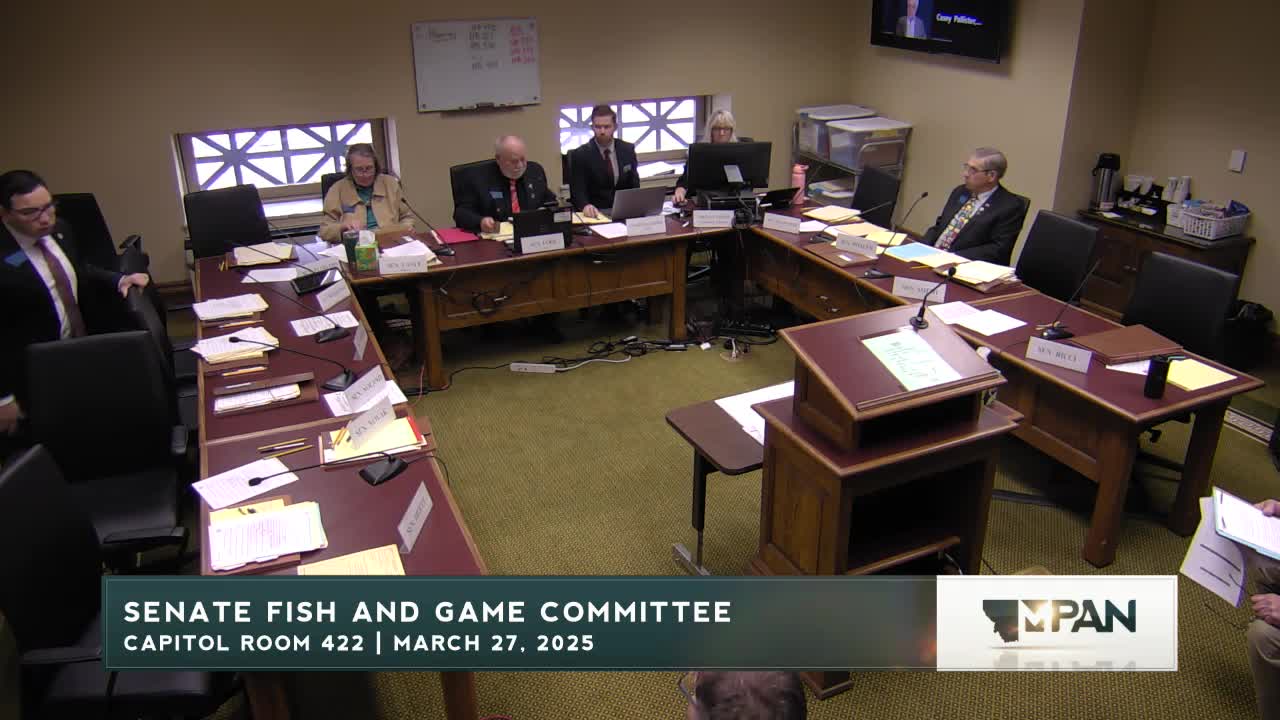
A House bill that would require nonresident bird-dog trainers to report how many dogs they train in Montana and give the Fish and Wildlife Commission authority to limit nonresident licenses and dogs per license drew support from conservation groups and ranchers at a hearing before the House Fish, Wildlife & Parks Committee.
Representative (sponsor) opened a hearing on House Bill 450, saying the measure is “a very simple bill” that would require nonresidents who purchase a Class D-5 bird-dog training license to report the number of dogs they are training and to have that number printed on the license.
The sponsor said the bill is intended as an information-gathering tool to help the state “get a handle” on how many out-of-state trainers and how many dogs are coming into Montana. He said the license fee was drafted at $5 and “might be amended to 10,” and that the House amended the measure to give the Fish and Wildlife Commission authority to limit the number of Class D-5 licenses issued to nonresidents and to limit the number of dogs that can be trained under a single license.
An operations captain with the enforcement division at Montana Fish, Wildlife & Parks testified in support and summarized the bill’s statutory change: it would amend Montana Code section 87-3-602 by adding the requirement that Class D-5 license holders report the number of dogs being trained when purchasing the license and require the number to be printed on the license. He confirmed the House amendment that gives the Fish and Wildlife Commission the authority to limit nonresident licenses and the number of dogs per license.
Conservation and producer groups said the reporting requirement and grant of limiting authority are needed to address large numbers of nonresident trainers using public lands in eastern Montana. Ben Lamb of the Montana Conservation Society said the change would help address “large numbers of dogs and a large number of out-of-state trainers coming in, taking advantage of Montana's upland game bird resource.” Scott Blackman of the Montana Wool Growers Association told the committee trainers sometimes arrive “with 10 to 30 dogs, sometimes more, camp on public lands and stay through the season,” and said the bill is “a small step” toward mitigating impacts on livestock and range users.
Individual ranchers and hunters described local impacts. Alicia Nathy, who farms and ranches in Daniels County, said commercial trainers arrive in large numbers, often bringing horses and many dogs, leaving ranchers unable to rely on existing enforcement tools to verify counts at remote camps. Jeff Herbert of the Montana Sportsman's Alliance, a long-time trainer, said he supported the bill but urged that resident professional trainers with long-standing relationships with landowners not be unduly restricted.
No formal committee action or vote occurred at the hearing. The sponsor closed by urging a “do pass,” describing the bill as a modest, information-focused step to determine whether stricter limits are needed.
Ending: The committee held a public hearing with multiple proponents and informational testimony; no final vote was recorded in the transcript.