Get Full Government Meeting Transcripts, Videos, & Alerts Forever!
Get email alerts on the Healthcare Nutrition topic
No spam. Unsubscribe anytime.
Montana committee hears bill to create dual licensure for dietitians and certified nutrition specialists
Summary
A bill (HB 806) to create separate licensed tracks for registered dietitians and certified nutrition specialists, defining medical nutrition therapy and exemptions for wellness providers, drew supportive testimony from practitioners and state stakeholders.
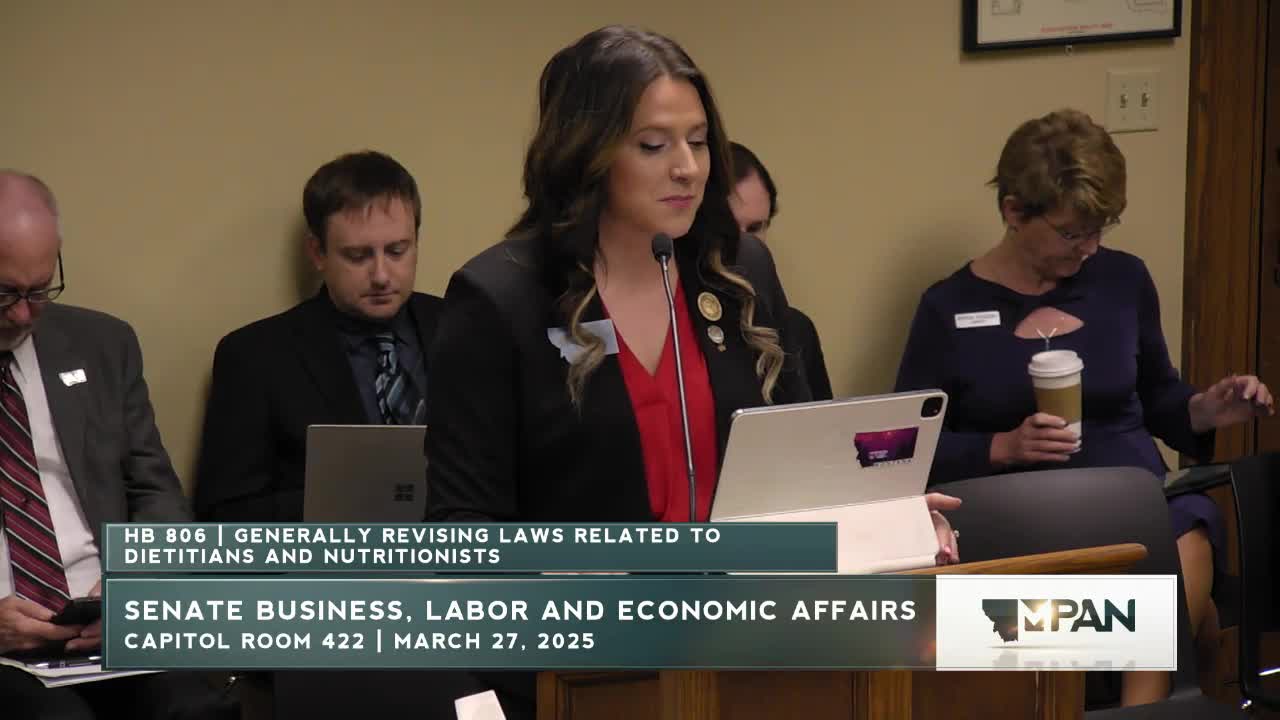
Courtney Sprunger, a member of the Montana House representing District 7, opened a hearing on House Bill 806, which would create a dual licensure structure so that registered dietitians (RDs) and certified nutrition specialists (CNSs) each have legally recognized titles and clear scopes of practice.
The bill’s sponsor said HB 806 "creates a dual licensure system, allowing RDs to be licensed as licensed dietitians and CNS professionals to be licensed as licensed nutritionists," and proponents told the committee the change is intended to protect public safety while expanding access to medical nutrition therapy (MNT).
Proponents including practicing clinicians and professional associations told the Senate Business and Labor Committee the bill clarifies that licensure is required for medical nutrition therapy — described in testimony as treatment for complex conditions such as chronic disease and eating disorders — while allowing health coaches and other wellness providers to operate without a license so long as they do not provide MNT.
Aiden Myhre of Billings Clinic and Paige Sadowski, public policy chair for the Montana Academy of Nutrition and Dietetics, testified in favor. Amy Smith, senior director for advocacy at the Board for Certification of Nutrition Specialists, testified that CNS programs include master’s or doctoral degrees, more than 1,000 hours of supervised clinical experience and a national board exam, and that CNSs can provide evidence‑based personalized nutrition for chronic disease alongside RDs.
Witnesses said collaboration between RD and CNS groups produced the bill language and that fewer than 25 people currently qualify immediately for the CNS pathway in Montana but that the profession is growing. The Department of Labor and Industry provided legal counsel as an informational witness and said a technical coordination amendment was drafted.
No opponents spoke at the hearing. Committee members asked technical questions about training, supervision and statutory alignment with federal programs.
The sponsor closed urging a do pass recommendation. The committee record shows testimony focused on workforce shortages, public safety through scope definition, and transitional language for current licensees.
Ending: The hearing closed with the sponsor asking the committee to give HB 806 a favorable recommendation; the bill will await any amendments from committee staff and possible further committee questions.