Get Full Government Meeting Transcripts, Videos, & Alerts Forever!
Get email alerts on the Nuclear Waste And Energy Policy topic
No spam. Unsubscribe anytime.
Montana committee hears bill that would let state accept, reprocess its own spent nuclear fuel
Summary
Lawmakers and witnesses debated House Bill 623 on whether Montana should authorize handling and reprocessing of the state’s own spent nuclear fuel; proponents urged removing regulatory barriers to future nuclear development, while opponents warned of high costs, long timelines and health and tribal-consent concerns.
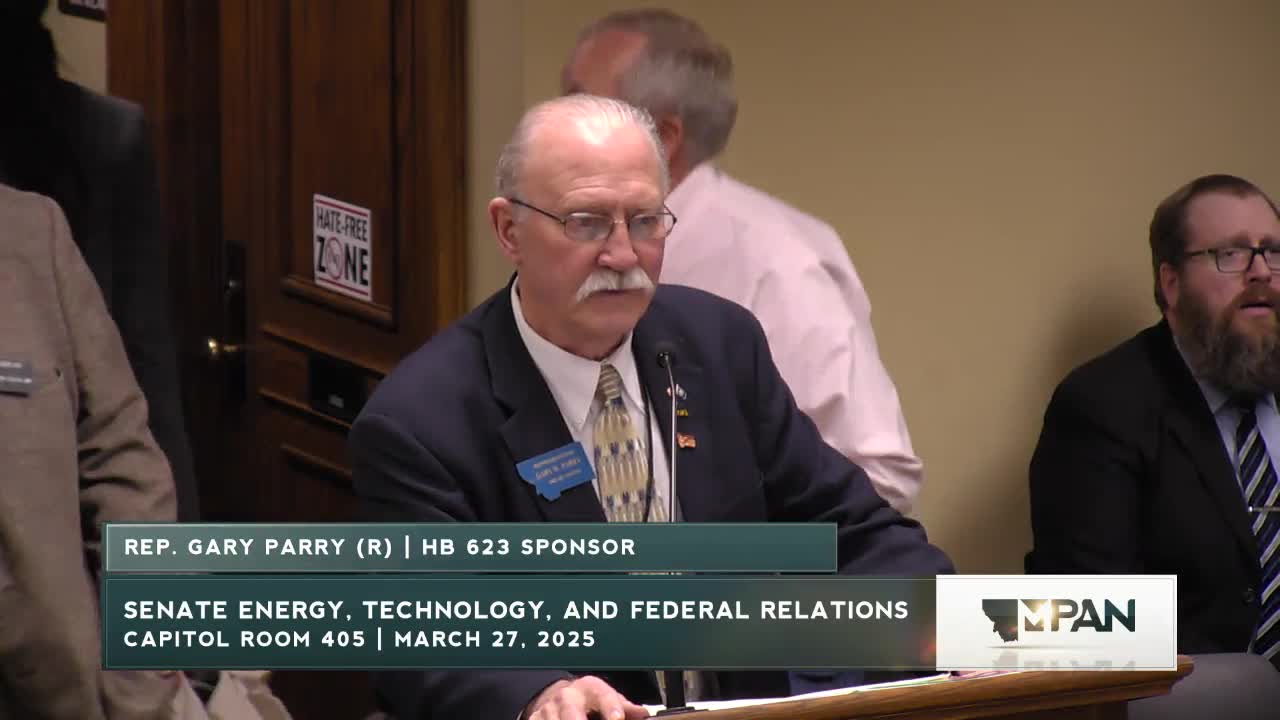
Representative Gary Perry opened the Senate Energy Committee hearing on House Bill 623 by saying Montana faces an energy shortfall and that the bill would let the state accept and reprocess its own spent nuclear fuel. "It's clearly recognized that Montana is in a very serious energy crisis. We're currently projecting a short shortfall of 7,500 megawatts over the next 6 to 10 years," Perry told the committee, framing the measure as a step to keep options open for baseload generation.
The bill, as described by Perry, would not authorize taking spent fuel from other states or nations but would allow Montana to develop storage and reprocessing capacity for fuel linked to in-state generation. "All this bill is doing is saying to the Nuclear Regulatory Commission, we are prepared to handle our own nuclear waste," Perry said, adding the proposal includes language to allow recycling and reprocessing similar to methods used in France.
Proponents who testified urged the committee to remove perceived statutory barriers and to preserve options for future small modular reactor projects. David Herbst of American Powerplay said the measure "lays the groundwork to make it happen" and argued Montana could become a reliable exporter of base‑load power. Alan Olson of Northwestern Energy said his company applauded the sponsor’s amendments to remove a house amendment and said nuclear remains expensive but could be part of long‑term planning. Labor and trades representatives — including Adam Haigt (Labor Local 1686), Al Ekblad (Operating Engineers Local 400) and Dwayne Wock (International Brotherhood of Electrical Workers 233) — testified in support, citing potential jobs and smaller footprints for newer reactor designs.
Opponents sharply questioned the economics, schedule and community impacts. Nick Fitzmaurice of the Montana Environmental Information Center said the United States has no permanent commercial repository and warned that storage decisions could saddle Montana with long‑term risks. "There is no permanent storage solution for nuclear waste in the United States," Fitzmaurice told the committee and urged retaining a house amendment that would require consultation with nearby tribal communities. He also contested the 7,500 megawatt shortfall figure offered by the sponsor, saying he had not seen that projection.
Other witnesses, including Jennifer Swearingen, Perry Gleesman and Derek Goldman of the Northwest Energy Coalition, cited high construction costs and historic cost overruns on recent U.S. nuclear projects. Several witnesses urged caution and said emerging small modular reactor projects have repeatedly faced delays and ballooning price estimates.
Committee members asked the sponsor and state agencies about roles and timelines. Perry said the bill is intended to open options that could take many years to materialize. Rebecca Harbage of the Department of Environmental Quality (testifying on a later bill but referenced during questioning) explained DEQ’s role relative to federal review would be to receive federal applications and provide state recommendations as part of the Nuclear Regulatory Commission’s process.
The hearing closed with the sponsor thanking members; the committee took no final vote on HB 623 during this session.