Get Full Government Meeting Transcripts, Videos, & Alerts Forever!
Get email alerts on the Education Legislation Votes topic
No spam. Unsubscribe anytime.
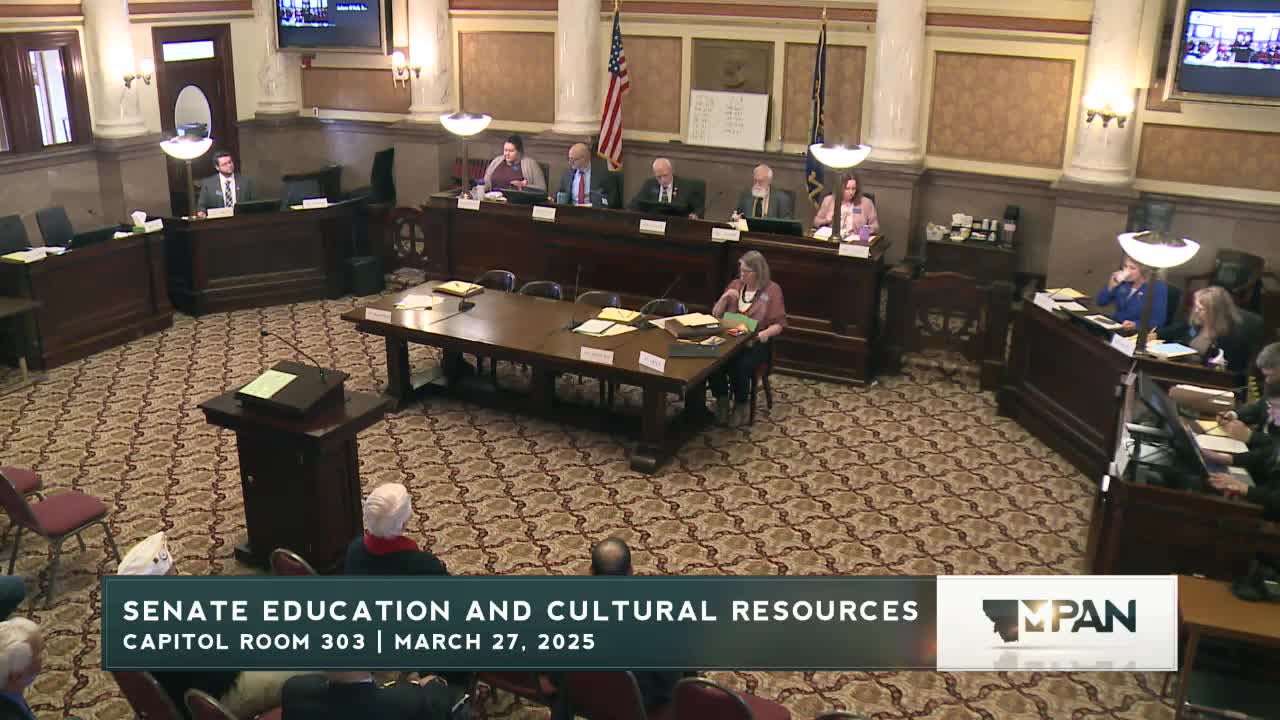
Senate Education Committee concurs on several education bills; one roll-call shows split vote
Summary
The Senate Education Committee took executive action to concur in multiple House bills on education policy. Most measures were approved by voice vote or unanimous proxy; House Bill 449 passed with a recorded 13–1 vote.
The Montana Senate Education Committee voted to concur in multiple House-origin education bills during an executive-action session, approving bills on out-of-district attendance, charter school definitions, higher-education contracting, program transitions and other technical changes.
The committee, chaired by Senator John Fuller, conducted executive action on a series of House bills that were previously heard in committee. Most measures were adopted by voice vote with yes-by-proxy statements for absent members; one bill, House Bill 449, was recorded on a roll call at 13 yes, 1 no.
Why it matters: These concurrences move the House-origin measures forward through the legislative process, allowing them to be considered by the full Senate floor. Several are described in committee testimony as cleanup or clarifying bills; one (House Bill 573) implements program changes that rely on appropriation language in the governor’s budget proposal.
Key outcomes
- House Bill 250 — concurred in by the committee. Sponsor and staff described it as a “cleanup bill” for out-of-district attendance law and included a coordinating amendment to align the measure with House Bill 156 (district base levy changes). The committee adopted an amendment (2.50.1.2) that corrected a subsection reference and added a coordination section. (Action: concurred; vote: voice vote/adopted amendment; detailed tally: not specified.)
- House Bill 251 — concurred in by voice vote. The bill clarifies aspects of public charter school district formation in light of prior House Bill 549. (Action: concurred; vote: voice vote; detailed tally: not specified.)
- House Bill 317 — concurred in by voice vote. The bill removes a statutory requirement that the commissioner of higher education enter into an agreement with the Idaho College of Osteopathic Medicine. (Action: concurred; vote: voice vote; detailed tally: not specified.)
- House Bill 449 — concurred in on a roll-call vote. Committee chair announced the result: 13 yes, 1 no. One senator explained opposition and asked that a record reflect their concerns. (Action: concurred; vote tally: yes 13, no 1.)
- House Bill 573 — concurred in by voice vote. Sponsors said the bill moves the Transformational Learning Program from phase 1 into a narrower phase 2 and that funding is included in the governor’s budget proposal; a staff witness said the appropriation is contained in the governor’s budget but could not state the amount during the hearing. (Action: concurred; vote: voice; detailed tally: not specified.)
Votes by proxy and presence
Several members registered “I by proxy” votes during voice votes when absent, as noted on the record for multiple bills. The committee confirmed a quorum before beginning executive action.
What committee members noted
Committee staff described the bills as largely technical or as clarifying prior session law. Senators asked for and received clarifications that one bill’s funding was included in the governor’s budget; staff said they would follow up with the amount. A senator noted possible additional amendments under consideration but said the sponsor preferred not to proceed at this time.
Next steps
Concurrence by this committee advances the bills to the Senate floor for further consideration. Where funding is required (for example, HB 573), the measures still depend on budget actions on the floor.
Sources: Committee executive-action session transcript excerpts and recorded voice and roll-call votes.