Get Full Government Meeting Transcripts, Videos, & Alerts Forever!
Get email alerts on the Education Funding topic
No spam. Unsubscribe anytime.
Educators, parents urge more than co-chairs’ SSF proposal; press to raise special-education cap
Summary
About 10 educators, school board members and parents told the Joint Ways and Means Subcommittee on Education that the co-chairs’ proposed state school fund (SSF) at roughly $11.4 billion would leave districts short, and they urged lifting the 11% special-education cap and fully funding the high-cost disability account.
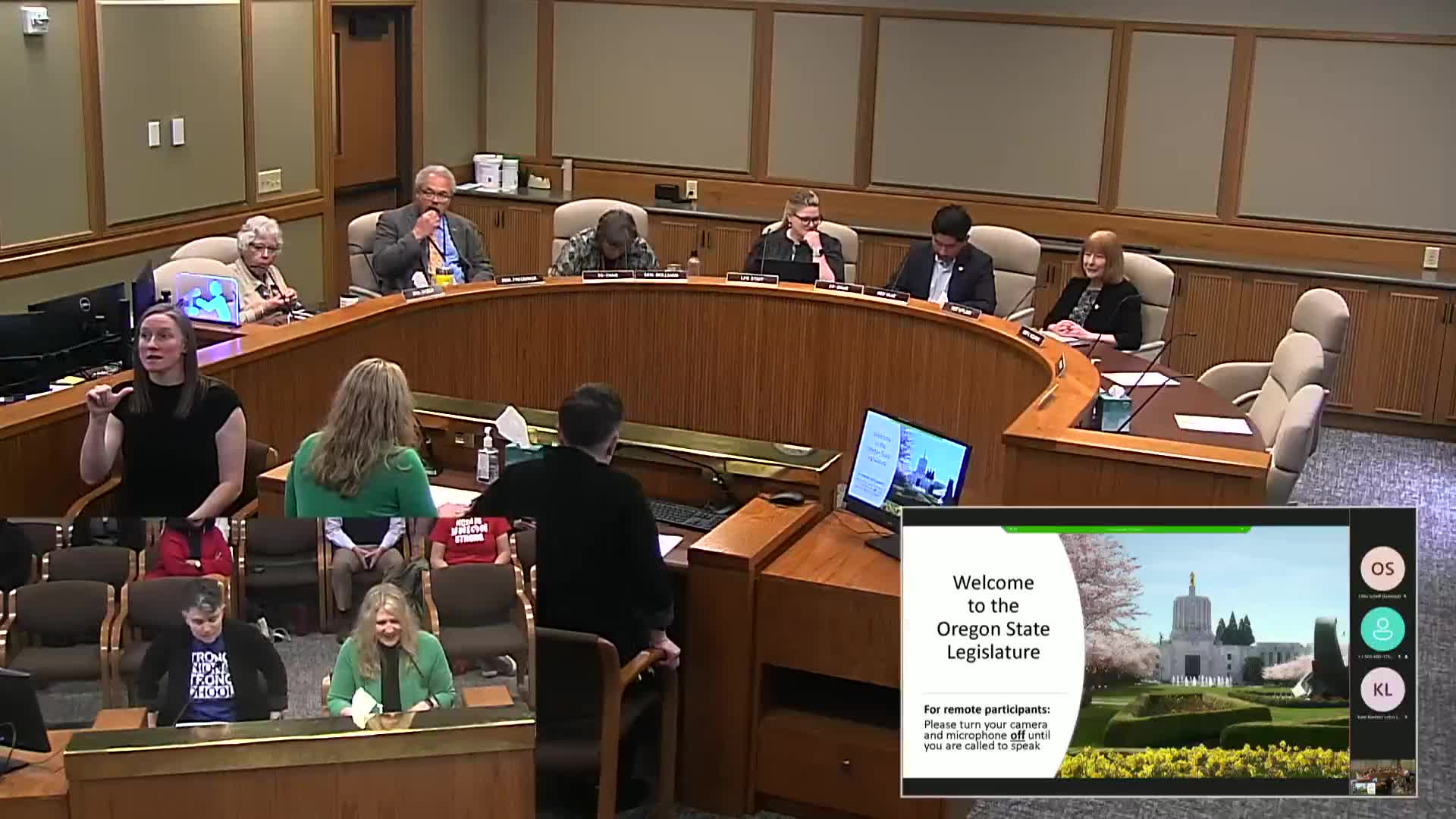
Salem — About 10 education advocates, school officials and parents testified at a public hearing on Senate Bill 5516, telling the Joint Ways and Means Subcommittee on Education that the co-chairs’ proposed state school fund (SSF) — cited in testimony at roughly $11.4 billion — would not prevent cuts in many districts and urged targeted investments for special education.
Speakers said the current-service-level SSF would leave districts contending with higher student needs and rising costs. "The status quo is not working for so many of our students and families, and they deserve better," Lindsey Ray, a high school math teacher and president of the Beaverton Education Association, told the committee.
Testimony gave district-level examples intended to show gaps in the proposal. Dr. Myelise Tolan, superintendent of Lincoln County School District and president of the Coalition of Oregon School Administrators (COSA), said Lincoln County must cover about $703,000 for 55 eligible students because of inadequate high-cost disability funding. Melinda Ryan, an elementary teacher and president of the North Clackamas Education Association, said nearly 20% of incoming kindergarteners this year have already been identified for special education and that North Clackamas expects at least 150 kindergartners next year with Individualized Education Programs (IEPs). Chris Cronin, president of the Oregon School Boards Association, said average special-education rates statewide are nearer 15% and cited local rates as high as 19.3%.
Multiple witnesses urged the legislature to lift the SSF’s long-standing 11% cap on special-education funding and to increase funding for the high-cost disability account. Cronin said school boards are asking that an additional $200 million be included for the high-cost disability account; other witnesses described a statewide special-education shortfall they placed in the hundreds of millions of dollars.
Speakers also described district budget pressure beyond special education. Ray said the Beaverton School District faces a roughly $30 million shortfall that will be handled through cuts and use of reserves. A Portland School Board member, Christy Split, said recent PERS adjustments forced Portland Public Schools to plan about $40 million in cuts for the coming year rather than $10 million. Enrique Ferrera, vice president of the Oregon Education Association, asked lawmakers to view the current-service-level conversation as the start of a larger funding discussion and urged investments that reflect actual costs to serve students.
Several witnesses linked funding to student outcomes and equity. Kate Kerler Lefko, a school social worker and parent in North Portland, said reduced staffing and larger class sizes fall disproportionately on historically marginalized students and that fully funding schools is an economic investment in the state’s future.
The committee closed the public hearing on SB 5516 after the scheduled speakers and announced that its focus next week will shift to higher education and the Higher Education Coordinating Commission. Some witnesses signaled they will return on April 30 to present additional parent testimony.
No formal votes on SB 5516 were recorded during the hearing; the session was a public comment period for the bill and related budget proposals.