Get Full Government Meeting Transcripts, Videos, & Alerts Forever!
Get email alerts on the Training Reimbursement topic
No spam. Unsubscribe anytime.
Bill would reimburse municipalities when recruits lateral-transfer within three years
Summary
A bill heard March 27 would require reimbursement to municipalities that pay academy or training costs when a police officer, firefighter or EMS hire laterally transfers to a different municipal employer within three years.
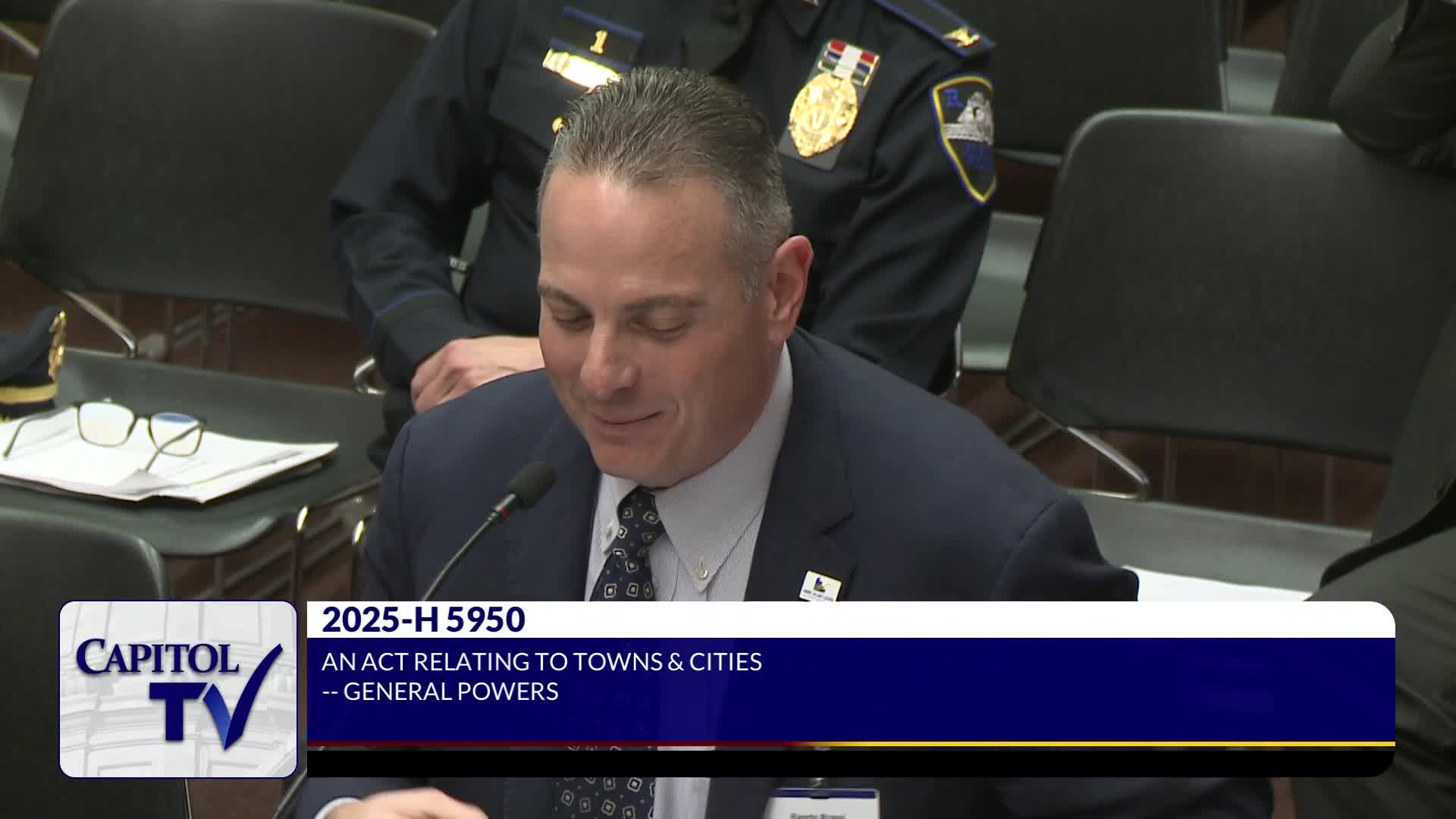
The House Committee on Municipal Government and Housing heard testimony March 27 on House Bill 5950, a measure to reimburse municipalities that have paid academy or training costs when a newly hired public-safety employee leaves for employment at another Rhode Island municipality within three years.
Why it matters: Municipal leaders said lateral transfers after academy training place an unfair cost burden on smaller towns that invest in recruitment and training only to lose new hires to larger agencies. Sponsors described a sliding reimbursement scale to balance fairness and mobility.
What the bill would do: The draft creates a reimbursement mechanism between municipalities for training costs (police academy costs were the primary example); the proposal includes a sliding scale (higher reimbursement in year one, reduced in years two and three) so that municipalities are made whole for a portion of training investment if an employee leaves early.
Key testimony - Randy Rossi (Rhode Island League of Cities and Towns) and Mayor Lisa Beauchamp (Woonsocket) supported the measure as a League priority. Rossi said some municipalities currently rely on informal or "handshake" agreements and that a statutory framework would make reimbursement routine and fairer for taxpayers.
- Chief Kevin Lynch and Sid Wardell (executive director, Rhode Island Police Chiefs Association) said many states have similar approaches and that police transfers are particularly implicated because state law requires police academy certification. The chiefs asked that the League and mayors set a recommended reimbursement figure (estimates discussed: $40,000–$50,000 total training cost per recruit as an illustrative range for academy and salary costs during training).
Questions and clarifications: Committee members asked how the statute would interact with existing employment agreements and whether it would cover state agencies; witnesses said the proposal targets municipal-to-municipal transfers, not transfers to state agencies, and the League would supply a recommended reimbursement figure rather than embedding a rigid amount in statute.
Next steps: Sponsors and the League agreed to provide a recommended reimbursement figure and additional draft language to define eligible costs and the mechanics of inter-municipal claims.