Get Full Government Meeting Transcripts, Videos, & Alerts Forever!
Get email alerts on the Public Safety Pensions topic
No spam. Unsubscribe anytime.
Committee hears testimony on public-safety pension changes, early retirement and presumptions
Summary
Lawmakers heard competing testimony on bills to allow earlier retirement for some police and firefighters, restore prior pension accrual rates, add cardiovascular presumptions for police, and adjust limits on outside earnings for disability retirees.
The House Committee on Municipal Government and Housing heard extended testimony on March 27 on multiple bills affecting police and firefighter retirement and disability rules, including proposals to permit earlier retirement for certain public-safety hires, restore prior accrual rates, extend disability presumptions to police, and raise outside-earnings caps for disability retirees.
Why it matters: The measures seek to change the pension and disability rules that govern when public-safety officers may retire and how their benefits are calculated. Sponsors and union representatives said changes address safety and recruitment challenges; treasury and municipal officials signaled fiscal concern and neutrality on some items.
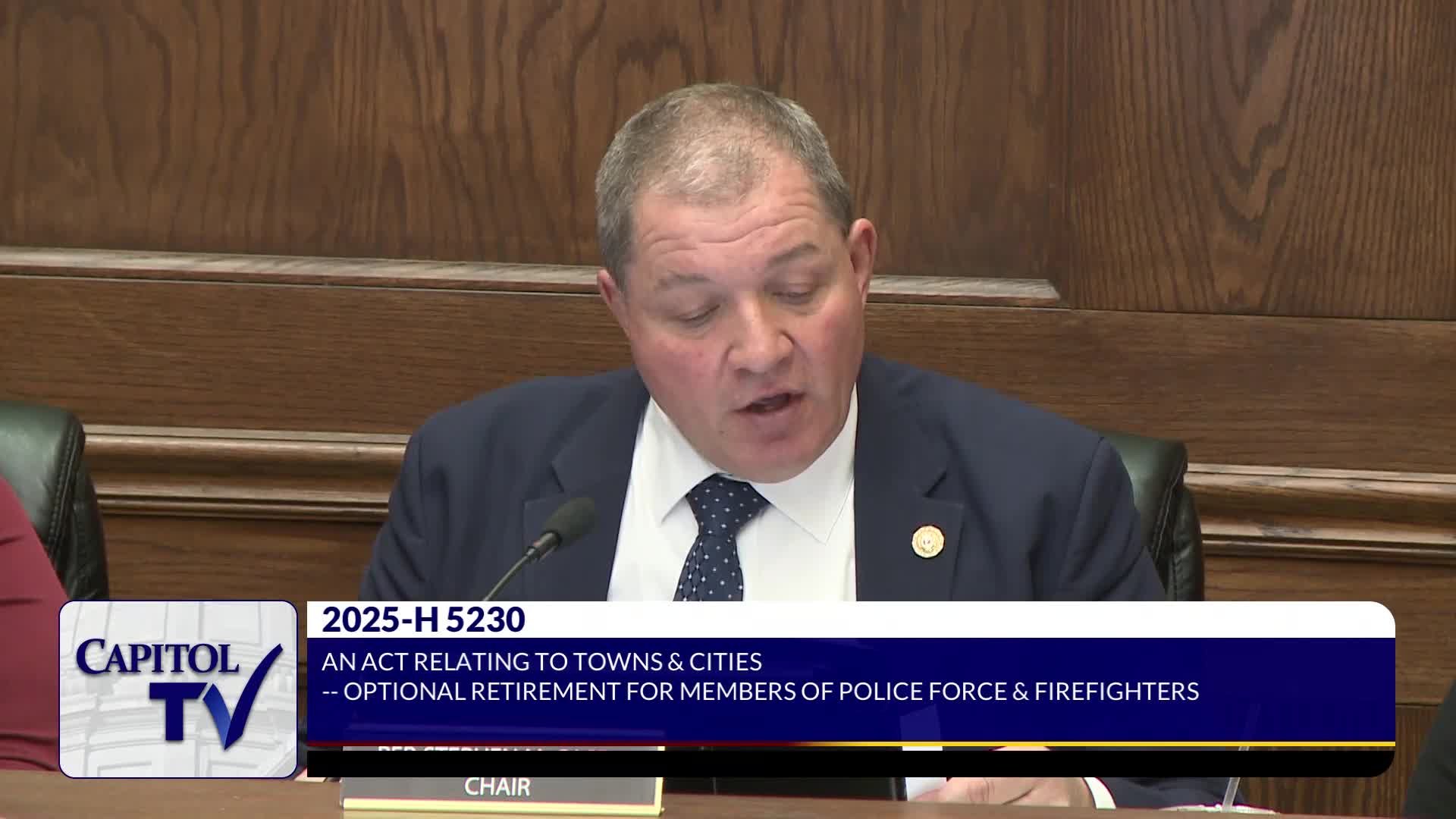
What the bills would do (as presented to the committee) - House Bill 5230 / HB5471 (Representative McEntee and Representative Craven; similar proposals): Allow police officers and firefighters hired before 2012 and with 20–24 years of service to retire at age 57 with a reduced pension (approximately a 10% reduction compared with later full pensions). Supporters said the change would affect roughly 37 people and argued it would reduce on-duty risk for older personnel and help recruitment by allowing later-entry candidates a 20-year career path.
- House Bill 5700 (Representative O'Brien): Restore a 2.5% pension accrual rate per year (the pre-2012 level) so officers would reach full pension in fewer years than under the 2% accrual established in 2012. Supporters argued the change would reduce years on duty for older officers.
- House Bill 5372 (Representative Craven): Extend presumption coverage (heart disease, stroke, hypertension) for police officers similar to statutes adopted for firefighters in prior sessions; testimony cited medical studies and other states' practices.
- House Bill 5271 (Representative Craven): Amend rules on outside earnings for retired disability pensioners to raise the allowable outside-earnings cap (bill text would permit additional earnings up to five times the member's earnable compensation in some circumstances).
Key testimony and points of contention - Paul Valletta (Rhode Island Association of Fire Fighters) and Chief Kevin Lynch (Rhode Island Police Chiefs Association and Bristol police chief) testified in favor of earlier retirement options and other public-safety pension changes. Valletta argued the 2012 changes forced many hires to work into their mid-60s and cited a fiscal note the treasurer's office produced that he disputed (he called the $600,000 estimate for state-wide cost "inflamed"). He and others cited national line-of-duty mortality data and said earlier retirement could reduce injury risk for aging first responders.
- Chief Lynch emphasized recruitment challenges and said the proposals are not intended to "enrich" pensions but to allow older or later-entry recruits a viable career path and reduce risk of line-of-duty injury or higher disability pensions.
- John Rossi (International Brotherhood of Police Officers) urged passage of HB5372 (cardiovascular presumptions for police) and said multiple states already provide similar presumptions.
- Treasury staff (written testimony from Robert Craven Jr.) submitted neutrality for several bills and produced fiscal notes that proponents disputed during testimony.
Fiscal and technical details discussed - Proponents cited a pension actuarial fiscal note (quoted as $600,000) and said the number is spread across many municipalities and may overstate local fiscal impact. Valletta said the $600,000 figure is allocated across the state and the cost per municipality would be much smaller; he also questioned actuarial mortality assumptions (Rhode Island's use of age-82 mortality vs commonly used age-72).
- Supporters said early retirees would accept an approximate 10% pension reduction compared with remaining to later thresholds; they argued earlier retirement could reduce future disability claims, which often pay higher, tax-free benefits.
Next steps: Committee hearings concluded for several of these bills. Some proponents submitted additional written testimony; the committee will consider fiscal notes and written materials as it moves to any subsequent votes.