Get Full Government Meeting Transcripts, Videos, & Alerts Forever!
Get email alerts on the Civil Rights Enforcement topic
No spam. Unsubscribe anytime.
Committee hears wide-ranging debate on Rhode Island Civil Rights Enforcement Act; bill held for further study
Summary
Supporters told the Senate Judiciary Committee that S538 would create a state-level cause of action to enforce rights in the Rhode Island Constitution; local governments and insurers warned it could spur litigation and undermine immunities. The committee voted to hold the bill for further study.
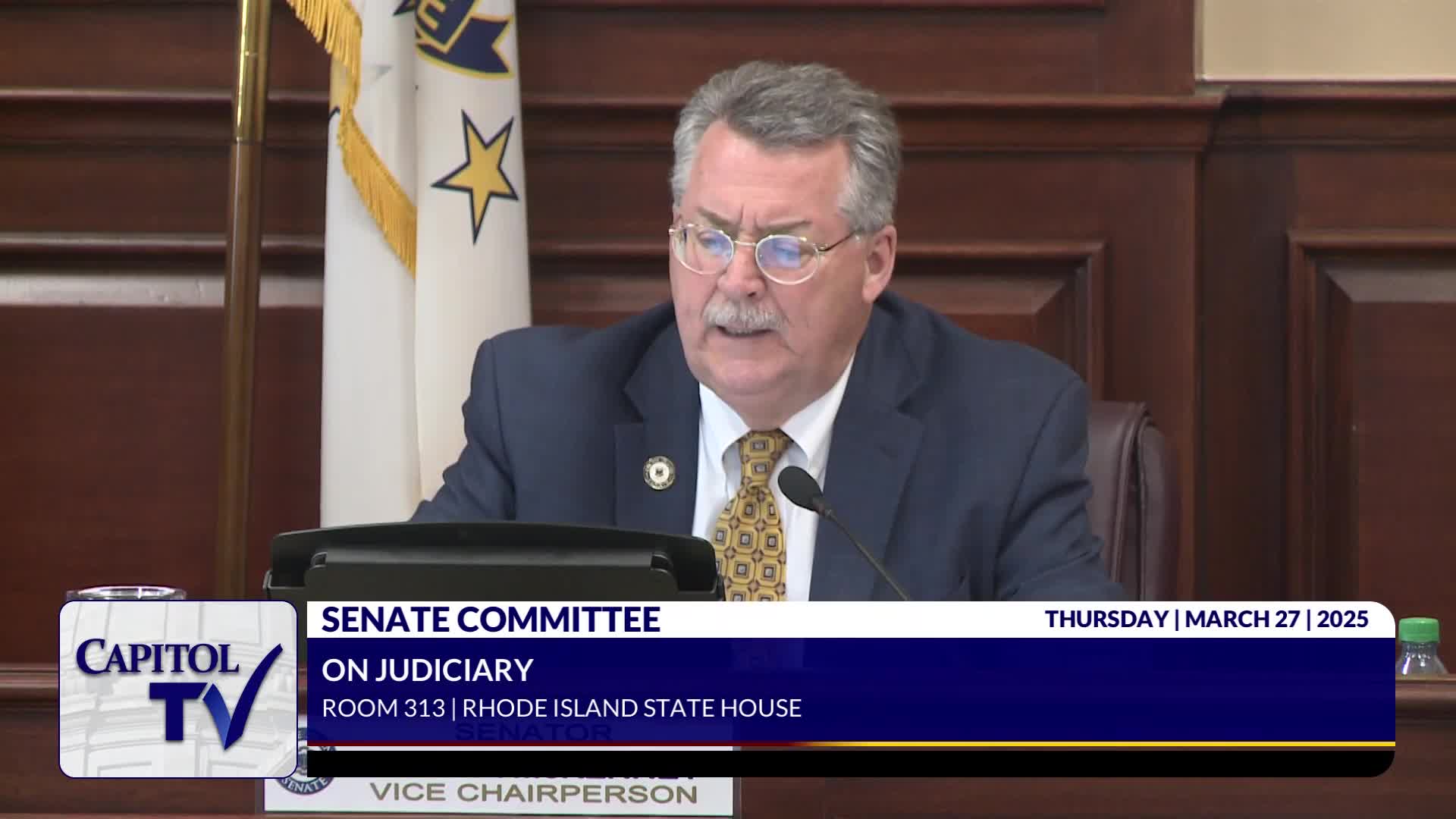
The Rhode Island Senate Judiciary Committee on March 27 heard extended testimony on Senate Bill 538, the Rhode Island Civil Rights Enforcement Act, which would create a state statutory cause of action to enforce rights guaranteed in the Rhode Island Constitution. After more than two hours of testimony from attorneys, labor and civil-rights advocates, municipal representatives and trade associations, the committee voted to hold the bill for further study.
Proponents said the measure would give Rhode Islanders a remedy when state constitutional rights are violated. "If the right is to mean anything, this body has to act and enact an enforcement statute," said Richard Sinappi, an attorney who said he has practiced in Rhode Island for more than 40 years and has worked with the ACLU. Sinappi told the committee that federal statutory relief under 42 U.S.C. §1983 does not fully protect state-created rights and that a state enforcement statute would provide compensatory remedies and deterrence.
Supporters included the ACLU of Rhode Island and the Rhode Island AFL-CIO. Stephen Brown, legal director for the ACLU of Rhode Island, said the bill addresses a real gap: "We have a state constitution that supposedly guarantees us very basic rights, but the court decisions say they are simply not enforceable," he said.
Opponents — including the Interlocal Trust, which represents most Rhode Island cities and towns — said existing statutory protections already provide remedies for many claims and warned that S538 could undercut doctrines such as qualified immunity, expose municipalities to broad liability and prompt a wave of litigation. Ian Ridlon, executive director of the Interlocal Trust, described the bill as "a solution in search of a problem" and said municipalities already face multiple statutory causes of action.
Other witnesses included labor and trade groups in support, and written opposition from police labor organizations. Christina Fernandez of the Rhode Island Association for Justice and Anthony Cherry of Build RI testified in favor; the International Brotherhood of Police Officers submitted written opposition.
Committee members asked about fee-shifting and the state budget. Sinappi said fee-shifting is essential for meaningful enforcement: "If you're not going to have fee shifting here, don't bother passing the bill," he told the panel, arguing that without fee awards private litigants would not be able to obtain redress and deterrence would be weak. Municipal representatives warned that a broad fee-shifting regime could have large fiscal consequences and might encourage speculative suits.
The record also included discussion of procedural details: opponents noted a three-year statute of limitations referenced in the bill and cautioned that Rhode Island's practice of applying statutory interest (noted in testimony as 12% per year) could have large cost implications if claims are successful but delayed. Committee members asked whether the House version of similar legislation had narrower language on claims and summaries; witnesses said the House draft sought to address some implementation concerns by limiting the kinds of actions covered and clarifying required disclosures.
After questions and further remarks, Senator Burke moved to hold S538 for further study; the motion was seconded and carried by voice vote. The matter was recorded as held for further study.
The committee did not take final action on amendments or adoption; instead members directed further review of scope, fee-shifting language and municipal fiscal impact studies.
The bill was the longest item on the committee agenda that day and drew the broadest range of witnesses. Committee staff will circulate written testimony and may schedule further hearings or amendments, according to the committee chair.