Get Full Government Meeting Transcripts, Videos, & Alerts Forever!
Get email alerts on the Fair Housing Act And Enforcement topic
No spam. Unsubscribe anytime.
Relman Colfax attorneys outline Fair Housing Act protections, highlight appraisal bias and algorithmic risks
Summary
Autumn Clark and Imani Cherry, attorneys with Relman Colfax, delivered an overview of the Fair Housing Act, its history and enforcement tools, and recent trends that local housing practitioners should monitor, including appraisal bias and the use of algorithms in housing markets.
Autumn Clark and Imani Cherry, attorneys with Relman Colfax, delivered an overview of the Fair Housing Act, its history and enforcement tools, and recent trends that local housing practitioners should monitor, including appraisal bias and the use of algorithms in housing markets.
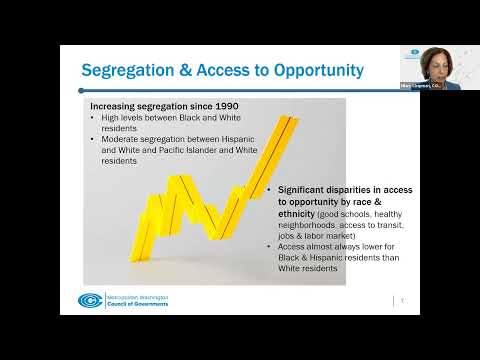
Clark placed the Act in historical context, noting the law grew out of mid‑20th century housing discrimination and civil‑rights struggles. "Congress clearly intended the Fair Housing Act to remedy segregated housing patterns and the problems associated with it," Clark said, tracing causes such as redlining, racially restrictive covenants and highway construction that contributed to residential segregation.
The presentation summarized key statutory provisions frequently relied on in enforcement. Clark and Cherry described Section 3604 (prohibiting discrimination in sale, rental and terms), Section 3605 (financing), Section 3606 (brokerage and multiple‑listing services), and Section 3617 (prohibiting coercion, intimidation or interference with fair‑housing rights). The attorneys explained the two principal legal theories used in modern enforcement: disparate treatment (intentional discrimination) and disparate impact (policies that are neutral on their face but have an unjustified disproportionate effect on protected groups). Cherry summarized the effects test affirmed in Inclusive Communities Project v. Texas Department of Housing and Community Affairs (2015): "All you need to show is that there's a disproportionate impact on a protected class," she said, describing the three‑part framework that defendants can rebut with legitimate business reasons and plaintiffs can counter with less‑discriminatory alternatives.
They reviewed common practices that generate claims: steering by real‑estate agents, discriminatory advertising, higher security deposits for families with children or people with service animals, and discriminatory tenant‑screening policies that rely on criminal records. Clark and Cherry emphasized that disability‑related claims are the most frequent in recent practice and illustrated reasonable accommodation and modification examples, including interpreter and website accessibility needs. On costs for accommodations, presenters said housing providers — particularly HUD‑funded providers — generally bear the obligation to provide reasonable accommodations and reasonable modifications, though details can vary by program and funding source.
The presenters highlighted recent enforcement and litigation trends: appraisal discrimination (cases and reports documenting lower valuations in communities of color), algorithmic and machine‑learning risks in lending, tenant screening and advertising, and renewed federal enforcement against redlining. Cherry noted recent actions such as an interagency task force on property appraisal and valuation equity (PAVE) and the Department of Justice's redlining initiative that produced multi‑million dollar settlements in some cases. Clark described a recent civil case her firm litigated, Gilead Community Services v. Town of Cromwell (Connecticut), in which a jury returned a verdict of $5,200,000 after finding the town had unlawfully interfered with a group home for people with mental disabilities.
Clark and Cherry also described consumer‑credit developments that could expand access to homeownership, such as special‑purpose credit programs permitted under the Equal Credit Opportunity Act (ECOA). Those programs are being used by some large lenders to target historically underserved communities and, according to presenters, have the potential to increase credit access if structured in compliance with fair‑lending rules.
Audiences asked questions about limited‑English proficiency (LEP) obligations and whether LEP rules apply only to federally funded programs; presenters said LEP enforcement is most clearly established in contexts involving federal funding but the legal contours continue to evolve and may be actionable in other contexts. Attendees also asked about protections for people with criminal records; presenters said this is a complex, evolving area where screening policies can intersect with race and disparate‑impact claims.
The attorneys closed with practical reminders for housing providers and local officials: review advertising and outreach practices to avoid steering or redlining risks, carefully document legitimate business justifications for neutral policies that could have disparate impacts, prioritize language access and reasonable accommodations for applicants with disabilities or LEP, and monitor appraisal, lending and algorithmic tools for potential bias. Relman Colfax provided contact information for follow‑up questions and urged attendees to consult the city's posted resources and the recording for further details.