Get Full Government Meeting Transcripts, Videos, & Alerts Forever!
Get email alerts on the Homeowners Associations Ombudsman Registration topic
No spam. Unsubscribe anytime.
Senate committee advances bill to create HOA ombudsman and statewide registration
Summary
The Senate Commerce and Consumer Protection Committee on March 27 voted to recommend passage of Senate File 1063, which would create an ombudsperson in the Minnesota Department of Commerce to assist homeowners with disputes involving homeowners associations and require registration of common interest communities.
The Senate Commerce and Consumer Protection Committee on March 27 voted to recommend passage of Senate File 1063, which would create an ombudsperson in the Minnesota Department of Commerce to assist unit owners in disputes with homeowners associations and establish a statewide registration for common interest communities.
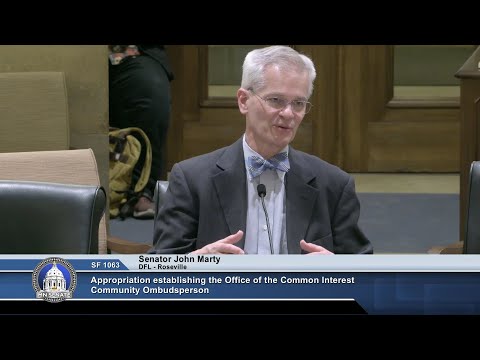
Senator Marty, a chief author on the measure, told the committee the bill would create an ombudsperson “to assist unit owners in enforcing their rights and to facilitate resolution of disputes between unit owners and associations.” He said the office would provide information and mediation but would not make legal determinations, which would remain the role of the courts.
The proposal pairs that ombuds function with a registration database for common interest communities. Senator Pa, presenting the registration portion, said Minnesota has roughly 7,950 common interest community associations affecting more than 1,500,000 homeowners and that required registration would bring transparency about who manages or controls an association.
Testimony to the committee included homeowners and advocates who described disputes with boards and management companies. Becky Cole, an HOA homeowner, recounted several cases she said show gaps in oversight, including one Blaine homeowner who faced a $55,481.45 charge (the witness provided a breakdown of $4,268 in collection costs and $24,213.16 in legal fees) and a disabled Eagan homeowner who received a city permit for a shed yet continued to face action from an association board. Cole also said some associations’ bank accounts are held and controlled by out-of-state management companies and described an account with roughly $1,800,000 under management.
Ron Ellwood of Legal Aid testified in strong support, saying the working group that drafted recommendations spent dozens of hours across the state taking testimony and that the group’s unanimous recommendation included creating an ombuds office. He said Legal Aid’s clients are often elderly homeowners and that the proposed office could reduce unnecessary escalation and foreclosures by providing education, plain-language explanations of Chapter 515 (the statute governing common interest communities), and a neutral dispute-referral function.
Patrick Hynes, with Messer Lee Kramer, testified on behalf of the Community Associations Institute Minnesota chapter, representing residents, board members and vendors who work with associations. Hynes said the group supports the bill as revised but urged protections for board members’ personal contact information and cautioned against publishing private management contracts online; the bill as presented would keep board-member contact data private.
Committee members discussed the scale of the office’s potential caseload and financing. Chair Cline noted the bill currently lacks a full fiscal note; the text contemplates both a registration fee and a general-fund appropriation. Senator Pa described a three-tier fee concept discussed by authors (examples cited in committee discussion: a lowest tier around $50 per year, a middle tier around $100, and a higher tier around $150) and estimated the registration fees could approach about $1 million annually if applied across the estimated 7,950 associations, while acknowledging actual numbers depend on a finalized count and fiscal note.
A technical amendment identified as A4, described by committee counsel as reviser-requested corrections, was offered by Senator Wicklund and adopted by voice vote. The committee then voted by voice to recommend that Senate File 1063, as amended, be referred to the Committee on State and Local Government; senators recorded no roll-call tally in the transcript and the motion was approved on a voice vote.
The authors and supporters repeatedly framed the ombuds office and registration as complementary: the ombudsman would provide education, referrals and mediation to reduce litigation and help the legislature and regulators identify systemic problems, while the registration database would give state officials a clearer count and contact points for associations. Committee members also flagged related policy issues—such as whether municipalities should be able to require HOA formation and how municipal ordinances interact with HOA rules—that the authors said are being addressed in a companion bill, referenced in committee as Senate File 1750.
The committee record shows the bill advanced with a technical amendment and is slated for further review in the State and Local Government Committee, where the authors expect to supplement discussion with a fiscal note and additional stakeholder negotiation.