Get Full Government Meeting Transcripts, Videos, & Alerts Forever!
Get email alerts on the Nurse Staffing Ratios topic
No spam. Unsubscribe anytime.
Minnesota Senate committee advances bill requiring nurse-to-patient ratios amid debate over access and enforcement
Summary
Senate File 2775, a proposal to set legally binding nurse-to-patient staffing ratios in Minnesota hospitals, advanced from the Senate Committee on Labor after a March 27 hearing and a voice vote to send the bill to the Senate Health and Human Services Committee.
Senate File 2775, a proposal to set legally binding nurse-to-patient staffing ratios in Minnesota hospitals, advanced from the Senate Committee on Labor after a March 27 hearing and a voice vote to send the bill to the Senate Health and Human Services Committee.
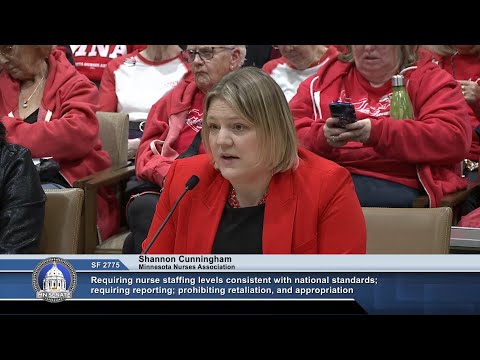
The bill’s lead author, Senator Port, presented the measure as a response to long‑running staffing shortages and patient‑safety concerns raised by bedside nurses. “Nurses and patients need safe, legally binding nurse to patient ratios in hospitals,” Shannon Cunningham, director of governmental and community relations for the Minnesota Nurses Association, told the committee.
Supporters said the bill would require hospitals to adopt staffing plans based on nationally recognized measures of patient acuity and nursing intensity; to set maximum patient assignments for RNs and direct care staff on each unit; and to prohibit retaliation against workers who report unsafe assignments. The bill text discussed by testimony includes specific assignment limits such as 1:1 care in operating rooms, trauma units, active labor and patients in immediate jeopardy; 1:2 in critical care and neonatal intensive care; 1:3 in newborn nurseries, postpartum couplet units, pediatric units and emergency departments; 1:4 in acute psychiatric and chemical dependency units; and 1:5 in skilled nursing settings. It would also require reporting of staffing levels and include an exemption for emergency situations.
Nurse testimony focused on safety and workplace conditions. Jeremy Olsen, a registered nurse at Hennepin Healthcare, described a shift he said required triple assignments in an ICU and recounted what he said was intimidation from leadership when staff refused unsafe assignments: “How can nurses be responsible for patient safety if we are threatened for simply standing up for it,” Olsen said. Ryan Hilmo, a registered nurse at St. John’s Hospital, said nurses faced threats of licensure reporting when they raised safety concerns and called for statutory protections from retaliation.
Union leaders cited peer‑reviewed studies and file‑specific evidence they said link improved nurse ratios to reduced adverse events, shorter lengths of stay and lower readmission rates. Chris Rubish, president of the Minnesota Nurses Association, urged the committee to act, saying “A society will be judged by how it treats its weakest members.” Several testifiers said the Minnesota Nurse Practice Act already requires nurses to act to ensure safe care and that enforcement mechanisms in the bill would support nurses exercising that duty.
Hospital representatives and rural providers warned the bill’s mandates could disrupt operations and patient access. Adam Carlin, chief nursing officer at M Health Fairview Southdale Hospital, said strict, inflexible ratios would force cancelation of scheduled procedures and could bar experienced supervisors from filling bedside roles under the bill’s counting rules; he urged rejection of the bill. Kelly Hagen, chief nursing officer at Rainy Lake Medical Center, said strict mandates could force hospitals to go on diversion or turn patients away and create “very frightening” impacts for rural communities that rely on a small workforce. Mary Krenke of the Minnesota Hospital Association told the committee the bill’s language on technology and video monitoring would undercut tools hospitals use to prevent falls and monitor agitated patients and presented a hospital analysis that, as stated in testimony, concluded hospitals would need “508,500 additional nurses” to meet the bill’s ratios.
Witnesses also debated legal and regulatory interactions. Committee members and witnesses repeatedly noted that EMTALA (the federal Emergency Medical Treatment and Active Labor Act) requires hospitals to provide emergency care and that the bill’s sponsors do not intend the measure to supersede EMTALA; Shannon Cunningham said “No one will be turned away at an emergency department. This language does not supersede EMTALA.” The bill also, as described in testimony, would clarify that reports of unsafe care filed within 10 calendar days cannot be the basis for discipline.
Committee members asked how the bill would affect emergency department access, rural hospitals, and instances when short‑staffed hospitals must manage surges. Senator Lisky recounted a personal experience waiting in a hospital lobby and asked what would happen if hospitals had to refuse patients; supporters responded that the bill would shift the operational burden to hospital administrators to prevent unsafe situations rather than leave those decisions to individual nurses. Opponents warned of unintended consequences including diversion, longer ambulance transport times and possible impacts on hospital licensing for chronic noncompliance.
After member discussion, Senator McEwen (chair) moved that Senate File 2775 be recommended to pass and be re‑referred to the Senate Health and Human Services Committee. The committee approved the motion by voice vote and sent the bill to Health and Human Services; no roll‑call tally was recorded in the hearing transcript. Senator Port, the bill’s lead author, told members her office was open to negotiations but that nurses asked the committee to start from the version on the table.
Next steps: Senate File 2775 will be considered by the Senate Health and Human Services Committee; proponents and opponents indicated they expect further amendment and negotiation at later committee stages.