Get Full Government Meeting Transcripts, Videos, & Alerts Forever!
Get email alerts on the Economic Interest Expansion topic
No spam. Unsubscribe anytime.
Tough debate as committee weighs expanding economic-interest filings to local officials
Summary
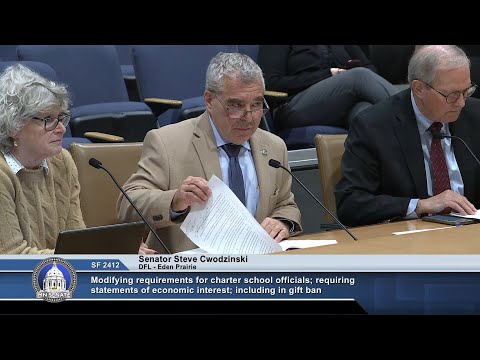
Senate File 2412, which would expand state economic-interest filing requirements to many local elected officials, prompted extensive testimony from school boards, small cities, counties and advocates; the committee adopted an amendment clarifying application beyond metropolitan units and laid the bill over.
Senate File 2412, a proposal to expand the scope of the statement-of-economic-interest requirement to a broader set of local elected officials, drew extensive testimony March 27 from school boards, small-city and county associations and transparency advocates and was laid over for possible omnibus inclusion after the committee adopted an A2 amendment.
Author Senator Swazinski said the measure aims to increase transparency and public confidence by ensuring voters can see candidates' economic ties. He argued voters have a right to know whether officials' financial interests could influence decisions about public spending.
Witnesses opposed and supported the expansion. Kim Lewis of the Minnesota School Boards Association said the change would impose a difficult 15-day filing deadline and a significant burden on largely volunteer school board members and could discourage candidates in small communities. Cap O'Rourke of the Minnesota Association of Small Cities and Pierre Ouellette of the League of Minnesota Cities cautioned the expansion could affect hundreds of small cities and create administrative strain for jurisdictions with few staff. The Association of Minnesota Counties flagged recruitment concerns for technical positions and urged the committee to more narrowly define which officials must file.
Clean Elections Minnesota and volunteer advisor David Fisher testified in favor, saying routine annual filings promote transparency and public trust. Jeff Sigurdsson of the Campaign Finance and Public Disclosure Board provided a staff perspective, estimating roughly 14,408 additional elected officials would be covered by the draft language and noting that, under current statute, only county commissioners and soil-and-water supervisors file directly with the board; most local filings are kept at the local filing agent.
Committee members asked about enforcement, public availability of the filings and whether the new requirement might deter candidates. Some senators expressed concern about administrative burden for small localities; others argued transparency for local decision-makers is important regardless of jurisdiction size. The committee laid the bill over for possible inclusion; members requested further information on fiscal impacts and filing logistics.