Lifetime Citizen Portal Access — AI Briefings, Alerts & Unlimited Follows
Senate Environment Committee advances 2025 legacy omnibus with targeted cuts and new carve-outs
Loading...
Summary
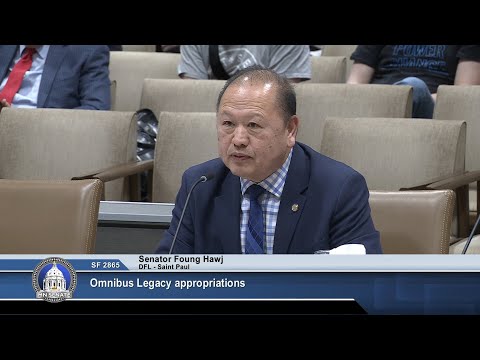
The Minnesota Senate Environment, Climate and Legacy Committee on March 27 advanced Senate File 2865, the 2025 legacy omnibus, after a multi-hour hearing that reviewed proposed appropriations for the Outdoor Heritage, Clean Water, Parks and Trails and Arts & Cultural Heritage funds and adopted multiple member amendments.
The Minnesota Senate Environment, Climate and Legacy Committee on March 27 advanced Senate File 2865, the 2025 legacy omnibus bill, after a multi-hour hearing that reviewed appropriations across the four legacy funds and adopted a series of amendments.
The bill would allocate money from the legacy sales tax dedicated by the 2008 Legacy Amendment and sets funding in four articles for Outdoor Heritage, Clean Water, Parks and Trails, and Arts & Cultural Heritage. Committee staff said the DE delete-all amendment presented to the committee reflects a February forecast adjustment that reduced available dollars and led to proportional and targeted reductions across the four funds.
Why it matters: the legacy funds finance habitat restoration, clean water projects, parks and trails, and arts and cultural programs statewide. Committee briefing materials said the DE amendment contains roughly $776,000,000 (first‑year figures described to the committee) in appropriations for the upcoming biennium and preserves the statutory 5% fund balance in each fund.
Spreadsheet review and fund-level changes Mr. Mueller, committee staff, walked members through the spreadsheet included in the packet (dated 03/26) and summarized the major changes. He told the committee the February forecast included a one-time downward adjustment of about $31.7 million due to a calculation error at the Minnesota Management and Budget office, which reduced carryforward available to the four legacy funds and required reductions in the DE amendment.
The committee heard the appropriation totals by article and program-level adjustments: the Outdoor Heritage Fund was presented with about $162,111,000 in fiscal year 2026 (staff noted the Outdoor Heritage Fund is typically appropriated for the first year only); the Clean Water Fund columns reflect targeted reductions totaling about $6.8 million; Parks & Trails retains a 40%/40%/20% split for state/metro/regional parks with a $140,000 fixed DNR administrative line added; Arts & Cultural Heritage will have roughly 12% less to appropriate in the upcoming biennium compared with the current biennium, and the bill includes both named grants and a competitive Community Identity and Heritage Grants program with carve-outs for ethnic media and emergency grants. Mr. Mueller summarized: "This bill contains $776,000,000 and $855,000 of appropriations." (citation: committee spreadsheet briefing.)
Key language changes called to members' attention Committee counsel Mr. Stanley flagged several language items in Article IV: new riders for a 250th‑anniversary appropriation, reduced capital‑investment language in multiple grant riders, explicit caps or limits on administrative costs for agencies that administer grants in the article, clarification that some named legislative grantees remain eligible for competitive programs, and a carve-out within the Community Identity and Heritage Grants program reserving $250,000 per year for ethnic media and $200,000 per year for emergency grants.
Testimony from agency and grantee representatives Paul Gardner, administrator for the Clean Water Council, thanked the committee for including the Clean Water Council's recommendations in the bill and said the council appreciated letters supporting its deliberative process.
Diane Kriesen, president of the Minnesota Children's Museum, urged continued legacy support for the museum and described how legacy funds have supported partnerships, access programming and exhibit development. "Legacy funds have been critical, and I wanna repeat critical, in 2 key areas," Kriesen said, explaining the museum's request for $650,000 annually to sustain community access and exhibit work.
Shannon Slatten Schwartz, executive director of CCX Media, asked the committee to include funding for community PEG media stations (Senate File 2289), describing declining cable franchise revenue and audience demand for local meeting coverage.
Hunter Peterson, public policy specialist at the Minnesota Farm Bureau Federation, thanked the committee for funding lines that support agriculture-related activities including FFA and county fair grants and said farmers are committed to environmental stewardship.
David Kelleher of the Minnesota Historical Society explained language in the bill dealing with unspent money that had been appropriated to facilitate negotiations to acquire the "ruby slippers"; Kelleher said the auctioned slippers sold for "$28,000,000" and that the museum spent some money on fundraising and negotiation activity and requested that remaining funds be used for an exhibit.
Member amendments and committee actions The committee considered multiple member amendments tied to named projects, carve-outs and technical changes. The committee adopted a number of those amendments by voice vote or division. Highlights: the A1 amendment (the DE delete-all) was adopted; the A2 amendment (a carve-out the author described as allocating $100,000 from a larger item to a local nonprofit) passed; A7 (a $318,000 grant for a Heroes and Heritage interpretive trail loop) was adopted; A15 (a Senators' stair-step foundation carve-out for cultural festivals, amended orally to narrow certain language) passed; A16 and A17 (additional carve-outs and project allocations) passed; A19 (a $200,000 appropriation for Hmong language and cultural preservation) passed; and A21 (a $200,000 appropriation for the Special Olympics USA Games fund) passed.
Other member proposals failed or were withdrawn. The committee declined to adopt the A5 legacy "good neighbor" notification amendment by final vote. Senator McKeown offered and then withdrew A10 (which would have deleted a Science Museum appropriation) after discussing labor and hiring concerns; Senator Drazkowski offered several amendments (A9 and A11 were withdrawn; A18 and others failed after discussion). The A14 amendment (extension/reappropriation tied to park projects) produced a division and a 4–4 result; under committee rules the amendment did not pass.
Formal referral and next steps After debate and amendment votes the committee adopted the motion to recommend Senate File 2865, as amended, be referred to the Finance Committee and allowed staff to make technical corrections. Committee members and staff said the bill will move next to Finance and that additional changes are expected during the Finance process and on the floor.
What the committee did not decide Committee staff and multiple witnesses stressed the limits on what legacy funds may be used for (programmatic investments rather than ongoing operations) and flagged that some proposed uses will require further review for consistency with legacy constitutional language and fund restrictions. Several members asked for additional discussions with agency staff before the Finance Committee hearing; committee staff said some amounts shown as "carry forwards" or with question marks will be finalized before Finance.
Ending Senator Johnson Stewart (chair) adjourned the committee after the referral motion. The bill will be considered next by the Senate Finance Committee, with expectant further negotiation among members and with the House on final appropriations and language.