Get Full Government Meeting Transcripts, Videos, & Alerts Forever!
Get email alerts on the Bonding Requests topic
No spam. Unsubscribe anytime.
Minn. Capital Investment Committee hears a slate of local bonding requests for water, public safety, roads and housing
Summary
The House Capital Investment Committee heard testimony from cities across Minnesota on March 31 about capital requests including drinking-water treatment and wastewater upgrades, public safety buildings and training facilities, road turnbacks and regional housing infrastructure. No formal votes were recorded during the hearing.
The Minnesota House Capital Investment Committee convened on March 31 for a multi-hour hearing in St. Paul that featured more than a dozen local governments seeking state bonding for infrastructure projects ranging from drinking-water treatment plants to public safety buildings, roads and housing infrastructure.
The hearing began with a presentation from Silver Lake, which said it needs funding to address elevated iron and manganese in its well water and to replace a century-old water tower. "Our water treatment is terrible, really bad," Mayor Bruce Beboe said, showing committee members samples he said were taken from a hydrant. City testifiers said lab results show iron at about 0.9 mg/L (the secondary standard cited in testimony is 0.3 mg/L) and manganese around 0.13 mg/L (MPCA/SWD reference given in testimony: 0.05 mg/L). Silver Lake asked the committee for funding to cover an unfunded portion of a larger infrastructure package.
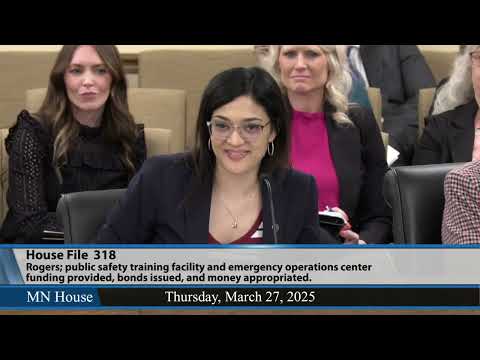
Committee members then heard requests from small and mid-sized cities across Minnesota. Cohasset (Itasca County) asked for bonding to repair a water tower and to begin multi-phase sewer work around Pakegama Lake to replace failing septics. Rogers (Hennepin County) presented two separate asks: a turnback/rehabilitation of Main Street (County State Aid Highway 150) tied to a previously funded bypass and a request for a public safety campus and emergency operations center, with the police portion described as roughly $22 million within an estimated $45 million city-hall/workforce campus.
Other notable requests included: - Howard Lake: seeking $15 million toward a $25 million water treatment plant to address contaminated or poor-quality drinking water and to avoid unsustainable utility rates for residents; the project originally had a lower cost estimate in 2021 but rising construction costs were cited. - Flensburg: presenting a $12.9 million plan to build a municipal drinking-water distribution system (including a regional connection to Little Falls and a new water tower) and replace a deteriorated sanitary sewer system; testimony noted a petroleum leak at a former gas station under MPCA oversight. - Excelsior and Excelsior-area projects: testimony emphasized 70-to-100-year-old lead/galvanized pipes, clay sanitary sewer conditions and contaminated soils, and requested state support after the city exhausted local bonding capacity. - Multiple public-safety facility requests: Rice Lake, Chisholm, New Prague, Owatonna, Sacred Heart (utility work tied to compliance), Wyomng and others presented either new or expanded police/fire/training/operations centers designed to improve regional response, provide trauma-informed interview space, or modernize aging facilities. - Transportation and local street projects: Greenfield asked to complete a multi-year reconstruction of Greenfield Road (estimated total $5.5 million; prior 2023 bonding provided $3.0 million), St. Louis Park and adjacent corridors requested partial state funding for roadway and multimodal upgrades, and Washington County and Representative Lilly outlined a complex safety/interchange study at the Highway 36/120 corridor. - Workforce and education facilities: Wright Technical Center (a vocational cooperative serving eight member districts) requested $10.5 million for critical infrastructure and program support; testimony stressed the center's role in training for health care, heavy equipment, machining and other trades.
Committee members asked programmatic and funding-source questions in several presentations — for example, whether projects were phased, local match availability, and whether housing proposals included affordability targets. Presenters generally said projects were frequently phased where possible and that some local matching or federal Rural Development funds were in place, but gaps remain. Several presenters noted that certain state programs or capped appropriations (for example, the state's emerging contaminants funding) cover only a portion of elevated project costs.
No formal motions or votes were recorded during the hearing; committee members repeatedly thanked presenters for traveling to St. Paul and noted the committee's limited bonding capacity and the need to prioritize requests. Chair Franzen and Co-Chair Lee led the session.
The committee scheduled its next meeting for April 1. Members of the public and municipalities will return as the House works to compile and prioritize bonding proposals for the 2025 session.