Get Full Government Meeting Transcripts, Videos, & Alerts Forever!
Get email alerts on the Green Ammonia topic
No spam. Unsubscribe anytime.
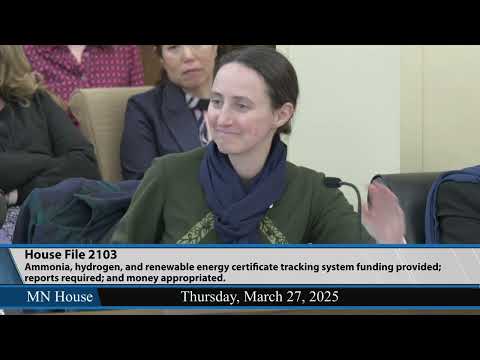
Committee hears bill to fund green-ammonia tracking system and rebates for Minnesota producers
Summary
Representative Paul Anderson introduced House File 2,103, the "Minnesota Made Ammonia Act," and moved the DE1 amendment during a committee hearing.
Representative Paul Anderson introduced House File 2,103, the "Minnesota Made Ammonia Act," and moved the DE1 amendment during a committee hearing. The bill would appropriate state funds to expand the Midwest Renewable Energy Tracking System (M-RETS) to create a registry for ammonia produced with renewable electricity and offer financial rebates to Minnesota businesses that register with the system.
Anderson said the measure could reduce farmers' fertilizer costs and spur local industry. "This house file 2,103 could have a huge impact in many areas of our Minnesota economy," Representative Paul Anderson said, adding that the amendment provides "a rebate to Minnesota companies ... up to a $500,000 rebate." Anderson described the proposal as a "prudent and one-time appropriation" to M-RETS to develop software that would issue auditable "ammonia certificates" tied to renewable energy used in production.
Rob Davis, chief growth officer for the Midwest Renewable Energy Tracking System (M-RETS), testified in support and described how the registry would operate. He said M-RETS would hire software developers and engineers to create a registry for locally produced ammonia that would function similarly to renewable energy certificate registries. "This registry for ammonia certificates produced by local distributed ammonia facilities will act in a similar fashion to M-RETS's existing registry for renewable energy certificates or RECs," Davis said. He told the committee the registry would provide an auditable record for each ton produced with renewable energy.
Rachel Stuckey, executive director of the Minnesota Conservative Energy Forum, also supported the bill. "By building upon the current M-RETS tracking platform, we can establish a framework that encourages private sector investment while ensuring market transparency," Stuckey said. She argued the tracking and certificates would attract private capital, lower input costs for agriculture and mining, and help position Minnesota as a leader in green ammonia and hydrogen markets.
Committee members asked technical and programmatic questions about who would receive the rebate and how reporting would work. Representative Jones, who said she studied agricultural and biological engineering, cautioned against using ammonia primarily as an energy carrier because of conversion losses, and asked whether the $500,000 rebate would go to end users or to producers. Davis replied that the rebate would be issued to the entity that registers with M-RETS and identifies as a Minnesota business, "so that would likely be ... the owner of the production facility."
Representative Kristin Kraft (co‑author) questioned whether the amendment read as if only a single $500,000 rebate would be issued. Davis clarified the practical effect: the rebate functions as a credit on fees charged to entities that transact and retire certificates in the M-RETS system and is applied over time as those fees accrue. Anderson told members the appropriation cap limits the total rebates and that "as I read the amendment, there could be a total of $9,000,000 in rebates," because "the total amount of rebates may not exceed the amount of the appropriation."
Davis said required reporting would cover "all of the ammonia certificates issued in the state of Minnesota," including those issued to out‑of‑state businesses, and that the registry would report statewide issuance counts. Proponents pointed to prior research and pilot work: Anderson said University of Minnesota Morris and the West Central Research and Outreach Center developed a method to produce ammonia using wind, solar and hydro more than a decade ago, and Davis cited a 2023 report from RMI titled "Roadmap for Distributed Green Ammonia in Minnesota." The transcript also referenced the federal 45V tax credit as a policy that supports local production.
A member of the public, retired chemist Dale Lutz, spoke in favor of the bill and described his work on electrolysis-related projects and a personal interest in reducing greenhouse gases. "Ammonia production currently is one of the largest producers of carbon dioxide greenhouse gas," Lutz said, and asked the committee for strong support.
The committee approved the DE1 amendment on a voice vote. The bill, as amended, was laid over for further consideration.
Ending: House File 2,103 as amended was laid over by the committee for future consideration. The bill would fund M-RETS to build an ammonia-certificate registry and establish rebate language that proponents say would lower first‑mover costs for Minnesota producers; committee members asked for clearer wording on rebate mechanics and reporting before further action.