Get Full Government Meeting Transcripts, Videos, & Alerts Forever!
Get email alerts on the Education Budget Governor Revisions 2025 topic
No spam. Unsubscribe anytime.
Committee reviews governor's revised K‑12 budget; $240 million in proposed reductions draw lawmaker pushback
Summary
The House Education Finance Committee reviewed the governor's revised K‑12 budget proposal, including updated cost estimates tied to the February 2025 forecast and proposed reductions totaling roughly $240 million across multiple state education programs.
The House Education Finance Committee reviewed the governor's revised K‑12 budget proposal, including updated cost estimates tied to the February 2025 revenue forecast and a package of reductions and reassignments the governor's office says are intended to help balance the state budget.
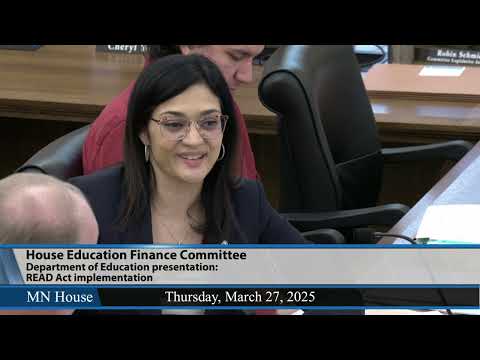
Commissioner Willie Jett and members of his department walked the committee through the revised recommendations. The package includes one‑time and ongoing changes: a $30 million addition to the special revenue fund to support unemployment insurance aid for hourly school workers, a one‑year $55.6 million adjustment for compensatory revenue calculations paired with a working group to review the formula, and multiple program reductions and eliminations across aid and grant programs.
House Fiscal staff highlighted numerous line‑item changes in the governor's revised table. Among the larger proposals discussed: elimination of the compensatory revenue pilot (saving roughly $6.6 million in the 2027 fiscal year), elimination of nonpublic pupil education and nonpublic pupil transportation aids (multi‑year savings varied by line item), proposed elimination of long‑term facilities maintenance (LTFM) aid for charter schools (about $20 million in the first biennium and $22 million in the second), a reduction in the Grow Your Own teacher pipeline grants (about $16 million per biennium), and a school library aid cut of $7.5 million in the first biennium ($15 million ongoing thereafter). The proposed elimination of the Computer Science Education Advancement grants would save about $1 million per biennium and would include elimination of a related MDE supervisor position.
Adosh Unni, director of government relations for MDE, said the revisions respond to a deteriorated fiscal outlook between November and February forecasts, and that the governor’s proposals are a starting point for negotiation. Commissioner Jett emphasized the difficulty of the tradeoffs and said the package is meant to protect core priorities while balancing the state budget. “This budget is a starting point, an invitation to engage in serious and thoughtful conversation,” he said.
Several committee members pressed department officials about likely local impacts. Representative Baeckberg asked who would pick up the cost if community education equalization aid were removed; Kathy Erickson, MDE director of school finance, said that the proposed language would shift the cost to local levies and property taxpayers rather than eliminate programming. On changes to special education reimbursement and transportation, Erickson described interactions among special education formulas and cross‑subsidy mechanisms and said unreimbursed costs would be partially compensated by cross‑subsidy aid where eligible.
Representative Bonner and others warned against cutting computer science funding, arguing Minnesota already lags other states in computer science instruction and that workforce needs in areas such as cybersecurity argue for investment rather than elimination. Representative Green raised concerns about reductions in special education amid uncertainty at the federal level and urged the department to consider the effect on vulnerable students.
MDE officials described a number of “no‑cost” adjustments and administrative transfers, and they proposed additional investments the governor continues to support, including strengthened fraud‑prevention and compliance staff and ongoing evaluation work around compensatory revenue. The department told the committee it will provide additional district‑level modeling and estimates about how the proposed reductions would affect individual districts.
Chair Kresha moved House File 2433 before the committee with the intention of laying it over for possible inclusion in the omnibus education finance bill. Committee members did not adopt final action on the governor’s bill during the hearing; members signaled broad concern and said they will continue negotiations.
Ending: Department officials remained at the table for follow‑up questions and the committee scheduled further review as omnibus negotiations proceed.