Get Full Government Meeting Transcripts, Videos, & Alerts Forever!
Get email alerts on the Education Literacy Reed Act topic
No spam. Unsubscribe anytime.
MDE details multi-year REED Act rollout; lawmakers press department on dual-language screening and coaching capacity
Summary
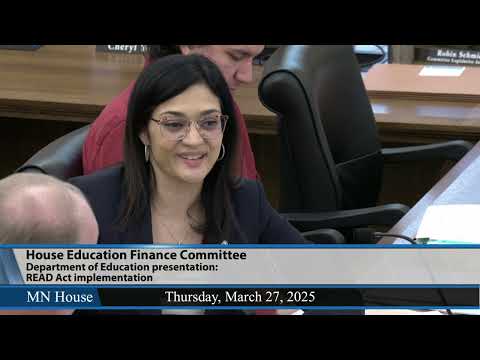
At a House Education Finance Committee hearing, the Minnesota Department of Education outlined progress and next steps in implementing the REED Act, saying the work will take several years and will focus on training, universal screening and local literacy plans.
At a House Education Finance Committee hearing, the Minnesota Department of Education outlined progress and next steps in implementing the REED Act, saying the work will take several years and will focus on training, universal screening and local literacy plans.
The update, delivered by Assistant Commissioner Bobby Burnham, said the department views the REED Act as “a comprehensive systemic reform effort” and warned that “we aren't going to see results overnight.” Burnham presented enrollment and implementation metrics, regional coaching structures and an anticipated timeline for seeing student‑level outcomes.
The department said districts and regional partners are building capacity through a mixture of professional development and coaching. Burnham said the state has stood up regional literacy networks across nine regions, placed literacy leads in Minnesota cooperatives and is providing phased training for teachers and paraprofessionals. He reported that, as of January 2025, more than 34,000 teachers had requested registration for training and that about 547 districts were engaged in the professional‑development process. He said further that the first district submissions of universal screening data will occur in June 2025 and that intervention materials reviews are scheduled to conclude by November 2025.
Lawmakers pressed the department on how supports will reach classrooms. Representative Green asked whether coaches are going into schools and “in the classrooms,” and Burnham said many coaches are working with district literacy leadership to build local capacity. “We just don't have that many coaches to assign to a specific school to get in classrooms,” Burnham said, adding that districts are encouraged to hire and train local literacy coaches and to consider train‑the‑trainer models.
Representative Bonner urged use of a train‑the‑trainer model; Burnham said that “that's definitely a possibility,” and noted that the REED Act requires that “every teacher in that classroom is gonna be trained in the science of reading and evidence based” practices.
Several representatives raised equity concerns for students in dual‑language immersion programs. Representative Perez Vega told the assistant commissioner the lack of universal screening tools in languages other than English was harming non‑English learners and teachers who trained outside the United States. Burnham said the limitation reflects the fact that publishers have not developed additional‑language screeners: “there's not been ... the development of those screeners by the publishers for additional languages.” Representative Perez Vega added, “we've got to work a little bit faster on this,” and asked the department to prioritize support for Spanish, Somali, Korean and other native languages used by Minnesota students.
Representative Clardy presented House File 2430, a one‑time appropriation bill tied to REED Act teacher training. Clardy described the measure as a blank appropriation intended to be set during omnibus negotiations and asked the assistant commissioner to testify in support. Assistant Commissioner Burnham said the appropriation would “incentivize” teachers and show appreciation for the additional work the law requires, urging the committee to consider the request. Clardy moved to lay House File 2430 over for possible inclusion in the omnibus bill.
Committee members were urged to review the department's slide deck for additional data on training phases, curriculum alignment and the local literacy plan template. Burnham said the department is using a combination of focus groups, screening data and local plan submissions to evaluate early implementation and that evaluation will be ongoing.
The committee did not take a final vote on House File 2430 during the hearing; the measure was moved to be laid over for possible inclusion.
Ending: Committee members said they would return with additional questions and that the assistant commissioner might be contacted for follow up as implementation continues.