Get email alerts on the Long Term Care topic
No spam. Unsubscribe anytime.
Committee hears bill to implement PACE program in Minnesota
Summary
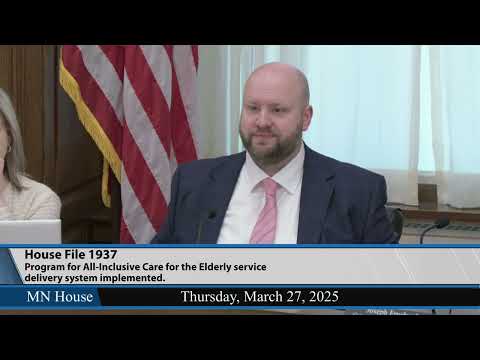
The House Human Services Finance and Policy Committee heard testimony on House File 1937 on implementing the Program of All‑Inclusive Care for the Elderly (PACE), a model supporters said would let nursing‑home‑eligible adults receive coordinated medical and social services while remaining in their homes and communities.
The House Human Services Finance and Policy Committee heard testimony on House File 1937 on implementing the Program of All‑Inclusive Care for the Elderly (PACE), a model supporters said would let nursing‑home‑eligible adults receive coordinated medical and social services while remaining in their homes and communities.
Proponents told the committee PACE combines primary and specialty care, prescription drugs, therapies, transportation, meals and social activities into a single, capitated service package. Representative Reyer, chief author, described the model as “an integrated system of care for older adults who are eligible for nursing home care but who wish to remain in their own homes and communities of choice.” Representatives and testifiers said studies show PACE can reduce hospitalizations and nursing home placements and produce high participant and family satisfaction.
The bill text lays out administrative and timing steps for the Minnesota Department of Human Services (DHS) to stand up PACE. According to bill language presented to the committee, DHS would be authorized to create a PACE program and define eligible persons as those meeting Medicaid requirements (with PACE enrollment available to people 55 and older). The testimony and bill summary said the commissioner will develop payment rates and submit a state plan amendment by October 2025, award contracts by December 2025 and establish operations by June 2026 so services could be available beginning January 2027.
Supporters from provider organizations described operational features they said are important to success. Wayne Olson of Presbyterian Homes and Services highlighted program metrics, saying “94 percent of participants in a PACE program would be expected to be living in a place they call home,” and that family members report high recommendation rates. Volunteers of America and other PACE operators told the committee that programs now operate in more than 30 states and serve tens of thousands of participants.
Representatives of Minnesota health plans urged a cautious approach. Chelsea Olsen of the Minnesota Council of Health Plans told the committee Minnesota already operates Minnesota Senior Health Options (MSHO), which combines Medicaid, Medicare and waiver services, and recommended either piloting PACE or integrating aspects into existing programs first. Olsen said, “If the decision is made to take PACE statewide, we know that for care coordination and management to truly best benefit enrollees there needs to be some longevity in coverage.”
The committee did not take final action but laid House File 1937 over for possible inclusion on the omnibus. The bill will proceed through committee activity and any markup before further actions are scheduled.
Ending: The committee hearing gathered proponents, operators and health‑plan representatives to discuss both program design and implementation timelines; DHS staff would be responsible for rate setting and contracting if the legislature authorizes program launch.
AI generated
The text on this page is AI generated. Summaries, highlights, analysis, and video transcripts are all produced from the original source material.
AI can make mistakes, so if you spot one, and we will fix it for everyone.
Note: the source content is unaltered by us. Any content source we link to, be it a video, an audio recording, or a document, is presented exactly as its publisher released it. That publisher is usually a government body, sometimes an individual official or another organisation.