Get Full Government Meeting Transcripts, Videos, & Alerts Forever!
Get email alerts on the Higher Education Financial Aid topic
No spam. Unsubscribe anytime.
Office of Higher Education warns North Star Promise funding strained by state grant shortfalls
Summary
The Minnesota Office of Higher Education told the House Higher Education Finance and Policy Committee that the North Star Promise scholarship program spent tens of millions of dollars in its first term and faces a shortfall in coming fiscal years tied to projected deficits in the state grant program.
The Minnesota Office of Higher Education told the House Higher Education Finance and Policy Committee that the North Star Promise scholarship program spent tens of millions of dollars in its first term and faces a shortfall in coming fiscal years tied to projected deficits in the state grant program.
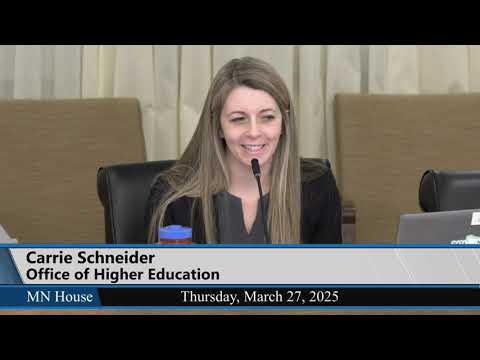
The agency’s commissioner, Dennis Olsen, and Carrie Schneider, research director for the Office of Higher Education, presented updated spending and projection figures and described how changes to state grant parameters and federal Pell outlooks affect North Star Promise resources.
The North Star Promise program was funded with an appropriation for fiscal 2025 of $117,000,000; $5,000,000 of those funds were transferred to cover costs for the Fostering Independence Higher Education Grant Program, leaving $112,000,000 in the program for fiscal 2025, Schneider said. The program has two components: a North Star Promise Base award that covers tuition and fees after other gift aid and a North Star Promise Plus award for students with greatest financial need that can cover additional costs such as books and supplies.
“Fall of 24 is the first term that the NSP base and NSP Plus awards were made to students,” Carrie Schneider told the committee. She reported institutions reported paying about $27,260,000 on North Star Promise Base awards and $19,160,000 on North Star Promise Plus awards for a fall total of about $46,420,000. Institutions reported 15,146 North Star Promise Base awards and 44,639 North Star Promise Plus awards in fall; the unique count of students receiving North Star support in fall was 50,466, with roughly 9,000 students receiving both base and plus awards. Schneider said the average base award was about $1,800 and the average Plus award about $429.
Schneider said that as of a few days before the hearing the program had dispersed roughly $54,000,000 in base awards and $33,000,000 in Plus awards for a preliminary total of about $87,000,000 for the year (fall plus partial spring). Based on current disbursements and February projections, the office projected total fiscal 2025 North Star spending near $105,382,000, leaving roughly $6.8 million to carry forward to the next biennium.
Committee members asked how the North Star outlook interacts with the state grant program. Department projections anticipate a North Star Promise deficit of about $7.35 million in fiscal 2026 because of reduced state grant spending this year and carry‑forward timing; Schneider said the North Star Plus match is likely to be set at 0% in fiscal 2026 and 2027 given available resources. The office also projects a large state grant deficit in fiscal 2027 under current law.
“Because resources are not projected to be available to fund the North Star Promise Plus component, we are anticipating the North Star Promise Plus match for fiscal year 26 to be 0%,” Schneider said. Commissioner Olsen told members the projections are a “snapshot” based on current law and that governor‑recommended parameter changes are intended to balance state grant spending and thereby affect North Star resources.
Members pressed whether the new North Star program has driven enrollment growth. Olsen said Minnesota saw an 18,000 increase in undergraduate headcount from fall 2023 to fall 2024, and that Minnesota ranked fifth nationwide for enrollment growth in that period. Olsen and Schneider said it is too soon to draw a precise causal link between North Star and enrollment because only one full year of data exists; they said preliminary evidence and outreach activity suggest the program likely contributed to increased enrollment, including among adult learners and first‑time students.
Schneider and Olsen told committee members the Office of Higher Education lacks authority over federal Pell policy and that federal Pell shortfalls complicate projection models; Schneider cited a projected shortfall in the Pell Grant program and said that uncertainty makes it harder to predict Minnesota program costs.
The presentation closed with OHE officials urging careful stewardship and noting the program’s early effects on access. “Our financial aid programs and efforts to increase access to higher education are working,” Schneider said, but she and Olsen warned ongoing budget and policy choices will determine North Star’s future funding and the availability of the Plus awards.
Looking ahead, the office said it will refine projections after a full year of North Star data and asked the legislature to consider how state grant parameter changes and any ongoing appropriation decisions will affect North Star and related programs.