Get Full Government Meeting Transcripts, Videos, & Alerts Forever!
Get email alerts on the Tax Policy topic
No spam. Unsubscribe anytime.
Council hearing on FY26 budget spotlights BERT and wage-tax changes, $800M HOME borrowing and small-business aid
Summary
City finance officials presented the mayor’s proposed FY26 revenue and borrowing package to the City Council Committee of the Whole, focusing on cuts to the Business Income and Receipts Tax (BERT), gradual wage-tax reductions and an $800 million borrowing for the HOME housing initiative.
City finance officials presented the mayor’s proposed FY26 revenue and borrowing package to the Philadelphia City Council Committee of the Whole, focusing on cuts to the Business Income and Receipts Tax (BERT), gradual reductions in the wage tax and an $800 million borrowing plan for the administration’s HOME housing initiative.
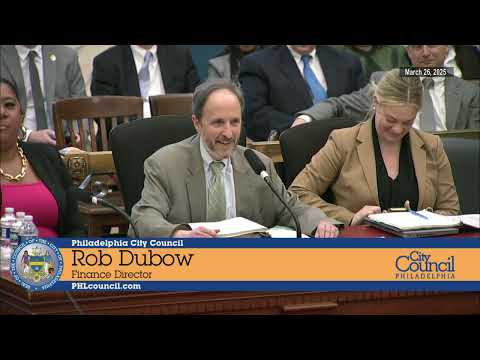
The administration told council the plan combines tax changes recommended by the Tax Reform Commission with a set of new revenue and financing measures. Finance Director Rob DeBeau, testifying for the Office of the Director of Finance, said the package would begin reductions to the gross-receipts portion of the BERT and resume small, scheduled wage-tax cuts through FY2030 while accelerating changes if the city’s pension fund reaches full funding. DeBeau said the administration expects the combined BERT and wage-tax changes to represent "roughly $200,000,000" in reduced net revenue through FY2030, with about "$17,000,000 in FY26." He also told council that the administration proposes two $400,000,000 taxable bond borrowings (totaling $800,000,000) to fund the HOME initiative.
Why it matters
Council members pressed the administration on three linked issues: the immediate cash-flow effect on small businesses if the city follows state advice to repeal the century-old $100,000 BERT exemption; who will pay if the city loses related litigation; and how the HOME borrowing and proposed real-estate tax and fee changes would be structured and overseen.
Legal risk and small-business transition
DeBeau told council that "the law department has advised us that the exemptions for the BERT and UNO should be repealed," and that the administration is drafting legislation to that end. He said the administration is including a proposed $30,000,000 annual program to help businesses adjust, "first, we'll provide tax preparation support," and second, to expand Commerce Department programs such as the Small Business Catalyst Fund, the Storefront Improvement Program and the Emergency Grant Program.
Council members repeatedly questioned why the city would remove the exemption before exhausting a legal defense. Revenue Chief Counsel Francis Beckley confirmed there is pending litigation ― a declaratory-judgment action in common pleas court challenging the exemption ― and said the law department does not publicly discuss details of pending cases. DeBeau and Beckley told council they would brief members privately on litigation risks. DeBeau also told members that, according to counsel, a worst-case judicial outcome could require repayment of prior receipts in some scenarios; the administration said it had estimated FY26 BERT receipts at about $725,000,000 and had factored potential liabilities into its fiscal planning discussion.
Borrowing, fees and other revenue changes
On the HOME initiative, DeBeau said the administration plans two taxable bond issues (one this fall and one in November 2027) rather than tax-exempt bonds so the funds can finance program elements that would not qualify under tax-exempt rules. He said the administration proposes raising the city portion of the real-estate transfer tax from 3.278% to 3.578% to generate roughly $178,000,000 over the life of the plan to help pay HOME bond debt service, and increasing certain meter rates in Center City (a $1 meter increase projected to raise about $4,000,000 annually, from the administration’s example) and recording fees to support housing trust purposes.
Property-tax relief portal and outreach
Revenue Commissioner Kathleen McColgan described an initiative to create a universal, online application for property-tax assistance (Homestead, low-income tax freeze, senior tax freeze and other programs). "Our goal is to implement that in FY26," McColgan told the committee; she said the department has begun requirements work with its vendor and that auto- and cross-enrollment will be used where legally and technically possible. McColgan also reported that homestead enrollment rose to about 247,000 properties for tax year 2025, "an almost 13,000 increase over tax year '24," and said the department is expanding outreach and auto-enrollment where feasible. She said wage-tax outreach last year included targeted notices and resulted in a doubling of low-income wage-tax refund recipients over the previous year.
Council concerns and alternatives suggested
Members from across the chamber questioned how many small businesses would be impacted, whether the $30,000,000 business-assistance fund will reach the tens of thousands of firms that would newly be required to file BERT returns, and whether the administration had considered alternative approaches such as expanding the BERT exemption, larger direct rate cuts targeted to small businesses, or a quarterly BERT filing regime to ease cash-flow impacts. Several council members also said they want the law department to defend the exemption in court before the city abandons it by legislation.
Board of Pensions and other fiscal context
The Board of Pensions testified separately; its executive director said the board will consider proposals that meet its fiduciary standards but that it is open to structures that deliver both financial returns and community benefits. DeBeau reiterated the administration’s view that continued improvements in pension funding are central to the city’s credit rating, and that the FY26 plan calls for building reserves and keeping positive fund balances in each year of the plan, noting a large balloon payment from older borrowing in FY2029.
Public testimony and next steps
More than two dozen public speakers addressed the hearing. Opposition speakers — including small-business representatives, labor unions, tenants’ advocates and neighborhood groups — urged the council to tax the very wealthy rather than cut business taxes and to defend the $100,000 exemption in court. Business groups and some developers urged tax reductions and greater predictability for employers. Several witnesses urged council to pair any business-rate reductions with local-hire or workforce provisions and suggested a dedicated fund for workforce development.
No final votes on the tax bills or borrowing were taken at the hearing. At the end of the session the committee recessed until the next scheduled meeting; a procedural motion to recess was moved and seconded and carried by voice vote.
What was decided and what remains open
Discussion only: the hearing was informational and exploratory; council members asked for follow-up data (including distributional impacts by business size, further litigation briefings, and modeling of alternative exemptions and rate scenarios).
Direction requested: DeBeau and agency leaders were asked to provide written follow-ups on litigation exposure, the projected reach of the $30,000,000 assistance program, timelines for the universal tax-assistance application and the HOME bond structure and debt-service projections.
Formal action: none taken on the ordinance bills at this hearing. A recess motion was carried at the end of the session.
What to expect next
The committee scheduled further hearings and follow-up briefings (administration officials said representatives from the Revenue Department, Commerce, the Board of Pensions, the Sinking Fund Commission, the Office of Property Assessment and the Treasurer’s Office will return to provide more detailed implementation plans and financial models). Council members also requested a closed-door law-department briefing on pending litigation related to the BERT exemption.
Ending
The FY26 tax and borrowing package presents competing priorities: the administration says it will use tax changes to spur business growth and fund a major housing push; critics say the proposed mix would shift burdens to homeowners and small businesses and remove revenue the city needs for schools, libraries and public services. Council has asked for additional details and legal briefings before moving legislation.