Get Full Government Meeting Transcripts, Videos, & Alerts Forever!
Get email alerts on the Wildlife Management Coyote Season topic
No spam. Unsubscribe anytime.
Kansas wildlife commission directs staff to draft rule expanding night-vision coyote season to Feb. 1–June 30 for public review
Summary
After public testimony and staff survey results, the Kansas Department of Wildlife & Parks secretary and a majority of commissioners asked staff to prepare a proposed regulation to extend the current Jan. 1–March 31 night-vision coyote season to Feb. 1–June 30 for formal rulemaking and public comment.
The Kansas Department of Wildlife & Parks Commission on March 27 asked department staff to prepare a draft regulation to extend the state’s night-vision coyote hunting season from the current Jan. 1–March 31 window to Feb. 1–June 30, and to begin the formal promulgation process that will include public notice and hearings.
The move followed a multi-part staff briefing on public input and biological considerations for night-vision coyote hunting. Secretary Christopher Kennedy summarized survey results and public meetings that showed strong support for year‑round expansion among night-vision permit holders and meeting attendees, with more mixed responses from landowners and traditional coyote hunters. Kennedy told the commission the department’s preferred option would be to begin a season on Feb. 1 and extend it through June 30, and he asked commissioners for an informal vote to direct staff to draft a proposed regulation for promulgation.
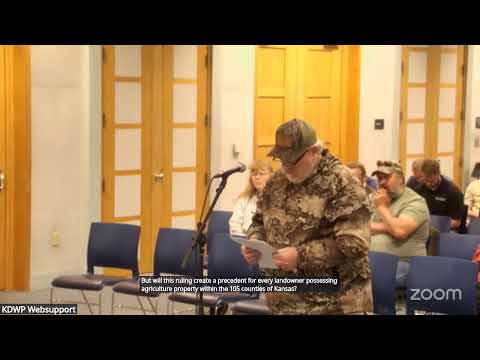
The request prompted extensive public comment both for and against expansion. Speakers in favor said expanded night-vision authority helps ranchers protect calves and gives hunters a useful tool in parts of western Kansas where coyotes are plentiful. Rancher and nighttime hunter Andrew Enfield said night optics let hunters identify animals at long distances and help responding to calving-season problems. Opponents raised safety, mistaken‑identity, fair‑chase and enforcement concerns. Ed Hickman, representing the Kansas Federation of Houndsmen, said lower‑cost thermal equipment can make species identification difficult beyond short ranges and warned of more nighttime shooting and possible trespass.
Secretary Kennedy and department staff described the outreach: a survey distributed to user groups, public meetings in El Dorado, Junction City and Hays, and roughly 57–60 emails submitted to the department between Jan. 1 and March 26. Department research staff reported that night‑vision permit holders and meeting attendees most strongly supported expansion; traditional coyote hunters and landowners were more likely to oppose it. Law enforcement concerns raised at previous meetings and in public comment—about identifying targets and backstops at night—were discussed as part of the record.
Commission discussion focused on balancing resident and landowner concerns, the ability of law enforcement to investigate illegal activity, and avoiding overlap with deer or elk seasons. Commissioners asked staff to refine the proposal to avoid conflict with active big-game seasons; Commissioner Emerick Cross and others noted the Fort Riley elk season and asked staff to confirm dates that might create overlap. Secretary Kennedy and Chief Counsel Curtis Ward said any draft regulation would follow the Kansas Rules and Regulations Filing Act (KSA 77‑415) and go through formal notices, workshops and hearings before a final commission vote.
The commission took an informal, nonbinding vote: a majority signaled support for directing the secretary to draft the Feb. 1–June 30 expansion and bring it through the regulatory promulgation process for additional public comment; Commissioner Delia Lister announced she would vote no. The commission did not adopt a final regulation at the meeting; the department will publish the proposed rule, schedule hearings and return to the commission for formal action in a later meeting.
The department asked the public to continue submitting comments and committed to incorporating biological data, law‑enforcement perspective and further public input before formal rule filing.