Get Full Government Meeting Transcripts, Videos, & Alerts Forever!
Get email alerts on the Research Data Governance topic
No spam. Unsubscribe anytime.
ERC advisory board approves a slate of data requests and research proposals; members clarify limits on linking identifiable supplemental data
Summary
The ERC advisory board meeting approved minutes, a consent calendar, numerous data and extension requests and 15 research proposals. Members emphasized privacy limits on linking supplemental data and amended several data-file requests before approval.
The ERC advisory board convened virtually and approved meeting minutes, a consent calendar, multiple data- and extension-request items, and a slate of research proposals and associated supplemental data requests during a meeting that included presentations from university- and community-based researchers.
Board action centered on routine approvals and review of 15 sponsored research proposals that requested access to the ERC integrated datasets (TEA, THECB, NSC, TWC and other administrative sources). The board approved the February meeting minutes and a consent calendar of extension items, then moved through a series of data-file approvals and new research proposals, often adopting amendments the board requested to clarify data ranges or to add specific CBM/CBM009/CBM00B/other files before voting to approve.
Why it matters: the ERC integrated datasets support longitudinal research and program evaluation across K–12, higher education and workforce data in Texas. Several presenters asked to link supplemental datasets that contained identifiers for record matching; board members and staff stressed limits on bringing personally identifiable information into the ERC and outlined allowable approaches for linking while protecting student privacy.
Researchers sought access for projects ranging from early childhood program evaluations to studies of disciplinary alternative education, dual-credit pathways, teacher attrition, refugee and ELL subgroup outcomes, and workforce alignment for STEM graduates. The board approved most motions on the meeting agenda, typically after brief Q&A or with amendments to the data request tables. Several approvals were recorded as “approved with amendments” to correct date ranges or to add specific state reporting files.
Privacy and supplemental data: Catherine Butida, research and evaluation lead at the Braselton Touchpoint Center at Boston Children’s Hospital, told the board her Bright Beginnings evaluation team planned to match children in their longitudinal Bright Beginnings dataset to ERC records “based just on their last name and date of birth” so the team could flag participating students for outcome analysis. But board members and staff emphasized that identifiable teacher or coach names cannot be linked at the individual level. As one board member summarized, identifiable supplemental fields “are not allowed to be linked to the student data at the person level,” and presenters were advised to separate linking variables (used only for matching and then dropped) from analytic variables that may be shared in deidentified form or at the program level.
Board amendments and file clarifications: several presenters accepted board suggestions to add or change requested files before a motion to approve. For example, the board asked one project to add CBM009 (public two‑year institution files), CBM00B, CBM002 and other THECB files and to change end dates to “most recent available.” Another presenter was asked to remove teacher names from supplemental tables and instead provide program-level deidentified indicators to preserve privacy.
Votes at a glance (selected approvals): the board recorded motions and approvals for the following (motion mover/second recorded in the transcript where specified; when a mover/second was not explicitly named in the transcript snippet, the item below lists the action and notes that the transcript did not specify mover/second):
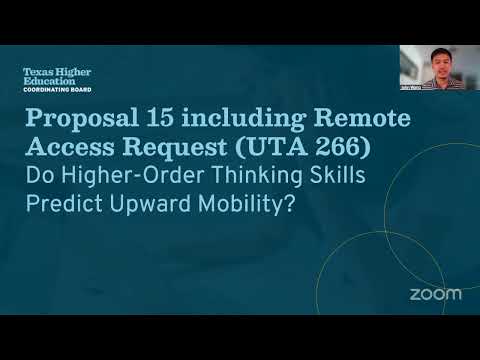
- Approval of minutes from the February 20, 2025 meeting — approved. - Approval of the consent calendar (extensions highlighted in agenda) — approved. - Approvals of scheduled data requests (Data1 UH051, Data2, Data3 UH95, Data4 UTD037, Data5 UTV1504, Data6 UTD168, Data7 UTD175, Data8 UTD176, Data9 UTV188, Data10 UTD214, Data11 UTD216, and others referenced on the agenda) — each approved, some with amendments to add years, census or faculty files as specified by the board. - Approval of multiple extension requests (extension items listed on the consent calendar and individual extension items 8, 1303, 1304, 1403, 1 601, etc.) — approved. - Approval of new research proposals (numbered in meeting materials): - Proposal 1 (Bright Beginnings early childhood evaluation; UH104) — approved. Board clarified that identifiable teacher/coach names cannot be linked at the person level; presenters were advised to provide linking variables used only for matching and then removed or to supply program‑level deidentified indicators. - Proposal 2 (Connect Community evaluation of newcomer student supports; UH105) — approved with amendments to the data table: the board directed the researchers to add specific CBM files (CBM OC1 for universities and ICUT, CBM009 for public two‑year institutions), add the high‑school graduation file, add CBM002/Texas Success Initiative files, and change date requests to “most recent available.” - Proposal 3 (CUNY Homes Choice Neighborhood Initiative evaluation; UH106) — approved with amendments clarifying that the only supplemental data to be linked would be the questionnaire included in the proposal and that early‑childhood and special‑education data be added to the data request table. - Proposal 4 (disciplinary alternative schools; UH107) — approved. - Proposal 5 (UTEP teacher residency effects; CUH108) — approved with amendment to change the end date to most recent available. - Proposal 6 (variation in arts access and outcomes; UTD territory) — approved. - Proposal 7 (gender differences and single‑sex public schools; CTD224) — approved with amendment to add p_student_class_enroll file. - Proposal 8 (outside opportunities and teacher attrition; UTD225) — approved with amendment to add a FERPA statement/exemption language to the application. - Proposal 9 (Burmese ELLs peer influences; UTD56) — approved. - Proposal 10 (students with disabilities postsecondary outcomes; UTD227) — approved with amendment to add the relevant P‑SPED files (services, program, disability files) for K–12 special education. - Proposal 11 (intraclass correlation benchmarks for English learners; UTA262) — approved. - Proposal 12 (math and science dual credit courses; UTA263) — approved. - Proposal 13 (understanding dual credit programs; UTA264) — approved. - Proposal 14 (pursuits and attainment of STEM degrees; UTA265) — approved with amendment to add FERPA exemption language if missing. - Proposal 15 (higher‑order thinking skills and mobility; UTA266) — approved.
All motions on the agenda passed unless noted otherwise in the transcript; where a board member flagged an abstention the meeting minutes recorded that abstention but the transcript snippet did not identify full vote tallies for every item.
What board members emphasized: board members repeatedly requested that researchers (1) fix mismatches in date ranges and data‑table file names before approval, (2) avoid including identifiable teacher or coach names in supplemental files to be linked at the person level, and (3) add relevant THECB/CBM files when the proposal sought postsecondary outcomes. Board members also encouraged requesters to set date ranges to the most recent available data to avoid having to return for extensions.
Next steps: approved projects will proceed through the ERC’s standard data access and privacy review steps. Presenters were asked to resubmit amended data tables where required and to supply FERPA justifications or exemptions when needed for longitudinal linkages.
Speakers (selected, as identified in the meeting transcript): Catherine Butida — Research and Evaluation Lead, Braselton Touchpoint Center, Boston Children’s Hospital (researcher, Bright Beginnings evaluation). Shawna Harris — Senior Director, Early Childhood Initiatives, United Way of Greater Houston (project partner, Bright Beginnings). Dr. Elliot Whitney — Researcher, Connect Community (nonprofit researcher presenting place‑based newcomer supports evaluation). Maria Gianni — PhD student, University of Florida (researcher presenting disciplinary alternative schools project). Dan Bowen — Associate Professor, Texas A&M (researcher presenting arts access project). Mira Chaskas — Researcher, Policy Impacts / MIT (researcher presenting single‑sex school outcomes study). Clara Kyung — PhD student, University of Chicago (researcher presenting teacher attrition study). Ahana Samat — PhD student, UT Dallas (researcher presenting students with disabilities project). Ian Thacker — Assistant Professor, UT San Antonio (researcher presenting STEM degree pipeline project). John Wong — PhD student, University of Virginia (researcher presenting higher‑order thinking skills project). Selected board members listed by first name in the transcript who participated in motions, seconds or questions: Celeste (board member), Kathy (board member), Holly (board member), Jackie (board member), Megan (board member), Angie (board member), Rayyan/Rayanna (board member), Eugene (board member), Celeste (chairing motions), and others who registered aye votes during roll calls.
Authorities and data sources noted during discussion: Family Educational Rights and Privacy Act (FERPA) — statute cited regarding privacy limitations; Texas Education Agency data (TEA/PEIMS); THECB (Higher Education Coordinating Board) postsecondary data; National Student Clearinghouse (NSC); Texas Workforce Commission (TWC); HUD Choice Neighborhood Initiative (grant funding referenced for a community project); CBM/CBM009/CBM00B/CBM002 file categories (THECB reporting files) — board requested specific CBM files for some proposals.
Community relevance and implementation notes: many projects target students in specific Texas regions (Greater Houston, Gulfton/Sharpstown, El Paso, San Antonio), and several proposals were amended to include early childhood and special education data files where presenters indicated longitudinal connections to K–12 or postsecondary outcomes. Board members noted some projects depend on supplemental data flow schedules (e.g., whether supplemental flags arrive every six months) and recommended minimizing disruption to TEA’s systems when requests require periodic supplemental uploads.
For the full list of approved items and motion text as recorded in the meeting transcript, researchers and data custodians should consult the ERC meeting minutes and the ERC data access office for precise motion language, vote tallies and required amendment text.