Get Full Government Meeting Transcripts, Videos, & Alerts Forever!
Get email alerts on the Public Comment Prayer Policy topic
No spam. Unsubscribe anytime.
Supervisors discuss prayer, pledge and public comment limits; consider rotating prayer and two-minute rule
Summary
Board debated whether invocation and pledge should be part of meetings, how to accommodate different faiths, and time limits for public comment and public hearings.
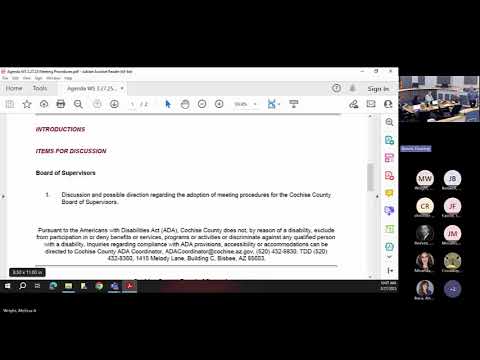
Cochise County supervisors discussed how invocation, the Pledge of Allegiance and public comment should be handled at official meetings and whether the board needs a written policy to govern those elements.
Chairman Frank Antonori said a policy should permit prayer and the pledge to remain part of meetings while ensuring the county—s compliance with the U.S. Constitution and applicable court rulings. "We do have to have a policy to allow people to come in and give the prayer and subject to reasonable time and place and manner restrictions," Antonori said.
The board debated practical options. One proposal was to rotate the invitation to give the invocation among the three supervisors by district, or allow constituents to request time to offer a prayer on the meeting agenda. Supervisors emphasized the government cannot favor one religion and must allow sincerely held belief systems; Antonori noted a court—s approach requires treating nontraditional faith expressions the same as traditional faiths.
On public comment timing, staff recommended a two-minute limit for general calls to the public and a three-minute limit for speakers at public hearings. Antonori and others described reasonable time, place and manner limits as lawful ways to keep meetings orderly while preserving free-speech rights. "If you don't like it, you're free to get up," Antonori said, describing options for members who disagree with a speaker.
The board also discussed how to handle repetitious remarks during public hearings and whether a chair may ask speakers to avoid repeating previously made points if the comments become repetitious. Staff said they typically encourage speaker sign-up by 9 a.m. on meeting days to facilitate remote participation and identify speakers accurately.
Ending: Staff were asked to draft language for a prayer/pledge/public comment policy that balances free-speech protections, nondiscrimination among religions, and orderly meeting management, and return with edits in a future draft of the board—s meeting rules.