Get Full Government Meeting Transcripts, Videos, & Alerts Forever!
Get email alerts on the Meeting Rules Procedures topic
No spam. Unsubscribe anytime.
Cochise County supervisors begin drafting formal meeting rules, consider Robert—s Rules and legislative procedures
Summary
Supervisors discussed adopting a formal set of meeting rules that mix abbreviated Robert's Rules with legislative procedures to clarify motions, decorum, conflict-of-interest handling and sanctions for misconduct.
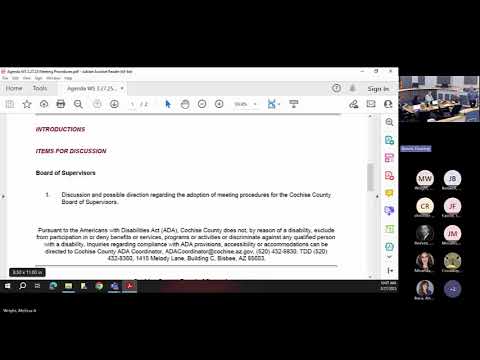
Chairman Frank Antonori, Cochise County Board of Supervisors, opened a work session March 27 to discuss adopting formal meeting rules and procedures for the board.
The supervisors said they want a rules package that is tailored to the board—s small, nonlegislative body rather than adopting full legislative parliamentary practice. "It's Robert's Rules, abbreviated," Antonori said, adding he also reviewed a state senate rulebook as a reference.
Why it matters: supervisors said a clear rule set would give the chair and members a shared vocabulary to call points of order and cite specific rules during debate, and would establish sanctions for repeated breaches of decorum.
Board members discussed several elements that would appear in a rules manual: the order of business (roll call, invocation, pledge, agenda), procedures to introduce, amend and second motions, limits on repetitious public comment, and sanctions ranging from temporary suspension from speaking to referral to an ethics committee for serious offenses. "If somebody's out of order, you could say, 'Mr. Chairman, I would like to point to rule 9, section a of the Cochise County board of supervisors rules,'" Antonori said.
Supervisors also reviewed how different rules handle conflicts of interest. Antonori noted that in some legislative contexts a member on the floor must vote yes or no and may instead invoke a conflict rule to avoid voting; he said the rules could specify how board members should disclose conflicts and whether the clerk must record them.
Several members emphasized keeping procedures practical. One suggested an abbreviated flowchart for chairs and presenters so routine items move efficiently while preserving formal options when necessary. The board discussed a draft rule text circulated before the meeting; staff were directed to revise that draft to incorporate the day—s feedback and return with a new version for review in May.
Ending: Staff were asked to edit the draft rules to reflect today's discussion about agenda order, decorum, public-comment limits and formal mechanisms such as points of order, and return a revised draft to the board for consideration.