Get Full Government Meeting Transcripts, Videos, & Alerts Forever!
Get email alerts on the State Legislature Texas topic
No spam. Unsubscribe anytime.
San Antonio council hears overview of 8,900 Texas bills; city outlines priorities and opposition
Summary
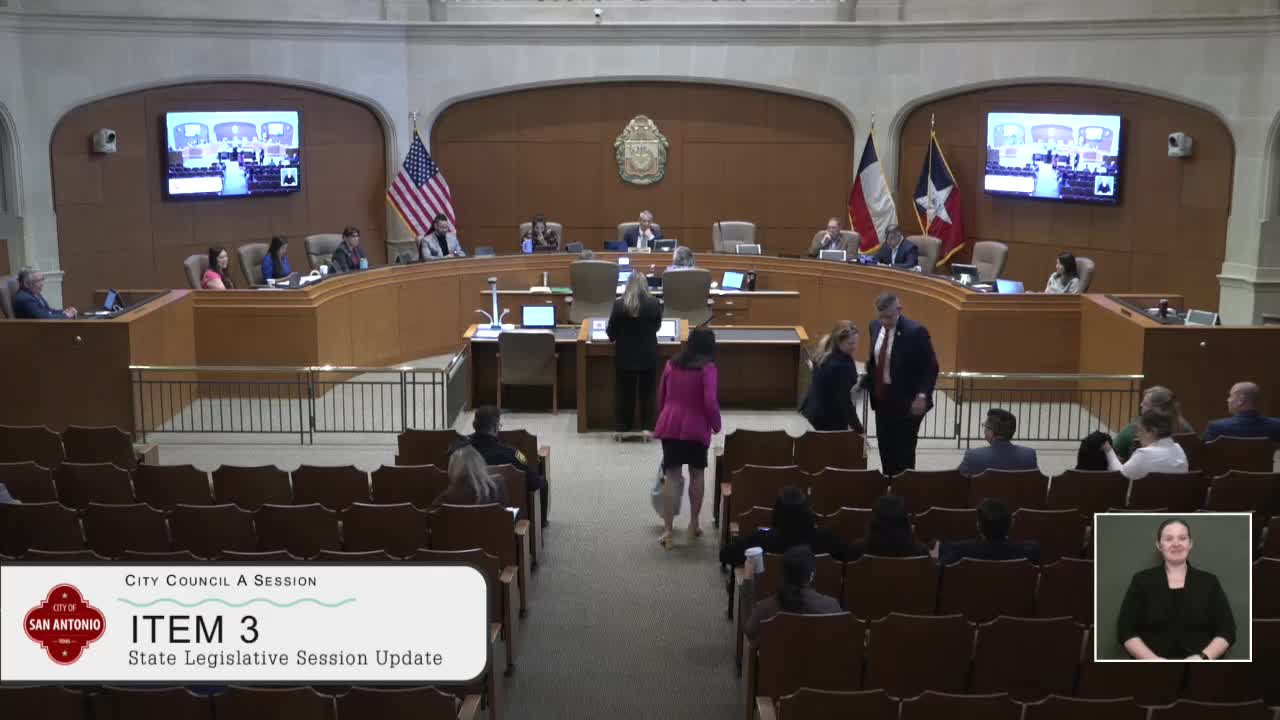
Sally Basut, the City of San Antonio’s director for government affairs, told city council on March 27 that more than 8,900 bills and joint resolutions had been filed in the 89th Texas Legislature and that city staff were actively tracking roughly 2,000 measures.
Sally Basut, the City of San Antonio’s director for government affairs, told city council on March 27 that more than 8,900 bills and joint resolutions had been filed in the 89th Texas Legislature and that city staff were actively tracking roughly 2,000 measures.
“This session, over 8,900 bills and joint resolutions have been filed,” Basut said. “The government affairs team is tracking and monitoring approximately 2,000 bills — the most ever.”
The briefing summarized bills the city considers priorities or risks and described where city staff have taken positions or provided testimony. Basut highlighted a proposal to establish a Texas cyber command at the University of Texas at San Antonio, an appropriation request tied to a proposed East‑West corridor (sometimes described in the presentation as the South Texas Parkway), public‑safety and public‑health measures, and a set of bills the city opposes because of their potential impact on annexation and emergency services.
Why it matters: city staff said the legislative package includes proposals that could change how San Antonio manages transportation planning, public safety services and local regulatory authority. The city’s brief also outlined funding requests and coordination steps that would require state action or appropriations to advance projects that San Antonio has prioritized.
Key points from the briefing
- Cybersecurity: Basut described H.B. 150 as the bill that would establish a Texas cyber command as a component of the UT system at UTSA and create a cyber‑security threat intelligence center and incident response capability. She said San Antonio was present “in support” of the bill, with Councilmember White testifying in person and “General Ayala” submitting written testimony. Basut told council the bill had been left pending in committee but remains under active monitoring.
- East‑West corridor / South Texas Parkway: Staff reported work to add the corridor to the city’s major thoroughfare plan, targeting a city council action in May 2025 and a call for projects from the metropolitan planning organization in summer 2026. Basut said Representative Luhan had submitted a $12,500,000 request into the House appropriations process for preconstruction activities (schematic design, environmental work and public involvement). She emphasized the appropriation process is lengthy and uncertain.
- Dangerous dogs and registry proposals: Basut summarized H.B. 2806 (which she said would increase penalties and expand authority for Animal Care Services officers) and noted Representative Campos filed H.B. 2325 to create a statewide dangerous‑dog registry coordinated by the Texas Department of Public Safety. Basut said the city supports measures that align with local Animal Care Services practices and that a statewide registry would likely be straightforward to share because San Antonio already maintains a database.
- E‑cigarette retail restrictions: Basut described H.B. 1816 as giving counties and municipalities authority to prohibit e‑cigarette retailers within 1,000 feet of public primary or secondary schools, with an exception for retail outlets whose e‑cigarette sales account for less than 50% of gross receipts. She said the bill was left pending in the Texas House Committee on Intergovernmental Affairs and that the city submitted written testimony on the topic.
- Emergency services districts (ESDs) and annexation: Basut said the city opposes H.B. 377 (Rep. Cortez) and H.B. 2345 because, in her words, they would restrict municipal service agreements and could invalidate existing annexation‑related service contracts, creating “duplicative services” and tax issues for residents of newly annexed territory. Several councilmembers pressed staff for more detail and expressed concern that the bills appear to protect ESD finances rather than improve public safety.
- Burglary of a vehicle: Basut and staff described two bills (H.B. 727 and H.B. 548) that would increase penalties for vehicle burglaries. A city staffer identified as Jesse explained that upgrading the offense from a class A misdemeanor to a state‑jail felony would raise the possible sentence to up to two years, with a statutory minimum in some cases (he cited a 180‑day minimum and a $10,000 fine as the state‑jail felony range discussed in committee).
- San Antonio Missions / National Park Service authority: Basut said H.B. 1866 would give National Park Service officers at the San Antonio Missions additional state law‑enforcement authority, including executing state arrest and search warrants and pursuing emergency detention or court‑ordered protective detention related to mental health incidents. Basut said the city submitted written testimony in support on behalf of World Heritage staff.
Other items noted: Basut and councilmembers discussed bills affecting local bond and tax rules (a proposed H.B. 2736 that would change local election timing and require supermajorities for some bond or tax measures), a Senate priority bill (S.B. 33) restricting use of government resources to support abortion‑assistance entities, and S.B. 15, a lieutenant‑governor priority the briefing described as changing minimum lot‑size rules to allow smaller lots and constrain local zoning authority.
Council reaction and follow‑up directions
Councilmembers asked staff for more detail on several items and applauded the government affairs team for monitoring the volume of legislation. Councilmember Peláez emphasized the council’s role to “advocate for the best interests of our residents” rather than simply “get along” with the Legislature. Councilmember Pelaez also requested additional briefings and follow‑up materials on specific bills affecting housing, water infrastructure, and ESDs.
General Ayala, identified in the briefing as a military‑affiliated witness who provided written testimony on cybersecurity, told council he did not believe the state proposal signaled a long‑term effort to subsume local cybersecurity responsibilities. “I don’t sense that, because, really, they really couldn’t,” General Ayala said, adding that San Antonio’s existing military and industrial cyber footprint made the city a natural partner for growth.
Staff said the city will continue to monitor committees and floor activity, provide written testimony where appropriate, coordinate with the delegation on appropriation requests, and return with updates on items councilmembers flagged for additional detail.
Ending note
Basut closed by reaffirming the scope of the session and the staff workload: “Committee hearings are in full progress forward, and the Senate is actually advancing bills at a faster pace than the House,” she said. Councilmembers asked staff to circulate deeper analyses on select items (water and wastewater funding, sales‑tax allocation proposals, and housing and transportation bills) as the session proceeds.
No formal council votes or ordinances were taken during the briefing; the presentation was informational and followed by member questions and staff commitments to provide additional research and updates.