Get Full Government Meeting Transcripts, Videos, & Alerts Forever!
Get email alerts on the Dmv It Modernization Ab3 topic
No spam. Unsubscribe anytime.
DMV requests delay to AB 3 implementation citing legacy IT work; seeks to align changes with multi‑year DXP modernization
Summary
DMV requested the Legislature delay AB 3 implementation from July 1, 2025 to July 1, 2029, saying changes required to support new court‑ordered license suspension and restriction rules cannot be completed safely on legacy systems while its multi‑phase DXP modernization continues.
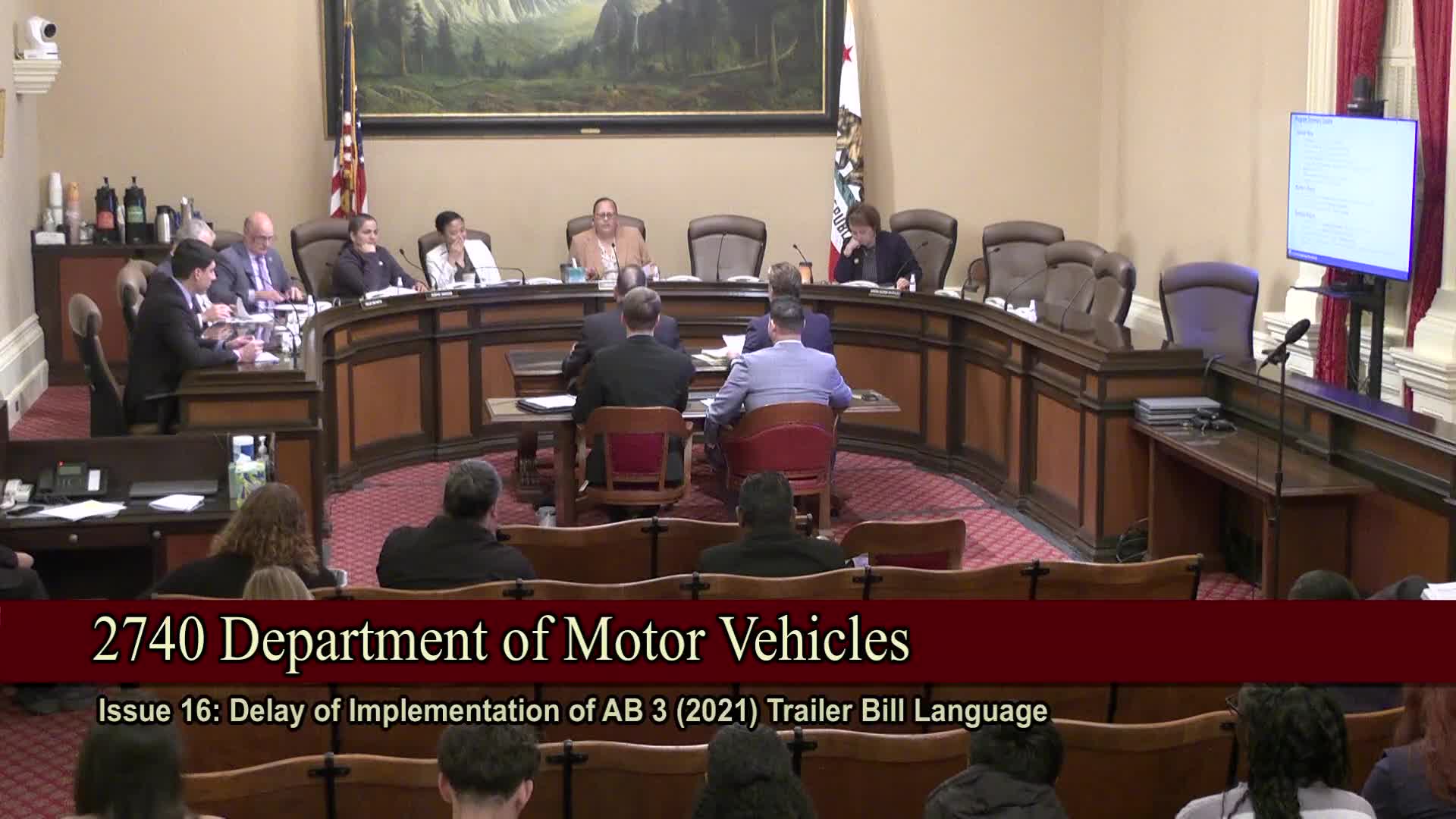
The Department of Motor Vehicles asked the Senate Budget Subcommittee No. 5 to delay implementation of AB 3 trailer‑bill language from July 1, 2025 to July 1, 2029, saying programming required to support a new court‑ordered license suspension and new license restrictions cannot be completed by the earlier date without extensive work on legacy core systems.
DMV witnesses said the department is midway through a multi‑phase DXP modernization program that began in 2019 and is migrating legacy, home‑grown systems to a common Salesforce‑based platform. They said the DXP project has completed the initial licensing phase and expects to finish vehicle registration and then dealer phases; DMV argued it is preferable to implement AB 3 changes once DXP has completed the driver‑licensing phase to avoid repeated changes to fragile legacy systems.
DMV staff estimated the AB 3‑related implementation would require code changes and integration work and that the most cost‑effective approach is to align those changes with the DXP timeline to ‘build once’ rather than repeatedly touch old systems. DMV indicated the delay request covers the bill’s major operational impacts and said there is an approximate $600,000 implementation cost noted for certain IT work, but the department did not present an immediate plan to phase in specific AB 3 elements earlier.
Committee members pushed back on the length of the proposed delay. Senator Sciardo urged DMV to find a path to implement license suspension functionality on schedule (July 1) because he characterized the provision as a public‑safety measure. DMV offered to brief members on its current suspension processes and to provide further technical details on what could be implemented earlier as the department modernizes.
The committee asked DMV to provide a more detailed implementation plan and to identify whether any AB 3 provisions — particularly the license suspension mechanism tied to public safety — could be implemented sooner without full DXP deployment.