Get Full Government Meeting Transcripts, Videos, & Alerts Forever!
Get email alerts on the High Speed Rail topic
No spam. Unsubscribe anytime.
High‑Speed Rail Authority promises a summer cost, schedule update after inspector general warns of near‑term funding gap and schedule slippage
Summary
The High‑Speed Rail Authority told the Senate subcommittee it will issue a supplemental project update this summer after a deep review of scope, cost and schedule, while the authority’s inspector general and the Legislative Analyst’s Office warned of a near‑term funding gap and schedule slippage for the Merced‑to‑Bakersfield initial operating segment.
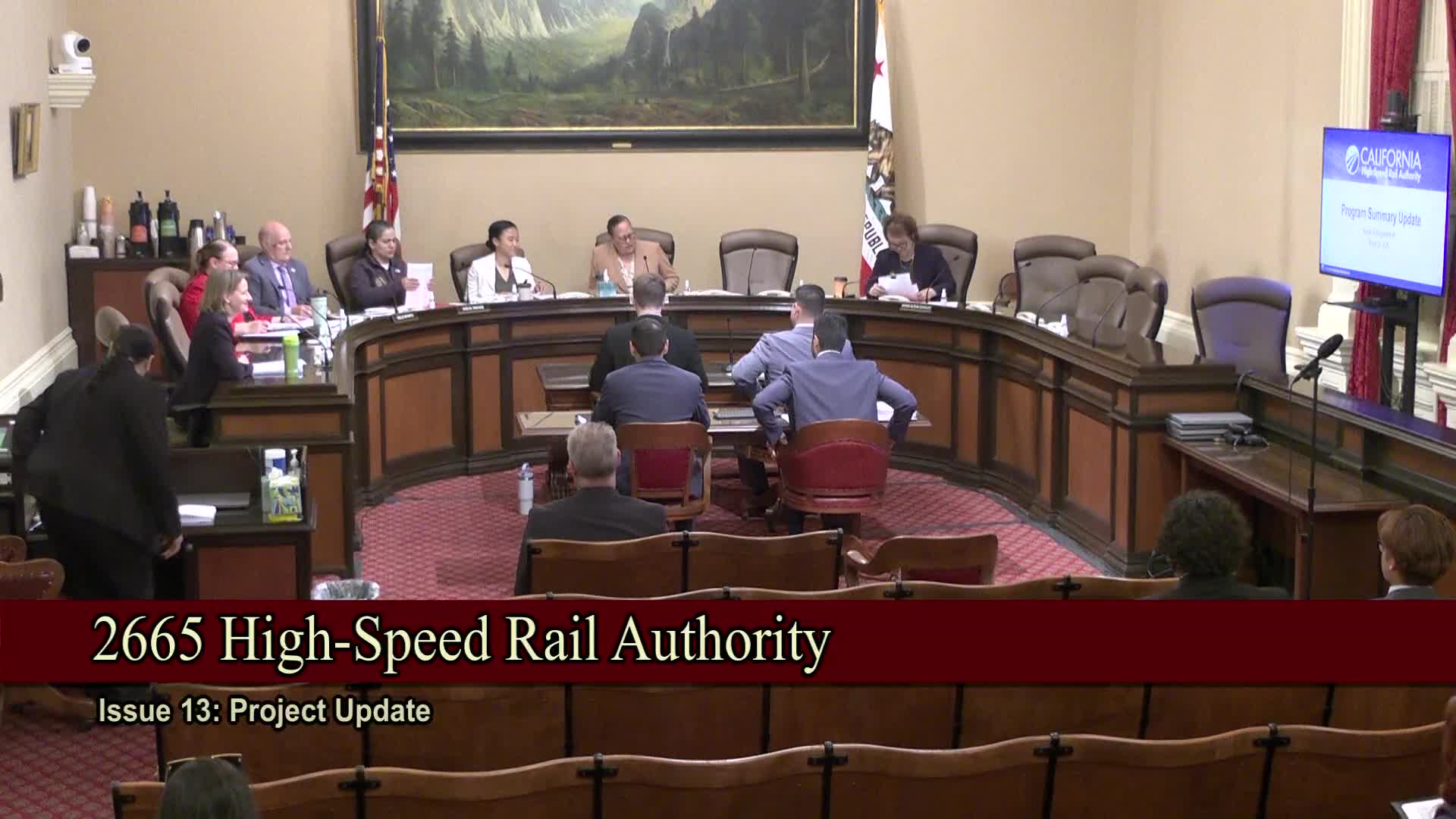
The California High‑Speed Rail Authority told the Senate Budget Subcommittee No. 5 it will issue a supplemental project update this summer after a “deep dive” into scope, cost, schedule and procurement strategy. Authority staff said the goal is to identify efficiencies and sequencing that improve deliverability while staying within available resources.
Mark Tolleson, chief of staff, and Jamie Matalka, chief financial officer for the authority, said work continues in the Central Valley, where 71 miles between Merced and Bakersfield are under construction or design and 463 miles of the overall 494‑mile San Francisco–Los Angeles/Anaheim system are environmentally cleared. They said 53 of 93 structures needed on the initial operating segment are complete, 19 miles of guideway have been completed and right‑of‑way acquisition is about 99 percent complete for the Valley segment.
Lawmakers pressed the authority on scope, timing and funding. The Legislative Analyst’s Office told the committee the authority faces “a significant funding gap” for the Merced‑to‑Bakersfield initial operating segment; the LAO cited an approximate $7 billion shortfall in the most recent public materials and said much of the gap needs to be secured by mid‑2026 to avoid schedule risk. LAO analysts also flagged risks from escalating construction costs, potential federal‑funding uncertainty and the variable nature of greenhouse‑gas‑auction revenues used for authority financing.
Ben Belknap, Inspector General for the High‑Speed Rail Authority, told the panel his office has published multiple reviews and concluded that (1) the Merced‑to‑Bakersfield segment faces a $6.5 billion funding gap that would need to be filled by summer 2026 to keep current schedules viable; (2) the authority’s internal schedules show about one year of slippage has already occurred; (3) the authority paused some procurements (including train sets) and did not apply for a critical federal grant cycle, adding to schedule and funding risk; and (4) third‑party delays and utility and right‑of‑way issues continue to pose construction risks. The IG emphasized the reports were intended as calls for course correction, not abandonment of the project.
Authority staff described a program‑level effort to “build smarter, faster and more economically,” including an industry forum and meetings with private investors, construction and tunneling experts, and financiers. The authority said it created more than 15,000 jobs so far and estimated $22 billion in economic activity tied to Valley construction. It cited the need for stable funding to continue and said it will present a new assessment of cost, scope, schedule, procurement and ridership this summer.
Committee members were sharply critical in some exchanges. Several senators — including those from the Bay Area and Southern California — said decades of planning and repeated schedule slippage have eroded legislative and public confidence and asked for clearer timelines and more executive‑level presence; Chair Richardson asked that the authority’s CEO attend future briefings and requested the supplemental update sooner than August if possible. The Legislative Analyst and the IG recommended additional details on proposed financing options (including how cap‑and‑trade revenues are used), sequencing of construction and risks associated with federal funds that are not yet obligated.
The Inspector General said his office lacks direct enforcement authority and will use reporting and recommendations to press for improvements and asked the legislature to use its oversight levers where required. Committee members asked the IG to consider procurement and supply‑chain questions in upcoming reviews; he agreed to consider requested scopes if there is a clear nexus to his work plan.
The committee directed the authority to return with the supplemental project update this summer and to respond in writing to specific LAO and committee questions; the chair urged the authority to have the CEO appear to answer legislators’ questions directly.