Get Full Government Meeting Transcripts, Videos, & Alerts Forever!
Get email alerts on the Juvenile Justice Realignment Jjrbg topic
No spam. Unsubscribe anytime.
State juvenile-justice office proposes new realignment formula; lawmakers press for spending transparency
Summary
The Office of Youth and Community Restoration told the Senate subcommittee it plans to revise the Juvenile Justice Realignment Block Grant formula to steer funding away from a static DJJ-based factor and toward counts of adjudicated youth, the youth population, and youth moved into less restrictive programs — a change officials said is designed to support alternatives to long-term incarceration.
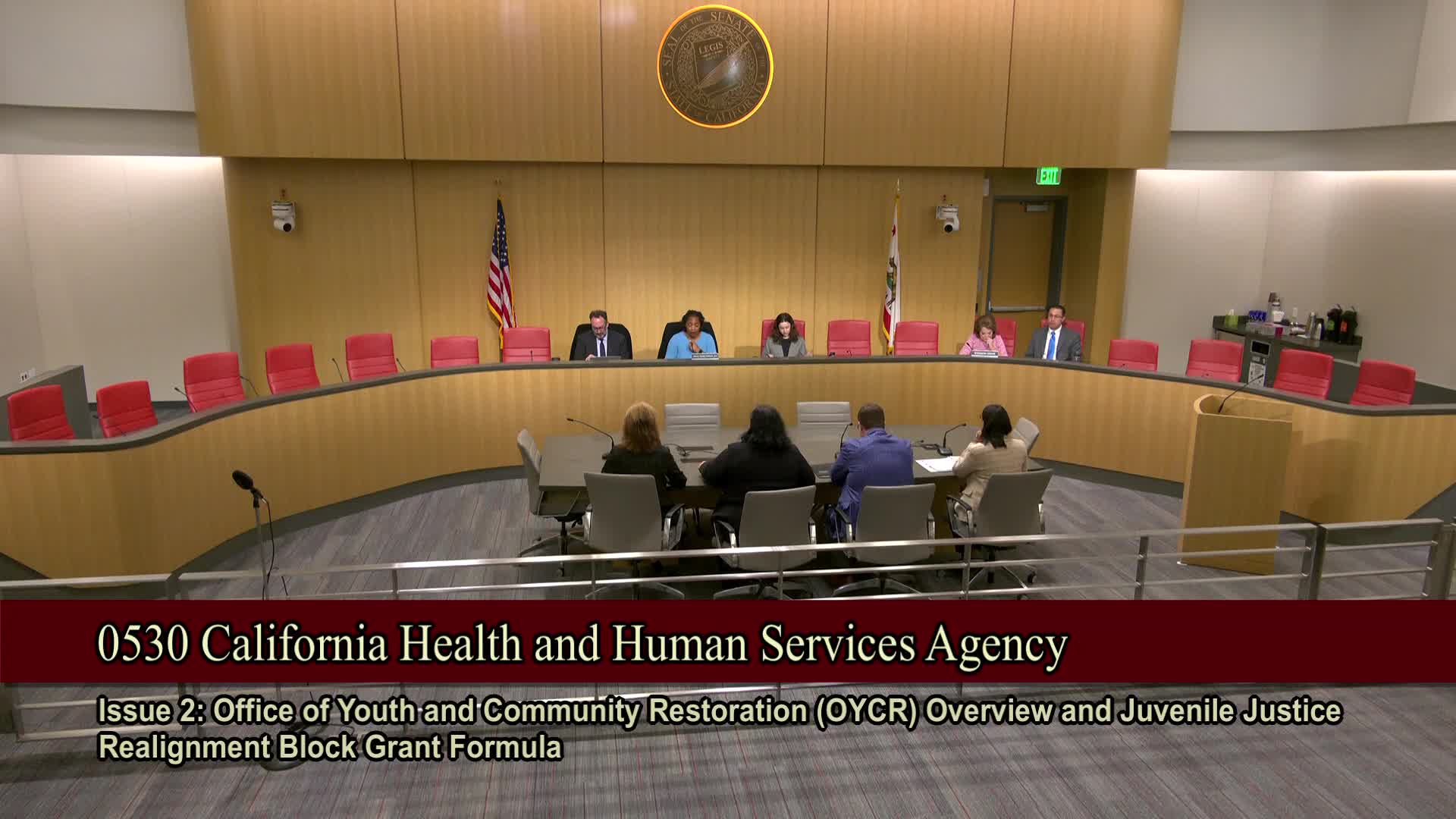
The Office of Youth and Community Restoration told the Senate Budget Subcommittee No. 3 on Health and Human Services on Wednesday that it plans to revise the Juvenile Justice Realignment Block Grant (JJRBG) formula to shift funding toward “less restrictive programs” and away from a static 2018 Department of Juvenile Justice count.
The change, OYCR Director Catherine Lucero said, replaces the old DJJ-based factor with measures that count youth ages 10–17, youth adjudicated for Penal Code section 707(b) offenses, and youth who move from secure youth treatment facilities (SYTFs) into less restrictive programs (LRPs). "The new factor... does move the infrastructure towards alternatives to long term incarceration when it is safe for the community and in the best interest of the youth," Lucero said.
The proposal is intended to implement the reforms of SB 823 by steering funds toward community-based alternatives and creating incentives for stepping youth down from secure settings. Deputy Director Alani Jackson told the committee OYCR has invested $15 million in grants to 11 counties to help build LRPs and described a broad set of OYCR programs, including educational initiatives, workforce development for justice-impacted youth, and an ombuds division that handled 296 complaints in 2024.
Why it matters: Senators repeatedly warned that changing the allocation formula without more robust accountability would risk sending money to facilities that do not deliver improved outcomes. "That is a complete failure on our part to give a location that has been asked to shut down automatic funding," Sen. María Menjivar said, arguing the current statutory allocation process would continue to send pro rata shares to counties even if a facility had been ordered closed. Several senators urged statutory language requiring reporting of actual expenditures, stronger recoupment or withholding authority, and periodic reevaluation of the formula.
Key details from the hearing: - OYCR's budget and programs: Lucero and Jackson said OYCR's total proposed budget is roughly $251 million, including state operations and local assistance. The office manages 37 authorized positions and a range of grants and technical assistance programs for counties and community-based organizations. - Ombuds data: OYCR reported 296 complaints in 2024; 56 had been closed at the time of the presentation. Substantiated findings numbered 21; investigators declined 84 complaints; 84 site visits were conducted and more than 5,000 “youth bill of rights” posters were distributed. Complaint types included alleged abuse or punishment, excessive force, denied visits or calls, medical issues, and conditions of confinement. - Formula mechanics and data sources: OYCR said the revised formula replaces the fixed 2018 DJJ count with three dynamic factors (youth population 10–17, 707(b) adjudications, and counts of youth diverted from or stepped down out of SYTFs into LRPs). The office told the committee AB 169 reporting will provide routine twice-yearly LRP transfer data; the department also uses DOJ/JCPSS data for adjudication counts. - Implementation timeline: The administration proposes a multi-year rollout and does not intend to implement the new allocations immediately; the earliest effective implementation discussed would occur in calendar 2027 with a phased ramp-up to avoid a “cliff.”
Concerns expressed by senators and others - Lack of expenditure tracking: Multiple senators asked how the state can ensure counties actually spend JJRBG allocations on youth services; OYCR acknowledged counties submit annual plans but the state does not currently track actual expenditures or require financial closeouts for JJRBG funds. Lucero said allocations are dispersed by Department of Finance independent of OYCR plan review. - Incentive alignment for judges and probation: Senators questioned whether the combined “prevention + step-down” component could let judges meet the allocation target while leaving probation with no incentive to pursue step-down placements. Lucero and others said judges rely heavily on probation recommendations and that the formula was designed to count both diversion and step-down activity, but senators requested clearer, separate incentives for distinct actors. - Distinguishing LRPs: Senators asked why the formula does not differentiate LRPs located on SYTF campuses (Title 15-governed) from truly community-based LRPs. OYCR responded their AB 169 data distinguishes transfers to Title 15 versus community LRPs, and said the formula built in the LRP factor to avoid perverse incentives that would favor placing youth in SYTFs to access alternatives.
Follow-up and next steps: Senators repeatedly pressed for statutory changes that would (a) require counties to report actual expenditures and closeouts, (b) allow the state to withhold or recoup funds from facilities ordered to close, (c) require periodic reevaluation of the allocation formula, and (d) improve data collection on dual-status youth (those involved in both foster care and juvenile justice). OYCR said it will continue stakeholder engagement and that the formula is intended as an iterative proposal.
Ending: OYCR provided written materials and the office said it will supply more detailed county-by-county spend and complaint data on request. Lawmakers left the hearing urging language that links funding changes to accountability measures so allocations cannot continue to flow automatically to facilities the state has asked to close.