Get Full Government Meeting Transcripts, Videos, & Alerts Forever!
Get email alerts on the Freight Policy topic
No spam. Unsubscribe anytime.
CalSTA asks Legislature to make freight policy team permanent to oversee $1.2 billion in port and freight investments
Summary
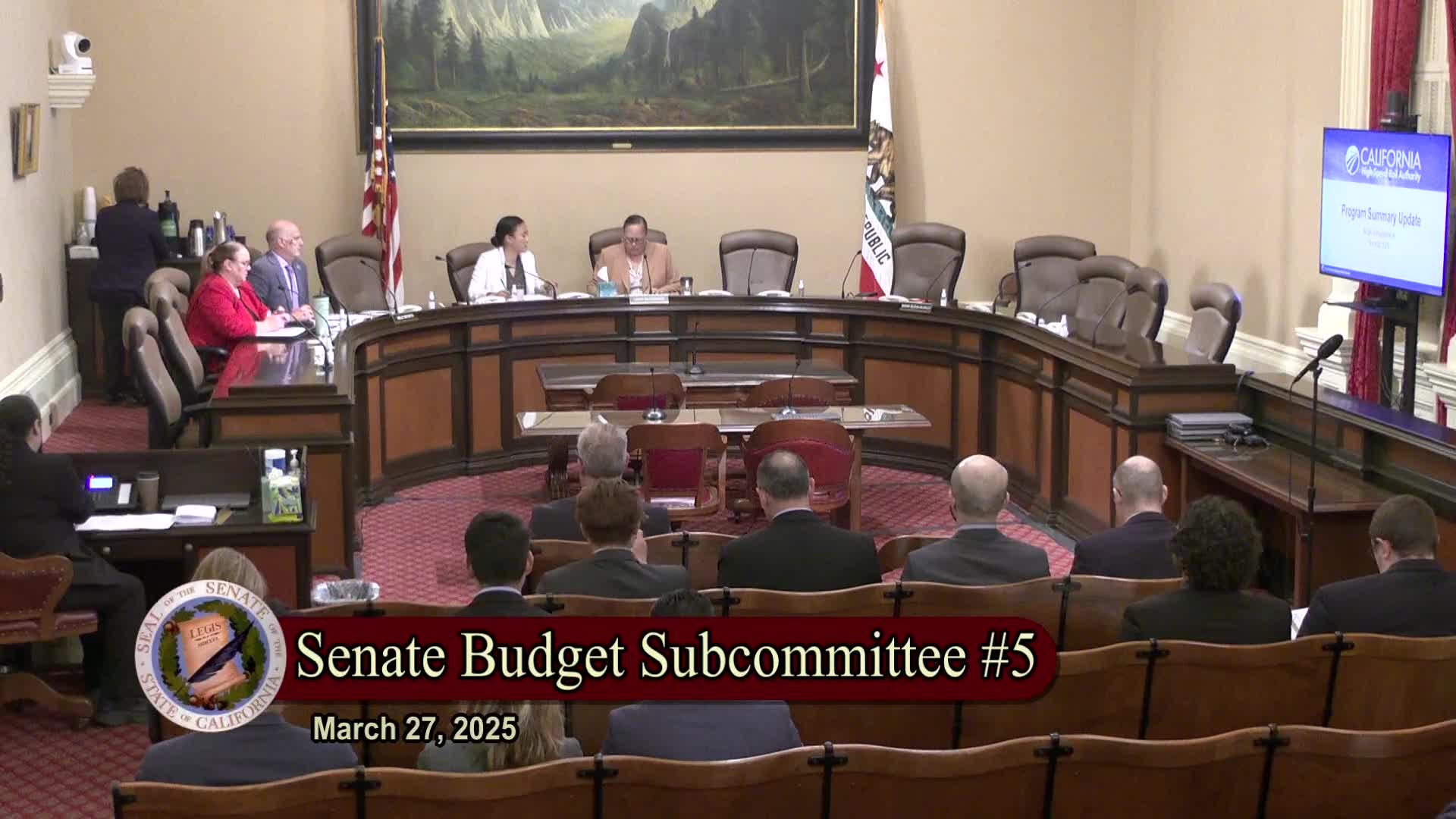
California State Transportation Agency asked the Senate Budget Subcommittee No. 5 to approve $603,000 in ongoing funding to convert three limited‑term positions to permanent for a CalSTA freight policy team that coordinates oversight of roughly $1.2 billion in port and freight infrastructure awards and ongoing supply‑chain projects.
CalSTA requested ongoing funding to convert three limited‑term positions to permanent for an agency‑level freight policy team charged with oversight and coordination of statewide freight policy and major port and freight infrastructure investments.
The request, presented by Christine Casey, deputy secretary for freight policy at the California State Transportation Agency, seeks $603,000 in ongoing funds. Casey told the subcommittee the freight team oversees roughly $1,200,000,000 in investments awarded through the Port and Freight Infrastructure Program and that the scale, complexity and multi‑year nature of those capital projects will require agency oversight through at least 2028.
“The CalSTA freight policy team is a long‑term necessity, not just a temporary program,” Casey said, adding the team leads intra‑agency coordination among CalSTA’s departments, boards and commissions and convenes industry and supply‑chain stakeholders and a state supply‑chain task force.
Casey cited major projects with freight implications, including the Vincent Thomas Bridge redecking and the Otay Mesa East port‑of‑entry project, and noted the upcoming Los Angeles 2028 Olympic Games as an event with freight and goods‑movement consequences. She also highlighted the freight sector’s emissions challenges, saying transportation accounts for nearly half of state greenhouse‑gas emissions and “nowhere will this transition be harder than in the freight sector.”
Frank Jimenez of the Legislative Analyst’s Office said the LAO had no concerns with the proposal. Finance staff present had no immediate objections. Committee members asked for follow‑up materials, including a list of the $1.2 billion program’s 15 grantees and descriptions of the awarded upgrades; Casey said she would provide the annual SB 198 report and a list of awardees.
Several senators praised the coordination role but pressed CalSTA on how it balances freight‑movement priorities with regulatory and climate mandates set by other agencies such as the California Air Resources Board. Senator Sciarto asked whether the freight team’s time is focused more on freight‑movement operations or on helping industry comply with emissions mandates; Casey said the team works on both and brokers conversations between industry and regulators.
Committee members from freight‑impacted communities asked about local impacts during large projects such as the Vincent Thomas Bridge redecking and sought more engagement and mitigation planning; Casey said CalSTA and District 7 engage community advisory and technical committees and that CalSTA staff are participating in stakeholder meetings.
CalSTA and several port and regional planning stakeholders testified in support during public comment, including representatives of the Ports of Long Beach and Los Angeles and regional agencies who argued a permanent coordination function improves statewide competitiveness and resilience of goods movement.
Committee members requested written follow‑up on awardees, project descriptions and any additional materials that would clarify the freight team’s workload, the projects it oversees and the timeline for ongoing agency oversight.