Get Full Government Meeting Transcripts, Videos, & Alerts Forever!
Get email alerts on the Electrification topic
No spam. Unsubscribe anytime.
Portland committee reviews citywide electrification plan, highlights grid and equity challenges
Summary
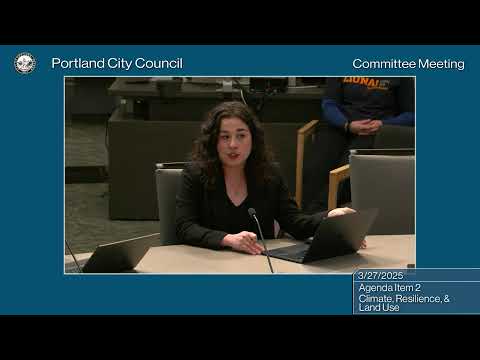
The Climate Resilience and Land Use Committee heard an overview of Portland’s electrification strategy March 27, including building performance standards, transportation charging plans and limits posed by utilities and grid capacity.
The Climate Resilience and Land Use Committee heard an overview March 27 of city staff’s strategy to accelerate electrification of buildings and transportation while flagging constraints posed by the electric grid and utility planning.
Eric Kingstrom, director of the Bureau of Planning and Sustainability, introduced the presentations from bureau staff and consultants and said the city is operating “in a framework where we would… transition to full electrification” but that “there’s a long way to go.”
City staff told the committee the local goal for 100% renewable electricity has been advanced in recent years: a 2017 resolution set a goal to reach 100% renewable electricity by 2035 and the 2020 climate emergency declaration pushed the city toward a 2030 target. Staff stressed that state law passed in recent years requires retail electricity providers to reduce the greenhouse gas emissions associated with electricity sold in Oregon, and that utilities must file clean energy plans that demonstrate progress. Andrea Jacob, climate policy manager at the Bureau of Planning and Sustainability, said those state actions help but also make the city “more reliant on the utilities and state regulators to get there for us.”
Why this matters: Transportation and buildings together account for most city emissions, and staff said grid decarbonization will be the “big blue wedge” that enables wide electrification. Committee members sought detail about the limits of local authority, possible timelines for building rules and how the city will ensure charging access is equitable.
Grid and utility constraints
City staff described multiple constraints outside municipal control. Jacob said Oregon’s recent clean-energy legislation (referred to in the briefing as House Bill 2021) sets state targets that utilities must meet and requires utilities to file plans; staff reported that Portland General Electric has made more progress than Pacific Power but that both lag where the city would prefer. The presentation also cited the 9th U.S. Circuit Court of Appeals’ ruling that local bans on new gas hookups are preempted, limiting a direct local route to prohibit gas in new construction.
Transportation electrification and charging access
Jacob Sherman of the Portland Bureau of Transportation (PBOT) said PBOT’s strategy combines reducing vehicle miles traveled (VMT), improving alternatives to driving and expanding charging infrastructure. Sherman said PBOT’s role is to “reduce barriers to charging so that residents, visitors and businesses can feel confident in the transition to electric vehicles.” He described a new public right-of-way permit program to site chargers in commercial centers that currently lack public chargers and noted ongoing coordination with utilities.
Key measures and projects described by PBOT: - A U.S. Department of Energy grant of about $3.5 million to plan and build roughly 40 level-2 chargers later this year, with utilities providing matching funds. PBOT said the chargers will use cost-effective, scalable approaches and a public GIS survey to gather community siting input. - A $2 million U.S. Department of Transportation pilot to create a regulated zero-emission delivery zone downtown; staff said the pilot temporarily converted five truck loading zones to zero-emission-only loading and permitted over 65 zero-emission vehicles to operate during the project’s pilot phase. - New construction requirements implemented in 2023 and later adopted statewide: for multiunit dwellings with five or more units and six or fewer parking spaces, 100% of spaces are required to be EV-ready; if a project has more than six parking spaces, 50% are required to be EV-ready.
PBOT staff reported that the city currently has 236 publicly available EV charging stations with 689 ports and cited an Oregon Department of Transportation estimate that the region will need about 3,500 ports by 2030. Staff emphasized the uneven distribution of chargers across the city and called attention to “EV charging deserts” in some neighborhoods.
Building electrification and performance standards
Andrea Jacob walked the committee through a policy matrix for building electrification across single-family, multifamily and commercial sectors and for existing versus new construction. Staff said the city currently implements home energy scores for single-family properties and commercial energy reporting for large commercial buildings, but that multifamily energy reporting remains a gap.
Jacob described a proposed “climate and health standards” approach (also referred to in prior briefings as the HEART standards) for existing buildings. That approach would set carbon performance standards for buildings over 20,000 square feet — including multifamily and commercial properties — and set interim emissions targets so individual owners could choose how to comply rather than follow a prescriptive appliance-by-appliance rule. Jacob said the city’s code package for the performance-standard proposal is under city attorney review and that, with additional technical work, staff could be ready to bring it back in roughly a month.
Staff also noted that the idea of banning new gas hookups was limited by the 9th Circuit ruling; staff discussed the theoretical use of local code amendments or green building policies to drive electrification in new construction but said state building-code preemption constrains direct local action.
Budget and funding risks
Presenters repeatedly warned that federal funding shifts and city budget pressures create uncertainty for staffing and program delivery. PBOT staff said the bureau is seeking additional funding to sustain permitting and program staffing, and that the bureau is exploring lower-cost charger models (including utility-pole-mounted chargers with retractable cords, which staff said can reduce vandalism risk).
Committee questions and next steps
Committee members pressed staff on how the city can influence utilities, whether municipal ownership of chargers has been considered, and how electrification goals fit with broader needs to reduce driving. Staff said the city’s primary lever with utilities is advocacy to the Oregon Public Utility Commission and state legislators, and that a municipal ownership model would require additional staffing and technical capacity the city currently does not have.
Council members also asked for additional, district-level data on charger distribution and for more analysis on how workforce, transit and land-use changes will affect VMT and electrification outcomes. Staff said they will return with further technical work and that some code packages and policy options could be moved forward when staff work and city attorney review are complete.