Get Full Government Meeting Transcripts, Videos, & Alerts Forever!
Get email alerts on the Pardons Jan6 Resolution topic
No spam. Unsubscribe anytime.
Minnesota Senate debates resolution condemning presidential pardons for Jan. 6 defendants; amendment to broaden transmission adopted
Summary
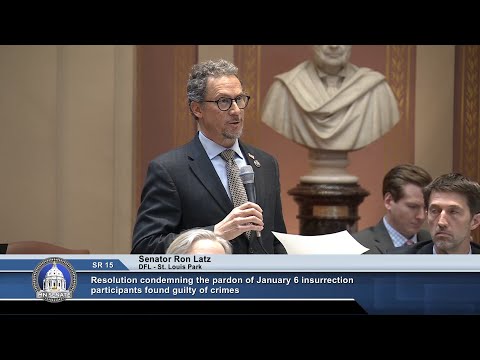
The Minnesota Senate spent hours debating Senate Resolution 15, which would formally condemn pardons issued by former President Donald Trump to people convicted or charged in the Jan. 6, 2021, attack on the U.S. Capitol.
The Minnesota Senate spent hours debating Senate Resolution 15, a measure that would formally condemn pardons issued by former President Donald Trump to people convicted or charged in the Jan. 6, 2021, attack on the U.S. Capitol.
Senator Ron Latz, the author of the resolution, said the pardons “undermined the very systems of government we are here to uphold” and framed the measure as the chamber’s available tool to condemn pardons for what he described as violent attacks on law enforcement and on democratic institutions. He told colleagues the pardons occurred “65 days ago” and said the resolution should stand as an official rebuke to those actions.
The debate turned sharply partisan as multiple senators argued both for and against a floor vote. Supporters emphasized the violence of Jan. 6 and the impact on officers; opponents said the measure was “political theater” that distracted from state-level priorities such as the budget, schools, and long-term care. “This is political theater,” Senator Crone said during floor remarks, criticizing the timing of the debate. Senator Julia Coleman, proposing and speaking for an amendment that condemned violence against law enforcement generally, said “violence against our brave men and women in uniform … should be condemned at every turn.”
Why it matters: While a state resolution carries no criminal or federal legal effect, SR15 would register the Minnesota Senate’s official statement on a high-profile federal act—pardons for those linked to Jan. 6—that supporters said affects law enforcement, public safety, and the rule of law. Opponents said the resolution diverts legislative attention from state budget work and other local priorities.
Key actions and amendments - An amendment (A25) that broadened the list of federal officials to whom the resolution would be transmitted was adopted on a roll call. The amendment added the President of the United States, the President and Secretary of the United States Senate, and the Speaker and Clerk of the U.S. House of Representatives in addition to transmission to Minnesota’s governor. The transcript records the A25 amendment as adopted (vote recorded as 37 ayes, 24 nays). The amendment was offered by Senator Lutz.
- An amendment (A29) adding explicit language condemning violence against law enforcement and reaffirming support for police was adopted unanimously on a recorded vote (64 ayes, 0 nays). The amendment was offered by Senator Coleman and described in debate as a statement that “violence against our brave men and women in uniform … should be condemned at every turn.”
- Multiple attempted floor amendments that sought to insert other subjects into the resolution—ranging from criticism of Governor Tim Walz’s 2020 handling of civil unrest, to allegations around the Feeding Our Future program, to federal pardons by other presidents—were repeatedly ruled not germane by the presiding officer and those rulings were appealed; several appeals were sustained (the transcript records the president’s rulings being upheld in roll calls during the debate).
- Earlier in the day the Senate agreed to take SR15 from the table so debate could proceed. The transcript records a motion to take the resolution from the table (moved and roll-called) with the secretary reporting 32 ayes and 29 nays on that motion.
- Late in the session Senator Murphy moved to lay Senate Resolution 15 on the table and requested a roll call. The transcript records the motion and the roll call being requested; the record included partial roll-call reporting but does not contain a complete, final tally in the provided excerpt. The legislative day then moved on to announcements and adjournment.
Discussion highlights and context - Supporters framed SR15 as a symbolic but important defense of law enforcement and democratic norms. Senator Latz read a summary of the Jan. 6 attacks and the scale of the subsequent prosecutions and argued the pardons crossed a line.
- Opponents repeatedly called the measure a diversion from Minnesota business, pointing to a projected state budget gap and citing constituent concerns about taxes, schools, and long-term care funding. Several senators said they would prefer state-focused resolutions or spending and policy work.
- The chamber repeatedly debated rules questions about germaneness—whether amendments addressed the same subject as SR15. Multiple points of order were raised and appealed; the presiding officer’s rulings that many of the competing amendments were not germane were sustained in recorded votes.
What the transcript does not show - The provided transcript excerpt does not include a final, complete roll-call result for the motion to lay SR15 on the table; the motion and roll-call request are recorded, and later business proceeded. The transcript does not record whether SR15 was finally adopted as a resolution on the floor.
Bottom line - The Minnesota Senate engaged in an extended, partisan floor debate over a state resolution condemning presidential pardons tied to the Jan. 6 attack. Lawmakers adopted at least two floor amendments—one broadening transmission of the resolution and another explicitly condemning violence against law enforcement—and repeatedly clashed over whether the chamber should spend time on the subject while the state faces budget and policy challenges. The transcript shows multiple roll-call decisions on amendments and presiding-officer rulings but does not contain a complete final vote on the resolution’s ultimate disposition in the excerpt provided.