Get Full Government Meeting Transcripts, Videos, & Alerts Forever!
Get email alerts on the Education Budget topic
No spam. Unsubscribe anytime.
GOP lawmakers push local control, warn governor's proposed K-12 cuts will hit special education and teacher pay
Summary
Republican legislators criticized Gov. Tim Walz's proposed education budget targets, saying proposed cuts and recent mandates are pushing some districts toward insolvency. Lawmakers outlined proposals for mandate relief and funding flexibility but did not take formal votes.
Republican lawmakers including Rep. Peggy Bennett, Rep. Ben Baker and Rep. Patricia Mueller criticized Gov. Tim Walz's proposed education budget targets and outlined a package of mandate-relief and funding-flexibility bills they said would protect schools and teachers.
The lawmakers said the governor's proposal would cut roughly a quarter-billion dollars from K‑12 programs and that districts are facing rapidly growing costs — especially special education — after a recent wave of mandates. They proposed delaying or allowing local school boards to waive mandates, expanding the ability of districts to transfer funds between accounts and prioritizing core academics.
An opening presenter said, "this self proclaimed education governor has proposed the largest cuts that I've seen of any of the governors I've worked with in my time down here," and accused the governor of asking for "250,000,000 in cuts to funding for our schools and children, while continuing to fund the priorities of the education department." That presenter also alleged the plan included "cuts to teachers pay and professional development, cuts to schools and education programs, cuts to services for children with special needs, denying textbook for school aged children, and more money for state bureaucrats to micromanage our schools." The presenter was not identified by name in the transcript.
Rep. Peggy Bennett, R‑23A, co‑chair of the House Education Policy Committee, said districts are "in crisis" and described the accumulation of recent mandates as pushing some toward what she called "statutory debt, which is, in the business world called bankruptcy." Bennett said many mandates were "not funded or not fully funded" and quoted a superintendent as saying the mandates were "torpedoes."
"Let them get their feet on the ground," Bennett said of the districts, urging "delay or allow schools through school board permissions to delay these mandates as needed" and arguing for funding flexibility so districts could "transfer dollars between accounts, which they can't do right now."
Rep. Ben Baker, R (vice chair of the Education Finance Committee) and a middle school principal, said he is seeing staffing impacts firsthand. "I have the privilege to serve the communities of Prior Lake Jordan, a portion of Shakopee and the surrounding townships," Baker said, and added that he was "coming off of just meeting with staff and telling them that their job is either cut or it is different next year." He told colleagues that local needs vary and argued the legislature should "trust our local school boards."
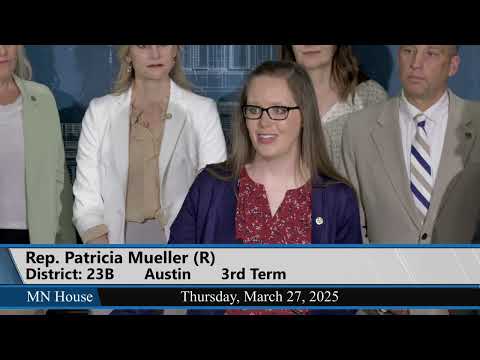
Rep. Patricia Mueller, R‑23B, a classroom teacher, highlighted specific areas she said would be affected by cuts cited in the discussion: special education, Q‑Comp (a teacher compensation and performance program), "non public pupil aid" that supplies textbooks or other materials to some nonpublic and homeschooled students, and charter school funding. "The cuts that we're talking about are not to our agencies. The cuts that we're talking about are special education, are to QCOMP, which is how some of our teachers are paid," Mueller said.
On mandates, a questioner asked which mandates the lawmakers would address first. An unidentified speaker replied that the "UI mandate" (unemployment insurance costs tied to summer employment) and the Universal School Lunch program — cited as a funding stream that can be locked into a particular use — were among the priorities. The speaker described the schools' difficulty as being that money can be "put in cookie jars" that districts cannot access without flexibility.
Speakers used differing figures for the governor's proposed cut. The opening presenter cited $250,000,000; later in the discussion one speaker said, "the governor's offered a $240,000,000 cut." The lawmakers described the broader state fiscal outlook in large numbers — one speaker said the state faces a "record breaking $6,000,000,000 deficit in 2 years" — attributing those figures to debate in the chamber rather than to a specific statutory estimate.
No formal action or vote on legislation occurred during the discussion. Lawmakers said committees have heard or will hear a "package of bills" aimed at mandate relief, funding flexibility and incentives for local innovation; Rep. Bennett and others said those bills will continue through committee consideration. The group urged faster negotiation with the governor and criticized the pace of the Senate's work.
The discussion centered on policy options rather than enacted changes: lawmakers repeatedly distinguished between discussion of proposals and formal action, and they urged the legislature to negotiate alternatives instead of leaving districts to make midyear staffing cuts. "We need to listen to our actual educators, the boots on the ground that do the work," Baker said.
Looking ahead, the lawmakers said they will press for bills that allow temporary delays or waivers of mandates, permit transfers across restricted fund categories and prioritize spending on reading, math and science. They did not identify specific bill numbers, formal motions or votes during the meeting.