Get Full Government Meeting Transcripts, Videos, & Alerts Forever!
Get email alerts on the Foia And Legal Guidance topic
No spam. Unsubscribe anytime.
County attorney advises Board of Equalization on FOIA, records, inspections and subpoenas
Summary
Sands Anderson attorney Andrew McRoberts briefed the Board of Equalization on the Virginia Freedom of Information Act, public-records retention, remote participation rules and limits on requiring interior inspections of appealed properties; he also discussed subpoenas and credibility assessments for witnesses.
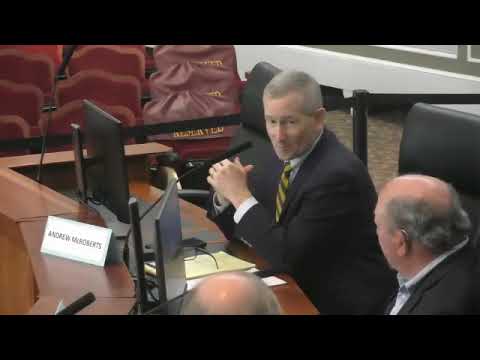
Andrew McRoberts of Sands Anderson, counsel representing the Board of Equalization, told members at the March 27 meeting that the Virginia Freedom of Information Act applies fully to the board and gave specific guidance on records, meetings and evidence.
McRoberts said the statutory definition of public records is broad: "If it's in your possession and it has to do with your public business, then it's probably a public record." He explained that notes taken by members are public records but, under records-retention rules, personal notes generally do not need to be retained permanently: "Notes are public records... but notes don't fall into any category under the Records Retention Act that need to be retained." The attorney and assessor's staff also said the Library of Virginia guidance allows the board to dispose of informal notes after the meeting unless a specific record-retention rule applies.
On closed sessions and attorney advice, McRoberts said the board may consult counsel in closed session under the statutory exception cited in the meeting: "Under 2.23711 a 8, you can go into closed session to receive the advice and consult your lawyer." He cautioned that some FOIA exceptions are limited and that virtual-participation requires an adopted remote-participation policy consistent with statute (the transcript cites 2.23708(0.3) as the related statutory framework).
McRoberts addressed whether the assessor or board may require interior inspections of homes as a condition of hearing an appeal. He said the board cannot condition an appeal on the taxpayer agreeing to an interior inspection or refuse to hear an appeal for lack of consent: "I think the answer is no... you do need to hear their appeal and you need to make a decision." He added that the assessor's office and the board may consider a taxpayer's refusal to provide requested information in assessing the weight or credibility of that party's evidence.
On evidence, testimony and credibility, McRoberts described the board as a "quasi‑judicial" body with authority to weigh witness credibility but not to impose criminal penalties for false testimony; criminal referrals would remain a matter for law enforcement or the commonwealth's attorney. He said members should disclose personal knowledge that might affect deliberations and that it is good practice to state such knowledge on the record to allow parties to respond.
McRoberts also confirmed that electronic communications about BOE business (emails, texts) are public records and advised members to limit such messages. Regarding subpoenas, he said the board likely has subpoena authority but the statutory process is not clearly laid out and he offered to research the precise procedure if the board wanted to pursue it.
Board members asked whether in‑meeting recollections between members (for example during lunch on the same day) could create an inadvertent meeting under FOIA; McRoberts advised caution: if three or more members discuss BOE business, that may meet the definition of a meeting and trigger FOIA notice and minutes requirements. He recommended erring on the side of avoiding such discussions when three or more members are present.
No formal votes were required for the attorney's guidance; board members asked to follow up on a written remote-participation policy and on the subpoena question.
The attorney's remarks are expected to guide how the county's assessor staff and BOE members handle record requests, remote appearances and evidentiary practice for the coming appeals season.