Get Full Government Meeting Transcripts, Videos, & Alerts Forever!
Get email alerts on the Small Farms Food Hubs topic
No spam. Unsubscribe anytime.
Small farmers and food‑hub pilots say local procurement can reduce hunger and stabilize rural economies but need long-term funding and land access
Summary
Farmers, food-hub operators and technical‑assistance providers described pilot projects that sell directly to food banks, schools and institutions; they urged state support for aggregation, land access and longer-term federal or state funding to scale the models.
California farmers and food-hub operators told the Assembly committees that regional procurement pilots and partnerships with food banks and institutions demonstrate both immediate food-access benefits and business opportunities for small and medium farms — but speakers said long-term funding and land‑access policies are needed to sustain and scale the efforts.
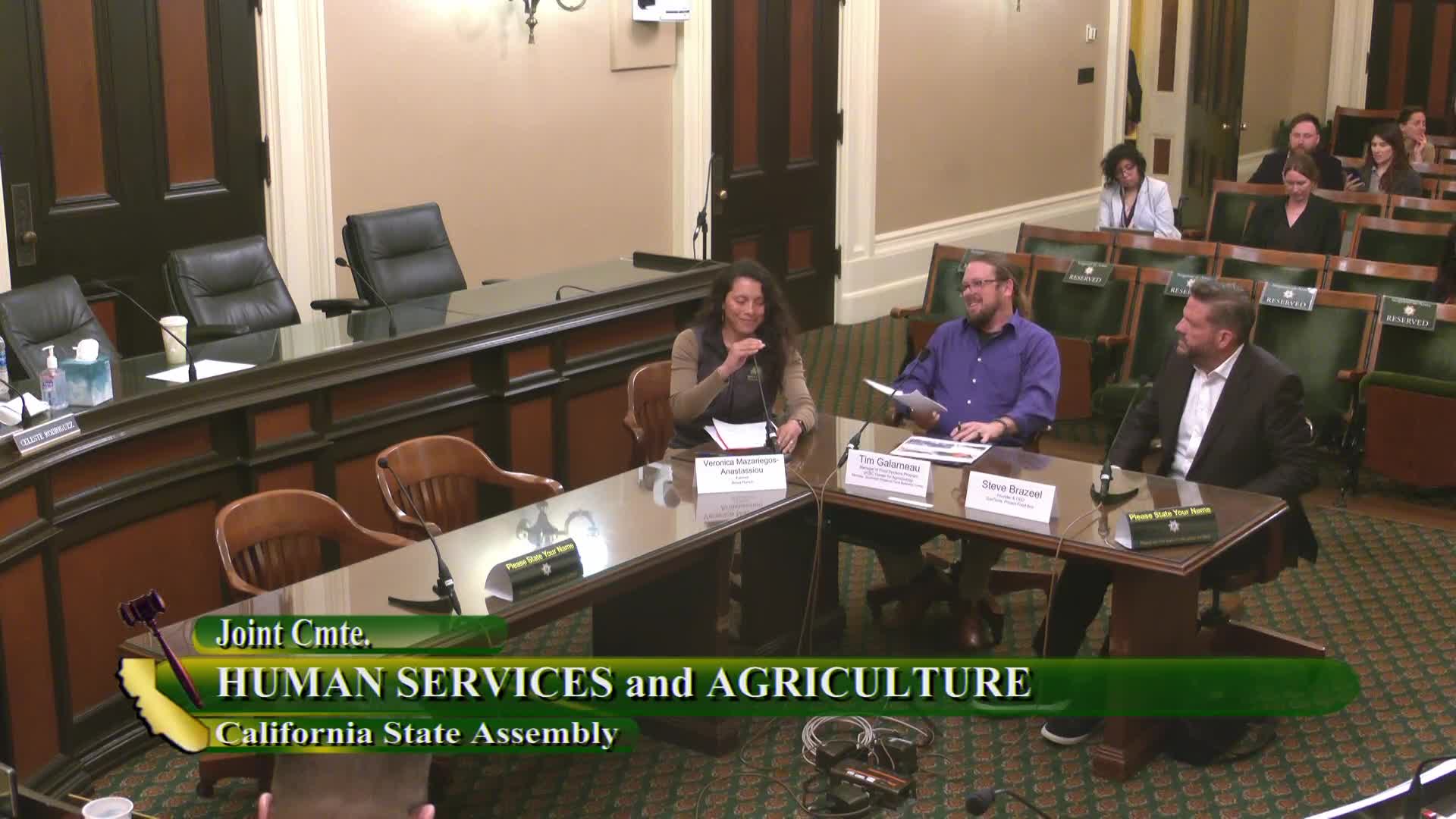
Veronica Masaryagos Anastacio, a Central Coast organic grower and co‑founder of a farmer‑led food hub, described a pilot that aggregated produce and sold directly to Bay Area food banks. "Our farms are well equipped to grow food for the diverse communities represented in our state because we are also part of those communities," she said. Anastacio described the Farms Together federal program (Local Food Purchase Assistance) as enabling early trials and called for a state equivalent after federal stop‑start funding.
UC and regional partners described technical assistance and small‑farm business‑builder awards from the USDA Southwest Regional Food Business Center and related state funds. Tim Gallardo of the UC Center for Agroecology said the regional center has supported more than 1,500 small and under‑invested farmers and launched dozens of market partnerships, and that California expects additional competitive grant rounds to support small producer aggregation and distribution.
A produce distributor and former farm-worker, Steve Brazil of Sunterra Produce, recounted how the USDA Farmers to Families Food Box Program during the pandemic forced industry‑nonprofit linkages that have endured: Sunterra contracted with dozens of nonprofits, supplied roughly 1,500,000 boxed distributions during the USDA program year, and later converted some of that capacity into ongoing relationships with food banks and Medi‑Cal plans, delivering medically tailored produce to members.
Speakers described barriers: long‑term land tenure, high costs of compliance for small producers (food‑safety and equipment requirements), irregular federal funding, and concentrated distribution markets that reduce farmers' price leverage. "One of the biggest challenges I have as a farmer is land tenure... We need to make it easier and more affordable for practicing farmers to buy land," Anastacio said. Panelists urged state support for low‑interest loans, aggregation investments, and expanded community‑food‑hub grants so that local procurement can scale without relying solely on unstable federal grants.
Committee members asked about opportunities to connect state procurement — from schools, higher education and Medi‑Cal contracts — to small‑farm supply chains; panelists said focused technical assistance, aggregation grants and procurement pilots can create reliable demand and keep more farm dollars in local economies.