Get Full Government Meeting Transcripts, Videos, & Alerts Forever!
Get email alerts on the Transmission Costs topic
No spam. Unsubscribe anytime.
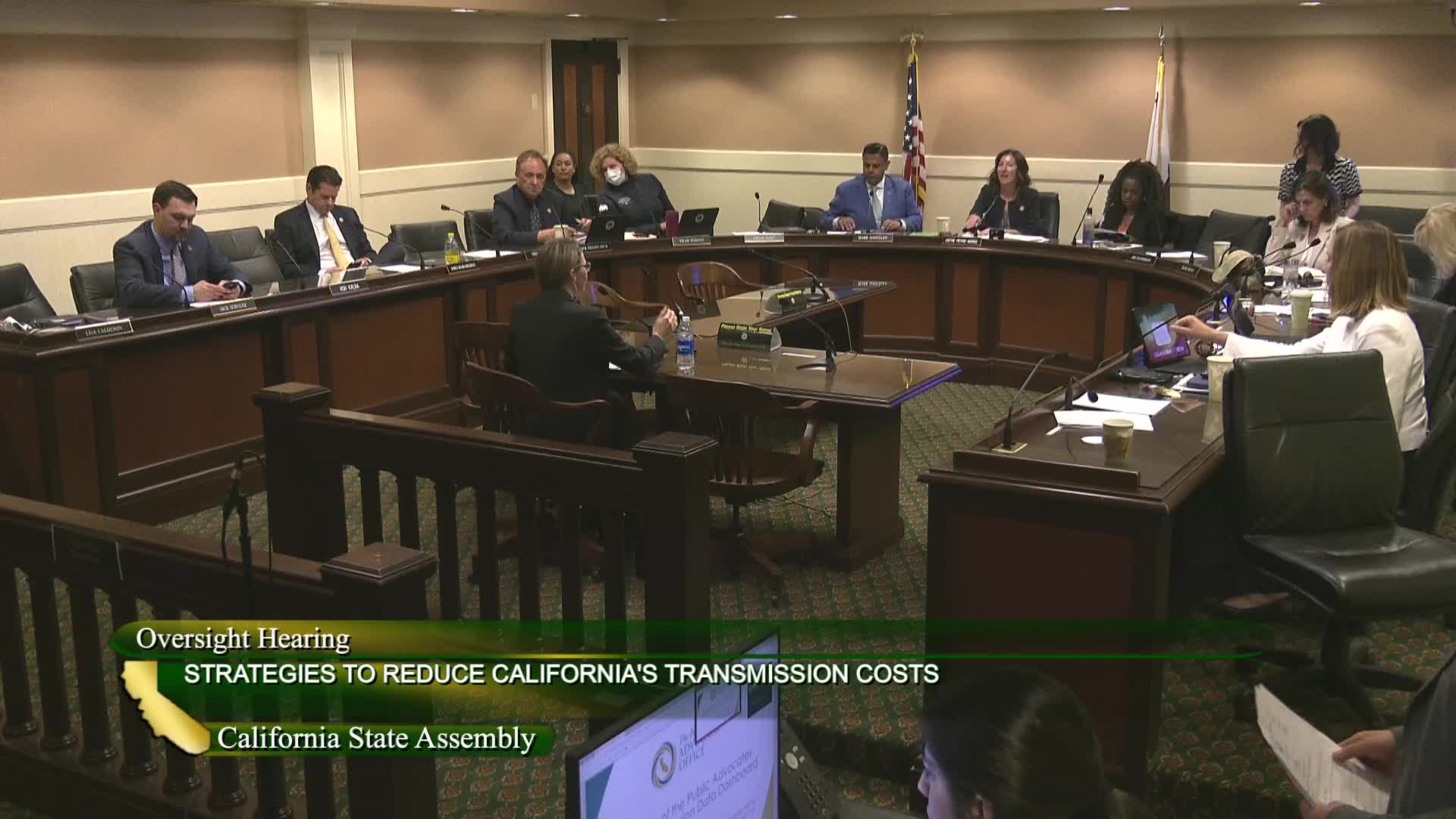
Assembly hearing: alternative financing, faster delivery could cut transmission costs; backlog and supply chains drive price risks
Summary
An informational hearing before the Assembly Utilities & Energy Committee reviewed California transmission needs, a growing backlog of approved projects, and proposals — including public financing and public-private partnerships — that witnesses said could sharply lower costs. Presenters estimated savings up to roughly $123 billion over 40 years
The Assembly Committee on Utilities and Energy held an informational oversight hearing titled “Strategies to Reduce California Transmission Costs,” where public advocates, consultants, utilities and private developers discussed the state’s transmission backlog, financing options, and causes of project delays. The session examined possible savings from alternative financing and practical barriers — from permitting timelines to supply-chain lead times — that are driving up costs.
Karen Haida (Public Advocates Office at the CPUC) opened the panel with a summary of the office’s transmission data dashboard. Haida said CAISO has approved dozens of projects that are not yet built, creating a backlog that is growing because approvals outpace construction. Key figures presented: roughly $19 billion in estimated cost to complete currently approved but unbuilt projects, an average transmission-project timeline of about 8.2 years, and a Transmission Access Charge (TAC) that has increased more than 3.5 times since around 2009. The Public Advocates Office is updating its dashboard with the most recent CAISO planning data and expects another release later in the summer.
Consultants and finance experts described several levers that could reduce costs. Denzel Hankinson (DH Infrastructure) and Neil Matuca (Net 0 California) presented analyses showing that combining public-sector financing (cheaper tax-exempt debt) with competitive project delivery could cut overall project costs substantially; their modeling estimated savings up to about 57% for competitively delivered lines financed with public debt, amounting to roughly $123 billion in avoided cost over 40 years for the portfolio modeled from CAISO’s outlook. Dan Adler, who previously worked on climate finance at the I-Bank, emphasized that derisking projects with public capital can allow a higher share of cheaper debt relative to expensive private equity and that structuring public finance as loans in a revolving fund multiplies impact.
Utilities and developers described operational barriers. Bill Manheim (PG&E) noted three pragmatic tools the IOUs have used to lower costs: federal loan guarantees, federal grant programs and public-private partnership (PPP) structures. PG&E is pursuing a PPP-style arrangement with Citizens Energy that would bring private capital and return funds to customers; the company said federal loan guarantees and grants have delivered measurable savings on projects that qualify. Matt Huber (San Diego Gas & Electric) described scheduling friction points: a pre-application phase after CAISO approval that can last multiple years while utilities and developers prepare full permitting applications, federal land agency resourcing constraints in regions with public land, long lead times for major equipment and internal resource constraints as many projects are queued simultaneously.
Labor and construction stakeholders said keeping crews on continuous work reduces cost overruns from repeated mobilization and demobilization. Ralph Armstrong (IBEW Local 1245) said the largest cost overruns come from starting and stopping projects and urged structuring work to sustain steady employment. Jack Wadley (EDP Renewables) said developers face long lead times for transformers and circuit breakers — quoted as multiple years in some cases — and costly land-carrying costs for projects that must secure acreage many years before interconnection work completes.
Panelists differed on ownership models and legal risks. Several analysts recommended lease-style PPPs — in which a public entity issues low-cost debt and leases the asset to a competitively selected private operator — as a promising hybrid that captures tax and financing advantages while leveraging private-sector construction expertise. Presenters warned that full state ownership raises concerns including inverse-condemnation liability for wildfires under California law and the fiscal and organizational challenge of creating a new state entity to own and operate transmission. PG&E and others noted tax-exempt ownership would reduce property-tax revenues that currently fund local governments.
Policy options discussed: (1) pilot a state revolving loan/green-bank fund or use IBank as a conduit to provide low-cost loans or loan guarantees for targeted transmission projects; (2) pursue competitive solicitations for construction to lower CapEx; (3) use federal loan guarantees and grant programs where eligible; (4) streamline the pre-application and permitting process with clearer timelines and more transparency; (5) encourage standardization and coordination to address long lead times for transformers and major equipment; and (6) consider targeted public ownership or PPPs for lines that are economically necessary but unattractive to private investors.
Why this matters: California’s clean-energy and electrification goals require substantially more transmission capacity; speakers said delays and rising costs for that infrastructure are a major driver of future rate increases. Committee members and witnesses agreed on the scale of the challenge and the need to align financing, project delivery and permitting to reduce cost and accelerate delivery.
Next steps: panelists urged piloting state financing tools and exploring revolving loan or bond-based approaches; committee members signaled interest in follow-up work on procurement, permitting timelines, equipment standardization and supply-chain resilience.
Quotes in this article come from witnesses who spoke in the committee hearing and are identified in the speaker list below.