Get Full Government Meeting Transcripts, Videos, & Alerts Forever!
Get email alerts on the Food Banks Calfood topic
No spam. Unsubscribe anytime.
California food banks warn loss of Cal Food and federal commodities will force closures and reduce variety
Summary
Food-bank leaders told the Assembly hearing that recent federal pauses and a planned state funding reduction for Cal Food would sharply reduce the network’s ability to buy California-grown products and keep food-distribution sites open.
Leaders from California’s food‑bank network told the joint Assembly hearing that recent federal program pauses and a planned reduction in the state Cal Food appropriation could significantly reduce the network’s purchasing power, force staff cuts and close distribution sites.
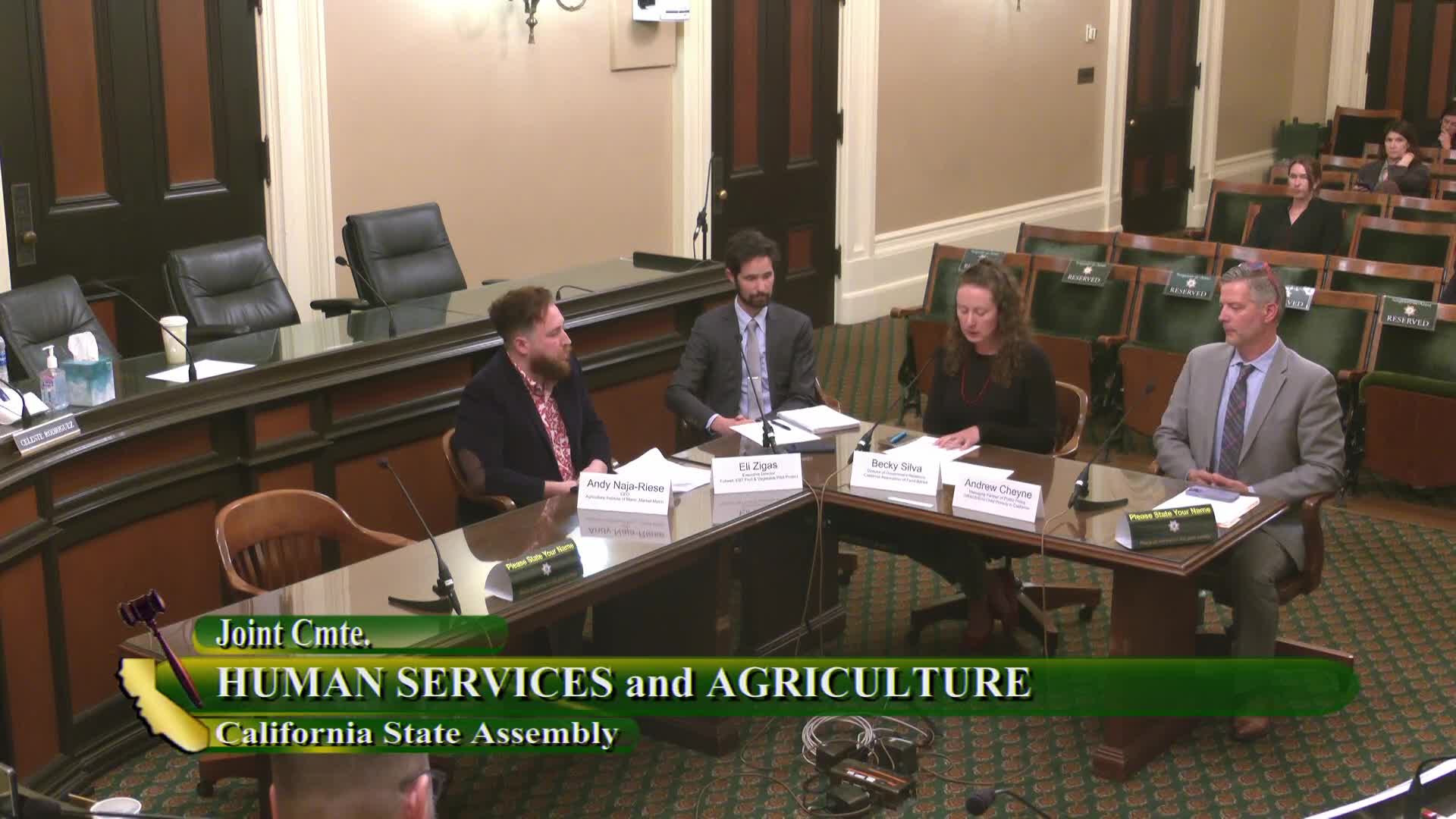
"This program [TFAP] over the last 3 months has seen around 300 truckloads of food either canceled or paused," Becky Silva of the California Association of Food Banks said, citing USDA commodity interruptions that have affected multiple food banks. Silva said the Los Angeles Regional Food Bank alone had more than 70 truckloads canceled or paused in the recent period.
Silva warned that Cal Food, a state program that lets food banks purchase California‑produced foods, has been funded at roughly $60,000,000 annually on average over the past three years but is scheduled to return to a baseline of $8,000,000 in 2025–26 unless the Legislature takes action. She said a simple survey of food banks found no viable "plan B" to replace that funding if it is not restored: "A third of food banks said that they would have to reduce their paid workforce, and 1 fifth of food banks said that they would have to close existing food distribution sites."
Food‑bank testimony emphasized that CalFresh and emergency distribution together meet many families’ needs. Silva noted that CalFresh benefits are small relative to current food costs: "CalFresh benefits average just $6.22 per day per person," she said, and argued for an increase in the minimum benefit and continued support for state purchase programs that allow local sourcing and choice.
Committee members and agency witnesses discussed contingency steps and urged continued state investment. Several members were asked to sign a budget letter supporting Cal Food funding and to coordinate with the Department of Social Services and CDFA to preserve local sourcing options for community distribution partners.
Food‑bank leaders also called for preservation of federal commodity and local‑purchase programs and asked the Legislature to consider state budget support if federal funding continues to decline.