Get Full Government Meeting Transcripts, Videos, & Alerts Forever!
Get email alerts on the Utility Rates Affordability topic
No spam. Unsubscribe anytime.
AB 99 advances amid debate: lawmakers weigh capping IOU rate increases above inflation
Summary
Assemblymember Ta introduced AB 99 to limit investor-owned utility rate increases to the rate of inflation except for narrowly defined exceptions; the committee passed the bill to Appropriations after contested testimony from utilities, labor and consumer advocates.
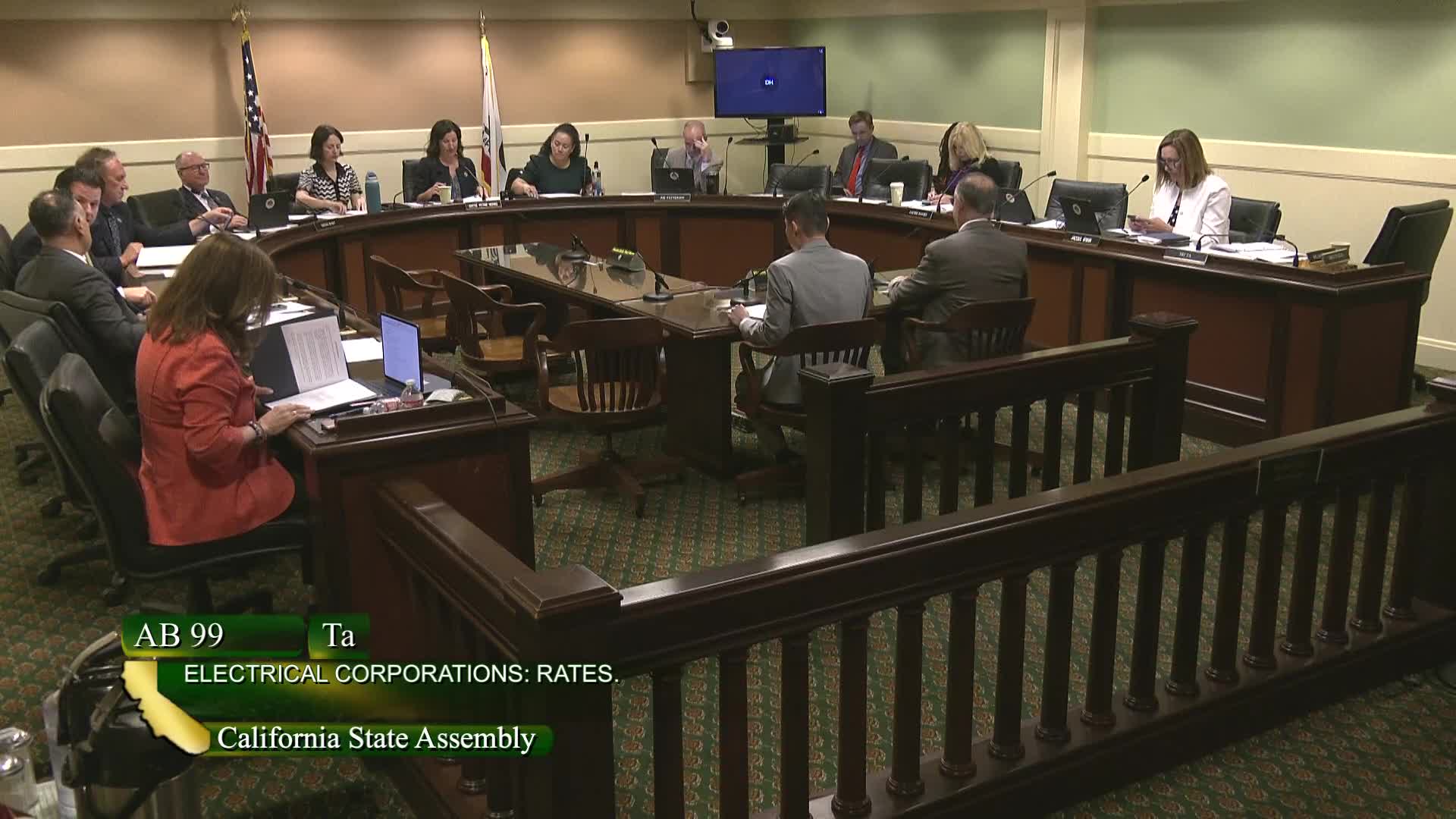
Assemblymember Ta presented Assembly Bill 99 to the Assembly Committee on Utilities and Energy, proposing a statutory mechanism to limit investor-owned utilities (IOUs) from raising rates beyond the rate of inflation, subject to specific exceptions for safety-related investments, modernization, and higher commodity or fuel costs.
Ta told the committee AB 99 is meant to protect vulnerable Californians, including seniors on fixed incomes, from rate increases that outpace inflation. “This legislation provides reasonable exception for costs directly related to safety enhancement, modernization, and higher commodity or fuel costs,” Ta said, and said the office would work to strengthen verification so exceptions were not abused.
Supporters included Jim Bohan of the California Senior Legislature, who told the committee that many seniors have been hit with steep electricity increases and that IOU rate requests have outpaced inflation over the last decade. Will Abrams, a wildfire survivor, said he opposed AB 99 as drafted because utilities should not be able to raise rates until wildfire victims are “fully and fairly compensated,” echoing concerns that compensation obligations interact with rate-making.
Opposition and concerns were raised by labor, utilities and business groups. Scott Wetsch, speaking for the California Coalition of Utility Employees, warned the bill could limit collective bargaining outcomes by constraining costs the utilities can recover. The California Chamber of Commerce and other business groups said AB 99 is a blunt instrument that would not account for large, demonstrable cost drivers such as wildfire mitigation, net-energy-metering (NEM) cost shifts and other legislative mandates. Utilities and labor also cautioned that the bill’s exceptions needed clearer treatment of labor and mandate-driven costs.
Committee members split along pragmatic lines: some praised the author’s focus on affordability and said the bill should be advanced to continue negotiating details; others said the bill’s cap approach was overly simplistic and risked unintended consequences by failing to account for real cost drivers. Assemblymember Erwin and others said advancing the bill was appropriate as a signal that affordability is a priority and to continue work with stakeholders.
A motion to pass AB 99 as amended to the Appropriations Committee was made and seconded; the committee recorded the measure as passed to Appropriations. The final roll call recorded 12 ayes, 1 no (Assemblymember Rogers), with several members not voting; the committee left the roll open for absent members to add later.
Why this matters: AB 99 seeks to impose a ceiling—indexed to inflation—on allowed IOU rate increases, with statutory carve-outs. Proponents framed the bill as essential consumer protection amid repeated rate increases; opponents said it risks underfunding required safety and climate investments without a careful way to handle mandated costs and labor obligations.
Details and context: Ta accepted a committee amendment during the hearing and said the office would continue to negotiate verification and exception language with stakeholders. Opponents urged more targeted reforms that address specific cost drivers (for example wildfire mitigation costs and the net-metering cost shift) rather than an across-the-board cap.
Next steps: AB 99 passed to the Assembly Appropriations Committee and will be subject to further hearings and negotiation; the author said he would continue talks with utilities, labor, environmental groups and committee staff.