Get Full Government Meeting Transcripts, Videos, & Alerts Forever!
Get email alerts on the Cdfa Programs Local Procurement topic
No spam. Unsubscribe anytime.
CDFA outlines state nutrition and procurement programs aimed at linking California farms to local food access
Summary
California Department of Food and Agriculture officials described incentive, refrigeration, farm-to-school, urban-ag and community-hub programs designed to increase access to healthy produce and strengthen local markets for growers.
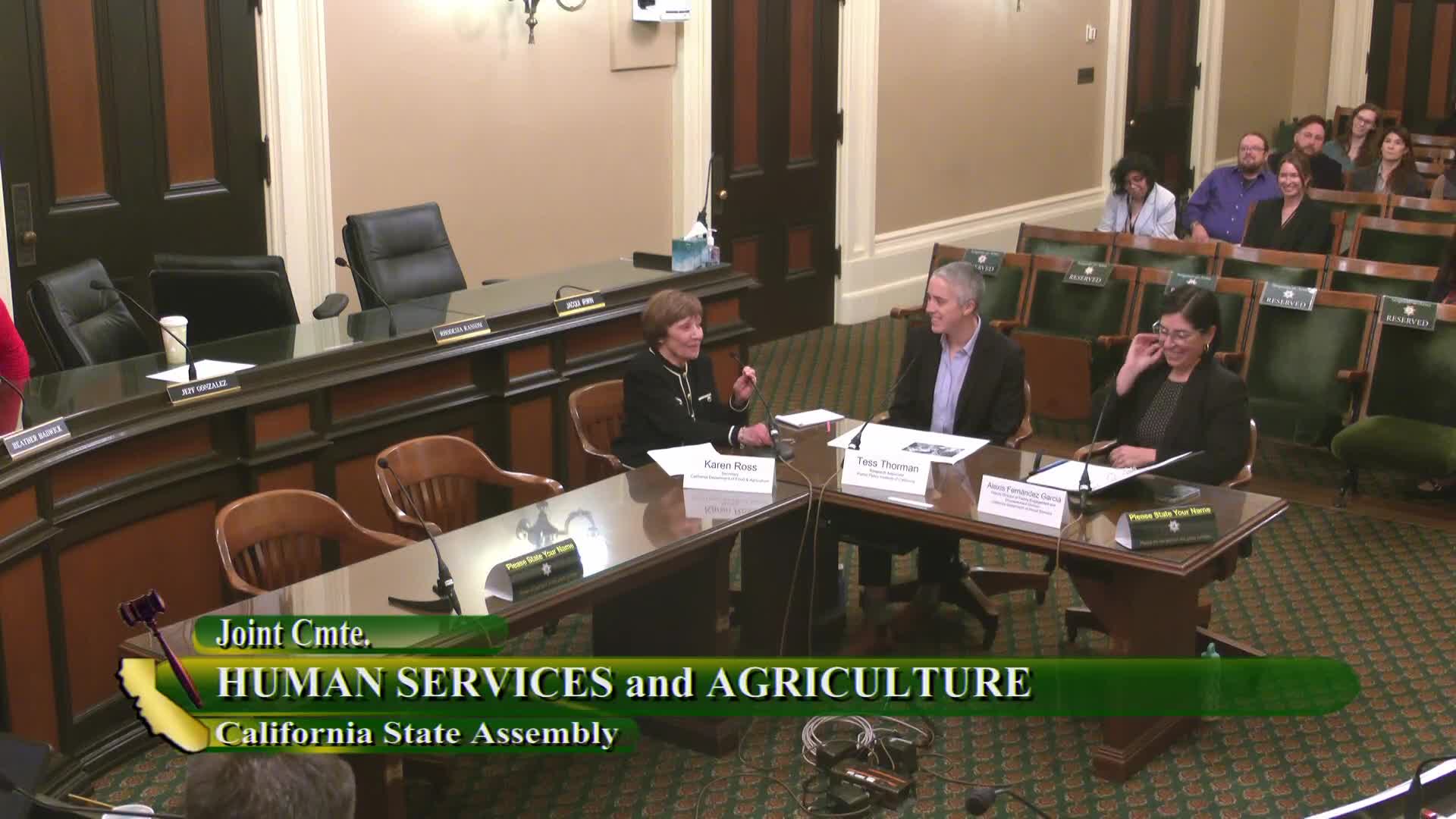
At the joint oversight hearing, California Department of Food and Agriculture (CDFA) officials described a portfolio of state programs they said are intended to pull federal nutrition dollars into local markets, strengthen small and medium farms and expand capacity to move fresh product into underserved communities.
CDFA Secretary Ross outlined a series of state initiatives that are designed to complement federal safety-net programs and to increase demand for California-grown produce. “We have been able to draw down over $35,000,000 in just recent years of federal dollars to match what we're doing here in the state,” Ross said, referring to the California Nutrition Incentive Program (CNIP) that matches federal incentive funding for farmers markets and corner stores. She also described the senior farmers market program — ‘‘a very small grant program of approximately $750,000 a year’’ — and said the department is working to expand on complementary programming.
Ross described a pilot healthy-refrigeration grant that funded refrigeration and mobile units to enable corner stores and mobile markets to sell fresh, perishable foods. She said two pilot rounds awarded roughly $4,500,000 the first time and $9,000,000 the second, and that demand “was oversubscribed.”
Other CDFA programs discussed included a $13,000,000 community food hubs grant to help aggregation and distribution for small farmers; a farm-to-school program supported with about $85,000,000 in state investment that connects districts and regional producers; and an urban-agriculture portfolio to support small plots, infrastructure and systems building, to which she said "we've had almost $12,000,000 go into that." Ross also described a tribal food-sovereignty start-up allocation of about $200,000 to support listening sessions and initial competitive grants.
CDFA staff emphasized the programs are intended to expand local procurement, increase farmers' market participation and create new market channels for small-scale producers. Sarah Hansen, who fields questions on incentive and market programs, said the California Nutrition Incentive Program shows measurable impacts on diet and local economies and can stretch families’ food dollars while channeling funds to local growers.
Legislators asked which programs show the highest return on investment and whether the department is coordinating across agencies; Ross and CDFA staff said they work closely with the Department of Social Services, Department of Public Health and local partners to connect procurement and incentive strategies to existing safety-net benefits.
CDFA officials and witnesses urged continued state funding to sustain and expand the programs, noting many are oversubscribed and depend on a mix of state and federal grants to operate.