Get Full Government Meeting Transcripts, Videos, & Alerts Forever!
Get email alerts on the Public Utilities Oversight topic
No spam. Unsubscribe anytime.
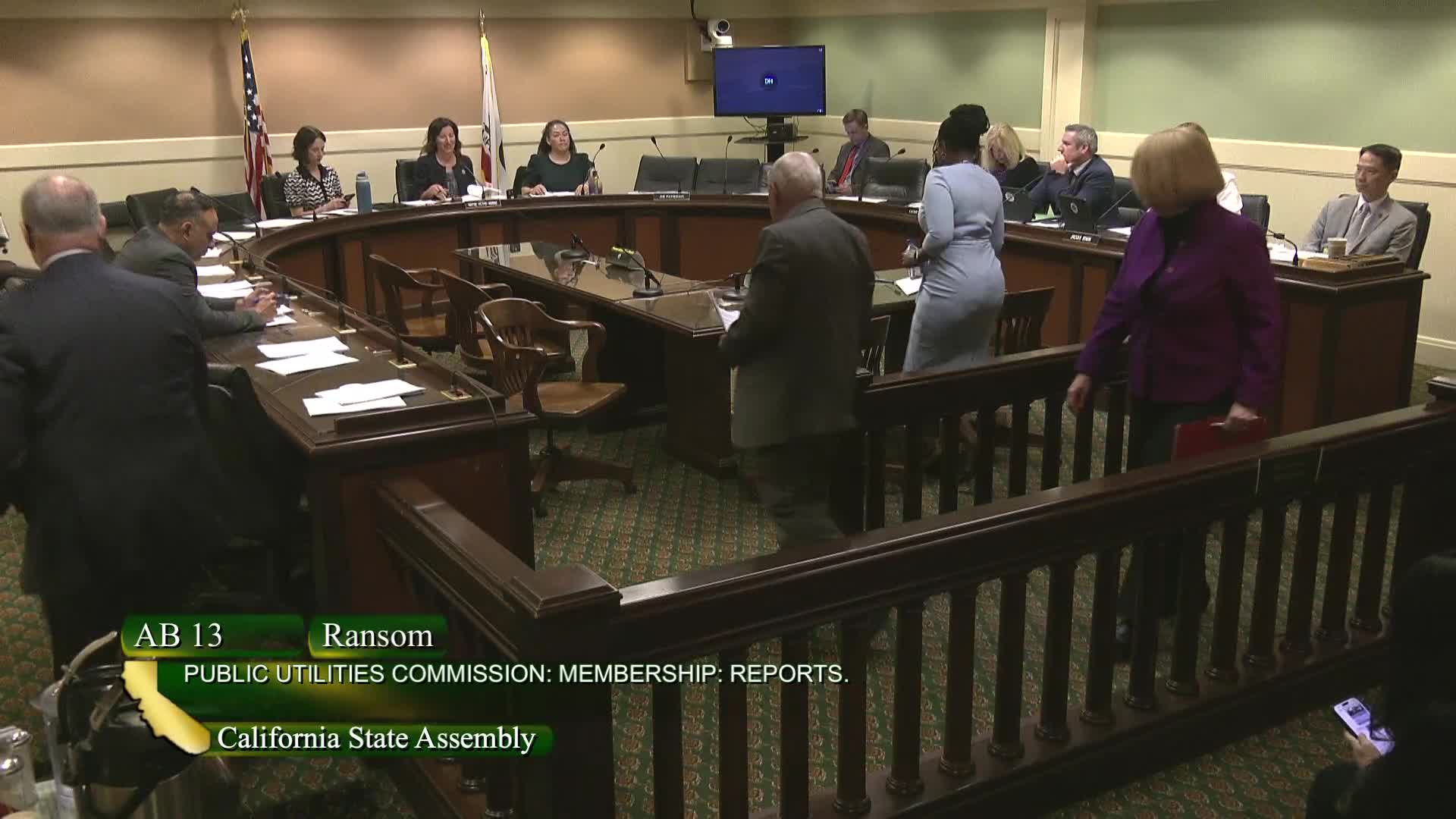
Assemblymember Ransom’s AB 13 aims to increase legislative oversight of CPUC; committee advances bill
Summary
Assemblymember Ransom introduced Assembly Bill 13 seeking to restructure the California Public Utilities Commission to expand geographic representation, add legislative liaisons and mandate faster, more specific reporting to the Legislature on rate-setting decisions.
Assemblymember Ransom introduced Assembly Bill 13 on the Assembly Committee on Utilities and Energy agenda, seeking to reorganize the California Public Utilities Commission (CPUC) to increase legislative oversight, require more detailed reporting on rate decisions and add geographic and public-interest representation to the commission.
Ransom told the committee Californians face “some of the highest utility costs in the nation” and said AB 13 would make the CPUC more accountable and transparent, including a requirement that the CPUC report to the Legislature within 15 days after finalizing a rate-setting decision. “We want them to be very specific about reporting out on rate affordability and pending rate decisions,” Ransom said during her presentation.
Supporters said the measure addresses a trust gap between consumers and the commission. Loretta Lynch, a former CPUC commissioner, testified the Legislature “has plenary control” through Article 12, Section 3 of the California Constitution and argued that legislative liaisons would let lawmakers act within the short windows — including a 30-day rehearing window — when meaningful oversight is possible. Jeff Shields, a former utility CEO, told the committee he supported the bill as a first step to correct what he called “regulatory capture” at the CPUC and to improve treatment of consumer advocates.
A range of organizations offered testimony. Will Abrams, who identified himself as a wildfire survivor, and the San Joaquin County Board of Supervisors’ representative Clifton Wilson spoke in support. Utility Reform Network (TURN) said it was neutral and working with the author toward support. San Diego Gas & Electric said it was “support if amended” and was negotiating with the author.
Committee discussion acknowledged broad bipartisan interest in PUC reform while several members asked for further detail on specific provisions and implementation. Assemblymember Davies said geographic representation could help commissioners hear from communities across the state; Assemblymember Zipper and others said they supported reform but wanted more time to work through structural questions such as the suggestion to align CPUC commissioner districts with Board of Equalization–style districts.
The committee carried the bill forward. A motion to pass AB 13 to the Appropriations Committee was made and seconded; the committee roll call recorded the measure as passed to Appropriations. The committee left the roll open for absent members but later confirmed the vote and clerical rolls recorded the final tally as 18 ayes, 0 noes.
Why this matters: the CPUC sets rates and rules that affect residential and commercial customers across California. AB 13 would not itself set utility rates but would change how the commission is staffed and overseen, and would require more timely reporting to the Legislature after rate decisions, which supporters say would increase transparency and could enable legislative action within statutory rehearing windows. Opponents asked for more detail about how new reporting and liaison roles would function and how the change would interact with existing CPUC procedures.
What the bill would require: among the items Ransom described in committee, AB 13 would (as presented in the hearing) seek geographically diversified commissioner seats, authorize appointment of one non-governmental public advocate with a public-interest-law background, add legislative liaisons from the Assembly and Senate to improve real-time communication, and require clearer, more specific reporting from the CPUC on pending and finalized rate matters — including a 15-day notice to the Legislature after finalizing a rate-setting decision. The bill text and committee analysis contain more detail on the exact statutory changes.
Details and context: committee staff noted the CPUC’s existing reporting and the complexity of CPUC proceedings; supporters said their changes are intended to improve the Legislature’s ability to respond to constituents during short statutory windows. Jeff Shields and Loretta Lynch described intervener compensation and other procedural areas where consumer advocates feel disadvantaged; TURN told the committee it was neutral while it worked with the author to improve language.
Next steps: AB 13 passed the committee and will go to the Assembly Appropriations Committee for further consideration and potential amendments. The author and stakeholders signaled ongoing negotiations to refine language and implementation details.
Speakers quoted in this article are drawn from the committee hearing transcript and identified in the article’s speaker list.