Get Full Government Meeting Transcripts, Videos, & Alerts Forever!
Get email alerts on the Nutrition Policy Snap Calfresh topic
No spam. Unsubscribe anytime.
California lawmakers, agencies warn proposed federal SNAP cuts would worsen hunger and ripple through state food system
Summary
At a joint Assembly hearing, state officials, advocates and food-bank leaders said proposed federal cuts to SNAP and related programs would increase hunger, reduce demand for California-grown food and risk job losses across the food economy.
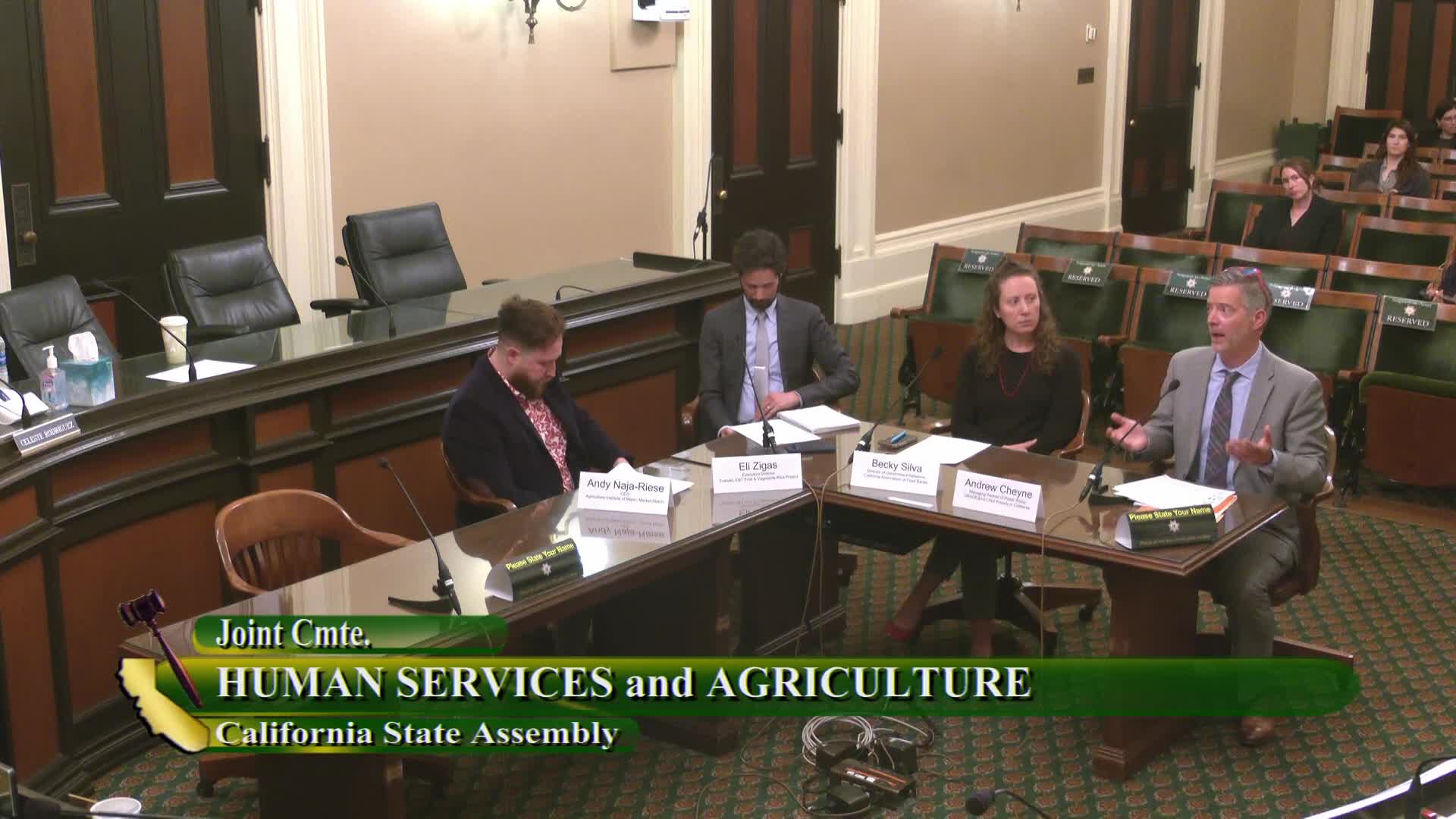
At a joint oversight hearing of the Assembly Human Services and Agriculture Committees, state officials, advocates and food-bank leaders warned that proposed federal reductions to SNAP and other nutrition programs could sharply increase hunger in California and harm the state's agricultural and food-distribution sectors.
Advocates said the scale of the possible federal cuts is large and would have downstream effects across jobs and markets. "There is a threat of $230,000,000,000 federally, nationally over the budget window, $30,000,000,000 shared to California," said Andrew Shane of GRACE and Child Poverty California, summarizing proposals being discussed in Congress and their projected national and state impacts. He added that "every billion dollars in benefits is 13,560 jobs according to USDA," and warned that cuts would translate to substantial employment losses in agriculture, trucking and retail.
The state's food-safety-net administrators described the current scale of benefits and participation but cautioned that federal policy changes could undo recent gains. "We currently provide about $1,100,000,000 in federally funded food benefits to over 5,500,000 Californians a month," Alexis Fernandez Garcia, deputy director at the Department of Social Services, told the committees. She and other speakers emphasized that CalFresh (California's SNAP program) is federally structured and that state efforts focus on maximizing participation and supplementing federal dollars where possible.
Food-bank leaders said federal pauses and cancellations of commodity shipments are already constraining emergency distribution. "TFAP has seen around 300 truckloads of food either canceled or paused," Becky Silva of the California Association of Food Banks said, describing recent interruptions to The Emergency Food Assistance Program (TFAP). Silva added that the state's Cal Food program — a state funding stream that lets food banks buy California-grown products — will fall from an average of about $60,000,000 per year over the last three years to $8,000,000 per year unless restored in the budget, a cut she called likely to force closures of distribution sites and reductions in paid staff.
Speakers repeatedly linked potential federal cuts to broader community impacts. Advocates pointed to research and administrative data showing that SNAP and related programs reduce food insecurity and poverty, and that reductions in benefits ripple through farm demand and local economies. "If CalFresh funding is taken away through SNAP cuts, we will see grocery store closures in rural areas, less market demand for farmers and disruptions in food distribution," Shane said.
Legislators and advocates at the hearing asked state agencies to track federal proposals and to consider state-level steps — including outreach to improve participation among underrepresented language groups and continued state investments where federal funding declines. Several members signaled plans to coordinate budget letters and requests for state funding to backfill losses should cuts occur.
The hearing underscored the interdependence of federal nutrition policy and California's agricultural, retail and emergency food systems, and participants urged continued state action to protect benefit levels and access while the federal picture remains unsettled.