Get Full Government Meeting Transcripts, Videos, & Alerts Forever!
Get email alerts on the Film And Television Tax Credit topic
No spam. Unsubscribe anytime.
Senate oversight hearing examines governor's $750 million film and TV tax credit amid budget trade‑offs
Summary
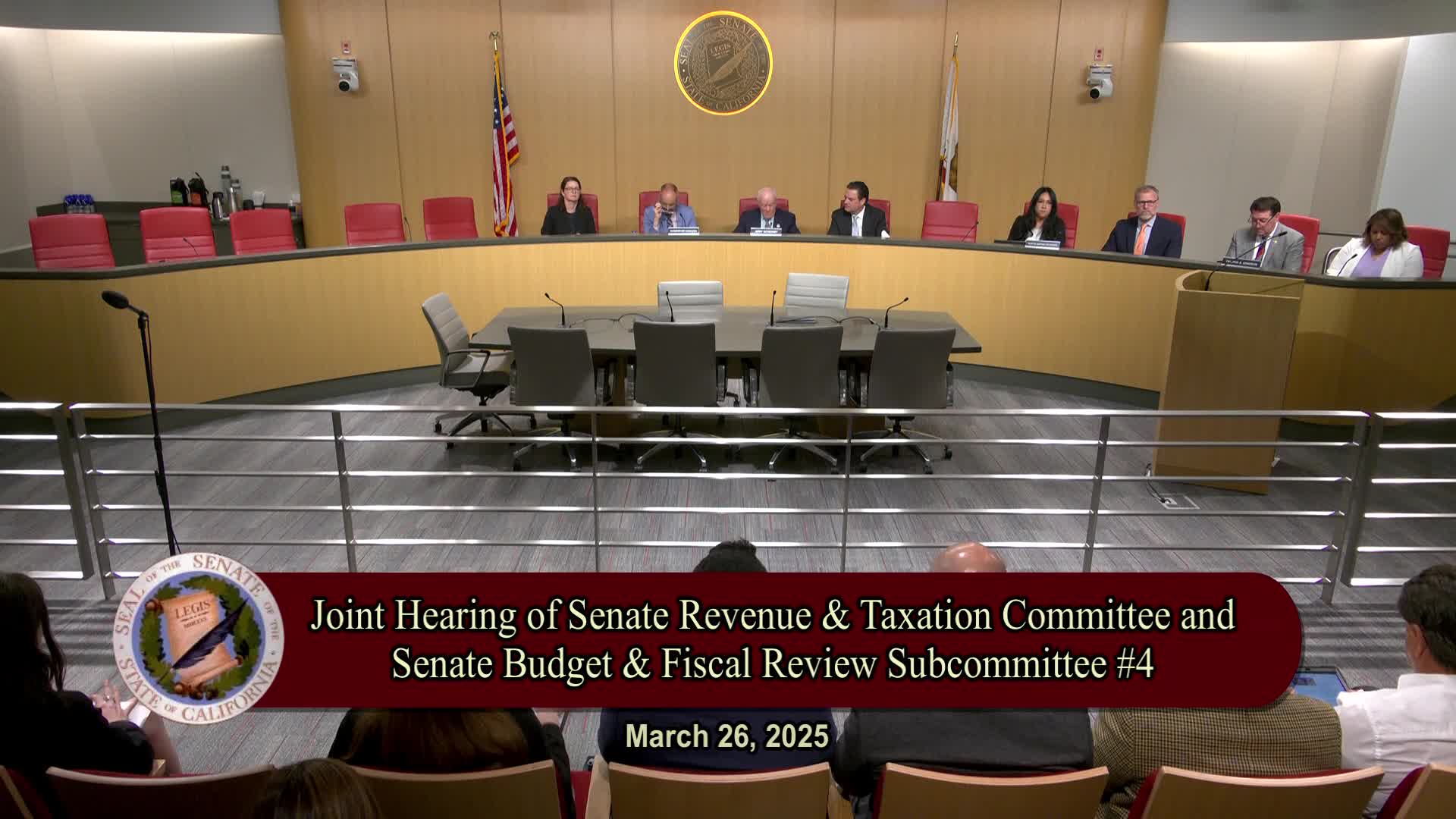
A California State Senate joint oversight hearing on Oct. 27 drew state officials, budget analysts, industry executives and union leaders to examine Gov. Newsom’s proposal to raise the Film and Television Tax Credit authorization to $750 million a year.
A California State Senate joint oversight hearing on Oct. 27 drew state officials, budget analysts, industry executives and union leaders to examine Gov. Newsom’s proposal to raise the Film and Television Tax Credit authorization to $750 million a year.
The governor’s Office of Business and Economic Development and the California Film Commission urged the increase, saying larger allocations are needed to keep production and middle‑class union jobs in California. Budget analysts and policy researchers warned the expansion would create ongoing budget pressure and recommended stronger fiscal benchmarks and reporting. Labor and industry witnesses described local economic and workforce harm from recent production declines.
“At $750,000,000, we are proud to bring forward this proposal to increase the film and television tax credit program,” Lauren Greenwood, deputy director of legislative and external affairs at Go‑Biz, said in her opening statement. Greenwood told the panel that the administration proposed the increase to help California capture more of a global entertainment industry it estimates at $660 billion.
Colleen Bell, director of the California Film Commission, told senators the program has returned money to the state in the form of jobs and activity. “Since its inception, our film and television tax credit program has generated over $26,000,000,000 in economic activity and more than 197,000 jobs with health and pension benefits,” Bell said.
The Legislative Analyst’s Office (LAO) agreed the credit is effective at attracting activity but urged caution about claims that it grows the overall California economy. “This proposal would make California’s credit the most generous among programs that have a cap,” Rowan Isaacs, an LAO economist, said; the LAO estimated the current tax‑credit program increases in‑state spending by about $1.5 billion a year after adjusting for windfall effects and other methodological factors.
Kayla Kitson of the California Budget and Policy Center focused on tradeoffs if the Legislature commits ongoing state dollars amid projected deficits. “Given the current budget situation and the threats of drastic federal cuts... it’s imperative that policymakers do consider alternative uses of the funds that are proposed to be added to the film credit program,” Kitson said, listing examples such as multifamily housing, homeless housing assistance and health‑care workforce investments.
Administration witnesses said the proposal is meant to restore competitiveness after states and countries with generous or uncapped incentives drew projects away. TJ Creighton of the Department of Finance said the structure of California’s program — a competitive, jobs‑based application process that focuses on below‑the‑line spend — differs from uncapped, first‑come programs elsewhere and helps target state benefits.
Industry and labor witnesses described local effects of the slowdown. John Prabhu, co‑owner of LA North Studios, and Alex Aguilar, business manager and secretary‑treasurer of a statewide entertainment union coalition, described falling hours, lost health coverage and shuttered small businesses. “Between 2022 and 2024, the motion picture pension and health plans reported a loss of 35,000,000 hours. That’s the equivalent of 17,000 jobs,” Aguilar said.
Speakers and witnesses disputed the magnitude of the program’s return to the state. The LAO cited academic literature and evaluations of other states showing mixed or limited evidence that incentives provide net fiscal benefit, while industry analysts and economic impact studies presented higher multipliers — including an LAEDC estimate cited in testimony that each credit dollar generates $24.4 in economic activity.
Committee members asked for further detail about which applications sit just beyond the current funding line and how marginal increases in authorization would translate to additional qualified projects, jobs and tax receipts. Several senators said they want clearer program benchmarks, stronger reporting on workforce and diversity outcomes, and independent or third‑party verification of project completion and demographic reporting.
Witnesses described existing oversight steps: the California Film Commission requires third‑party audits to verify production spend and jobs claimed, and projects are subject to Franchise Tax Board audit when credits are claimed. Lawmakers pressed agencies to further tighten reporting of local hiring, trainee placements tied to state‑backed credits, and county‑level economic impacts.
No formal action was taken at the hearing. Committee chairs referred technical and fiscal follow‑up to Budget Subcommittee No. 4, which will consider the governor’s budget proposal in the regular budget process.
Why it matters: The tax‑credit expansion sits at the intersection of economic development, workforce policy and the state budget. Supporters argue the increase is needed to stop “runaway production” and preserve thousands of union jobs and small business revenue across California. Critics say the state must weigh the program’s fiscal cost against other urgent needs amid projected deficits and uncertain federal funding.
The committee hearing produced bipartisan recognition of the industry’s cultural and economic importance, but significant analytical disagreements remain about the size of the program California should authorize and the fiscal tests the Legislature should require before making the authorization ongoing.
Next steps: Budget Subcommittee No. 4 will consider the fiscal proposal during the budget process; committee members requested more detailed data on unfunded applications, applicant profiles just beyond the funding threshold, and options to strengthen trainee and local‑hire requirements tied to credit awards.