Get Full Government Meeting Transcripts, Videos, & Alerts Forever!
Get email alerts on the Agriculture Waste Management topic
No spam. Unsubscribe anytime.
Assembly committee advances bill allowing routine composting of livestock carcasses
Summary
The Assembly Agriculture Committee advanced AB 411, sponsored by Assemblymember Pappan, to allow routine on‑farm composting of livestock carcasses outside declared emergencies. Supporters cited university research and reduced predator attraction; rendering industry representatives urged narrow amendments to protect existing services.
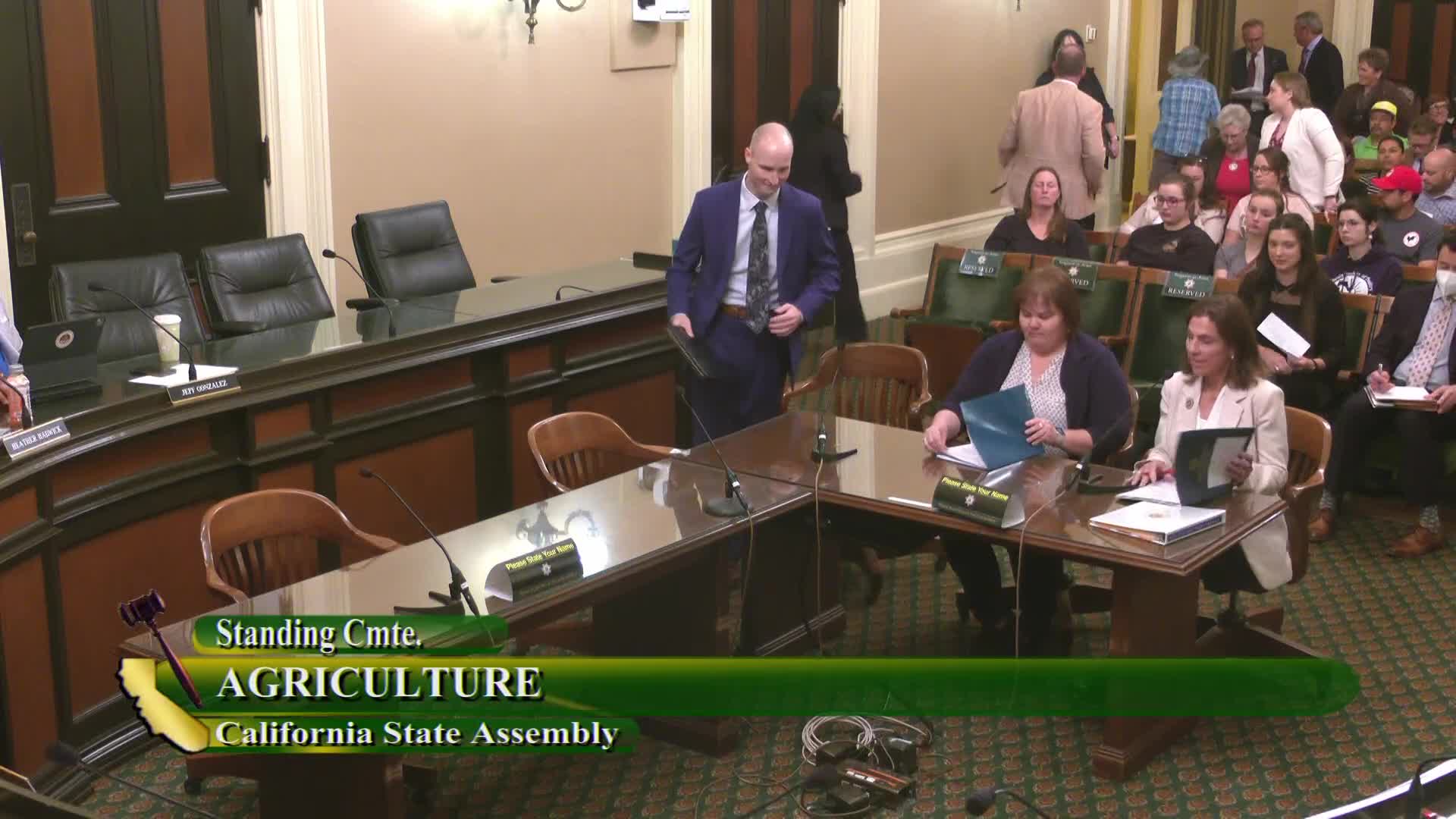
Assemblymember Pappan presented AB 411 to the Assembly Agriculture Committee, saying the bill would allow ranchers and small-scale meat processors to compost routine livestock mortalities on their property rather than relying on limited rendering, burial, or bone‑pile disposal methods. The committee voted to refer the bill to the Natural Resources Committee.
Supporters told the committee the change would give rural producers a practical, lower‑cost disposal option and could reduce predator conflicts. Dr. Casey D'Atlee, an associate professor and rancher who testified in favor of the bill, said, "composting whole carcasses or butcher waste can be done in 90 or 45 days respectively using materials and equipment that ranchers already have access to." She described multi‑site research conducted under agency exemptions and said the compost product did not accumulate heavy metals or pathogens in the trials. Kirk Wilbur of the California Cattlemen's Association, a cosponsor, said composting can reduce conflicts between livestock and predators and support regenerative practices.
Representatives of the rendering industry opposed the bill as drafted unless amended, citing worker and plant impacts and the industry's role in processing carcasses into animal feed, fertilizer and industrial products. Michael Koehler, president of Sacramento Rendering Company, said the industry had been designated critical infrastructure and urged limiting the bill to producers without rendering access and ensuring oversight by the Department of Food and Agriculture (CDFA).
Committee members acknowledged the benefits for rural producers and the concerns raised by rendering representatives and local regulators. The motion to pass AB 411 to the Natural Resources Committee carried on a roll call vote recorded as Soria (Aye), Alanis (Aye), Aguiar‑Curry (Aye), Connolly (Aye), Gonzales (Aye), Hadwick (Aye), Ransom (Aye). The secretary recorded the outcome as do pass to Natural Resources Committee (mover: Vice Chair Alanis; second: Assemblywoman Hadwick).
The bill's supporters asked the committee to consider standards, oversight and training for on‑farm composting to address pathogen control, and opponents asked for geographic or service‑coverage limits and CDFA oversight. The author and stakeholders said they will continue discussions on amendments before subsequent hearings.
AB 411 now moves to the Natural Resources Committee for further consideration.