Get Full Government Meeting Transcripts, Videos, & Alerts Forever!
Get email alerts on the Corrections Reentry topic
No spam. Unsubscribe anytime.
Michigan MDOC outlines ‘offender success’ programs, responds to recent facility audits
Summary
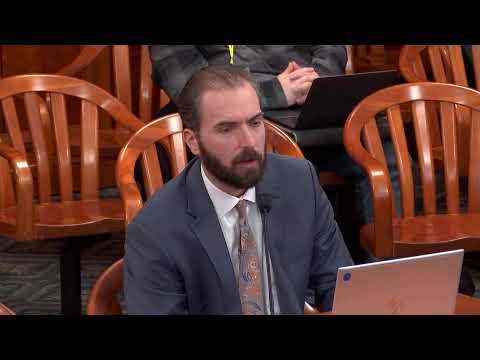
The House Appropriations Subcommittee on Corrections and Judiciary heard a detailed briefing on Oct. 27, 2025, from Kyle Kaminski, vendor success administrator and legislative liaison with the Michigan Department of Corrections, on the department’s Offender Success (OS) programs, budget lines that fund reentry services and education, and the department’s response to recent Auditor General facility audits.
The House Appropriations Subcommittee on Corrections and Judiciary heard a detailed briefing on Oct. 27, 2025, from Kyle Kaminski, vendor success administrator and legislative liaison with the Michigan Department of Corrections, on the department’s Offender Success (OS) programs, budget lines that fund reentry services and education, and the department’s response to recent Auditor General facility audits.
Kaminski told the subcommittee that OS combines several targeted programs operating at different stages of the felony criminal‑justice process and that the combined approach has coincided with declines in prison intake and recidivism. "We want safer communities, safer neighborhoods," Kaminski said, adding that the department’s mission centers on preparing people for self‑sufficiency through employment and skill building.
The department presented comparative data showing statewide improvement on several measures between the early 2000s and 2023: a three‑year recidivism measure fell from about 43 percent for releases tracked in 2003 to 22.7 percent for releases tracked in 2020; the number of new‑sentence "pro violators" dropped from roughly 1,600 to under 600, Kaminski said. He cautioned that cross‑state comparisons are imperfect because states measure recidivism differently, but said Michigan’s measure places it among the better performing states using the common metric.
Kaminski outlined the principal budget lines that support OS staffing and programs. The offender success services line funds most OS staff (in‑reach staff who do intensive planning in the final 60 days before release, central office staff, and related curriculum and licensure costs). MDOC education carries roughly 270 FTEs and about $40 million in annual expenditures, Kaminski said; prisons operate academic and career and technical education (CTE) programs, and the state now runs three immersive vocational "villages" in Ionia, Jackson and Ypsilanti. Postsecondary college programming operates through memoranda of understanding with external colleges and universities; Kaminski said there are 12 programs (about 14 partner institutions) and that Pell Grant eligibility has supported expansion.
Community supports for parolees are funded through a separate "offender success community partners" line. The state is divided into 10 regions for that contract work; each region selects an administrative agency, and contracts are performance‑based, Kaminski said. Housing is the largest single cost for parolees: roughly one‑third of individuals leaving prison do not initially have their own housing and the state seeks to place them in transitional placements generally expected to last fewer than 90 days, with regional variation.
Other budget items Kaminski listed include: community residential services (budget language calls it "probation residential services") with a FY25 provider reimbursement set at a $200 initial assessment and $70 per day; an offender success programming line of about $15.5 million that funds community‑based sexual‑offender treatment and health‑services reintegration contracts (internal referral codes D47 for higher mental‑health planning and D48 for higher physical‑health needs); and a criminal‑justice reinvestment line of roughly $2.5 million for evidence‑based pilots and data tools. He also described one‑time and smaller grants referenced in the budget, including funding for the Thumb Educational Center expansion.
On education, Kaminski said roughly 13,000–15,000 people participate annually in correctional education across the system and 9,000–10,000 program completions are typical. He described the vocational villages as high‑touch CTE settings where students remain in classroom/work simulations most of the day and where employer partnerships (examples cited: DTE, Meijer, Ford) support credentialing and placement.
During Q&A, members asked about county‑level replication. Kaminski said some components are already run at the county level through the community corrections program (he cited PA 511 of 1988 as the statute creating that program) and pointed to Muskegon County’s diversion program as an example of a successful local effort. He urged counties to adopt evidence‑based curricula and coordinate with state programs.
The briefing also addressed three facility audits released by the Auditor General earlier that week. Representative Cabot and Representative O'Neil raised concerns; O'Neil noted staffing pressures and retention challenges. Kaminski acknowledged the Auditor General’s findings related to custodial and security practice inconsistencies and said the department "agrees that those findings are problematic." He said MDOC is applying lessons from the facility audits across all 26 facilities, expanding internal quality‑assurance checks, and reviewing supervisory roles so front‑line supervisors can spend more time on coaching and training. Kaminski said some audit instances included documented activities that could not be corroborated on review and that those cases were referred for investigation and potential discipline.
Two routine procedural actions recorded by the subcommittee were approved without objection during the meeting: Representative O'Neil’s motion to approve the minutes of the March 20 subcommittee meeting was approved; Representative Cabot’s motion to excuse absent members was approved by voice without further roll call.
The department’s presentation and the audit discussion left the subcommittee with a picture of a multi‑pronged reentry approach that state officials say is associated with reduced prison intake and lower measured recidivism, and with an acknowledged set of operational shortcomings at some facilities that MDOC has pledged to address.
Looking ahead, Kaminski described ongoing projects with external partners — including the Thumb Educational Center building renovation (under DTMB design selection) and continued rollout of updated curricula developed by the University of Cincinnati — and invited legislators to graduation events for postsecondary programs.