Get Full Government Meeting Transcripts, Videos, & Alerts Forever!
Get email alerts on the Cub Credit topic
No spam. Unsubscribe anytime.
Committee hears proposal for 30% 'CUB' credit to convert underutilized buildings into housing and other uses
Summary
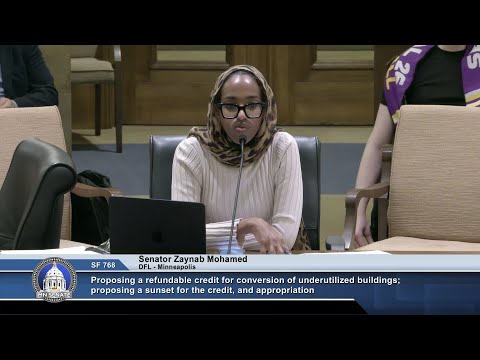
Senate File 768 (the "CUB" credit) would create a 30% tax credit or grant for qualifying conversions of underutilized buildings to housing or other uses; the committee adopted an amendment and laid the bill over after testimony from developers, municipal leaders and labor groups.
Senate File 768 (the "CUB" credit, for Catalyzing Underutilized Buildings) would create a new tax credit or grant equal to 30% of qualifying conversion expenses for eligible projects that repurpose underutilized buildings. The committee adopted an A‑1 amendment by voice vote and laid the bill over for further consideration after substantial testimony from developers, municipal leaders, labor representatives and nonprofit groups.
Under the bill text presented to the committee, key provisions include: applicants must file with the commissioner of deed before a conversion begins; the commissioner may charge application fees of up to 1% of estimated qualifying conversion expenses to offset administrative costs; the commissioner issues an allocation certificate and later a credit certificate or grant after the project is placed in service; credits may be assigned and must be reported to the commissioner within 30 days of assignment; the credit is refundable and the bill appropriates from the general fund amounts necessary to pay refunds and grants. The program would expire after fiscal year 2031 but the commissioner may issue credit certificates through 2035 based on allocation certificates issued before fiscal year 2032.
Senator Mohammed, the bill sponsor, described the credit as a tool aimed at converting vacant or underused commercial buildings into housing and other productive uses to address a shortfall of approximately 100,000 housing units statewide and to stabilize local tax bases. "This bill responds directly to the current market realities," he said, citing shifts in office and retail demand since the COVID‑19 pandemic.
Supporters from the development and preservation communities argued the credit could unlock financing for projects that otherwise would not be viable in the current interest‑rate and construction‑cost environment. Chris Sherman, president of Sherman Associates, said the policy would catalyze conversions and cited case studies where assessed values increased substantially after conversion. "This tool can truly be a catalyst for delivering housing," Sherman testified.
Municipal leaders including Minneapolis Mayor Jacob Frey told the committee the city is seeing declines in commercial valuations and that conversions of older buildings are a practical response. "When those valuations drop, it's not like we don't still need to collect the necessary tax dollars to provide basic city services. We still get them, but we get them from our residential taxpayers," Frey said.
Labor witnesses urged protections to preserve good jobs and warned that residential property management often lacks the pay, benefits and protections of unionized commercial jobs. Braheem Kohn, secretary‑treasurer of SEIU Local 26, urged stronger worker standards and affordable housing expectations for projects that receive public support.
Fresh Energy recommended the bill consider enhanced incentives for energy efficiency and electrification to reduce embodied and operational carbon when buildings are converted.
Senator Weber asked about fiscal limits and cited South Carolina's similar program; Senator Mohammed said the bill's financial parameters are still being evaluated and that many elements are scalable. The committee adopted the A‑1 amendment and laid Senate File 768, as amended, over for further review; no final fiscal figure or final enactment was decided in the hearing.