Get Full Government Meeting Transcripts, Videos, & Alerts Forever!
Get email alerts on the Public Health Budget topic
No spam. Unsubscribe anytime.
MDH outlines revised budget cuts and warns of immediate harm after CDC cancels grants
Summary
The Minnesota Department of Health told the Senate Health and Human Services Committee that immediate cancellations by the Centers for Disease Control and Prevention will halt use of roughly $226 million in grants, disrupt nearly 200 MDH-funded positions and force urgent program reductions across the state.
The Minnesota Department of Health (MDH) told the Senate Health and Human Services Committee on March 1 that federal action cancelling multiple Centers for Disease Control and Prevention (CDC) grants will force an immediate stop to funded activities and seriously disrupt public health services across the state. Wendy Underwood, MDH deputy commissioner, said the CDC notified MDH that all use of the affected funds must cease immediately and that MDH has 30 days to submit final invoices.
Underwood said the cancelled grants total about $226,000,000 and fund a wide range of local public health, tribal public health and community programs as well as nearly 200 MDH employees. “These grants currently total $226,000,000 and fund a wide range of local public health, tribal public health, and community based programs across Minnesota, as well as nearly 200 employees at MDH,” Underwood told the committee. She said the immediacy of the cancellations — rather than the fact that the grants would eventually end — is what is causing the harm.
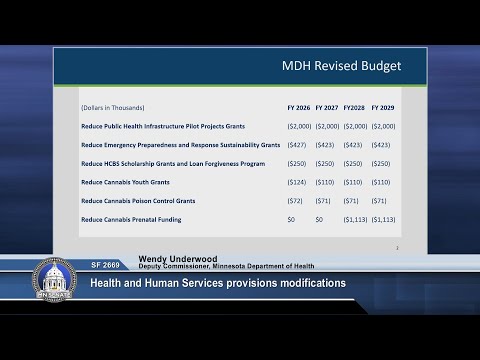
MDH presented other revisions in the governor’s revised budget that would reduce or restructure existing programs. Among items Underwood described: a reduction of the annual Public Health Infrastructure Pilot Projects appropriation from $6,000,000 to $4,000,000, a roughly 5 percent cut to $8,400,000 emergency preparedness and response sustainability grants, and a $250,000 annual reduction beginning in FY 2026 to a $1,450,000 scholarship and loan-forgiveness program for HCBS direct-care workers. MDH also described modest reductions and timing changes to several cannabis-related education and prevention programs.
Committee members pressed MDH for detail about how much of the federal funding had already flowed to counties and other partners and what immediate service disruptions might look like. Underwood said grantees had 30 days to submit reimbursements for eligible expenses incurred through the date CDC specified (March 24), and that counties and tribal partners that depend on those reimbursements must now scramble to decide whether to continue programs, shift funds, or lay off staff. Bridal Wright, MDH legislative budget director, and other MDH staff joined Underwood for questions on fee increases and fee structure later in the hearing.
Senators reacted strongly. Sen. Carla Mann (D) described the cancellation as “systematic destruction of our public health infrastructure” and urged a rapid state response. Sen. Tom Abler (R) pressed for detail on how much of the federal funding flowed to counties; Underwood said $50,000,000 appears to remain unspent on grants but that MDH staff were still compiling totals. Underwood cautioned that final numbers and precise impacts were changing hourly as MDH and partners examined hundreds of grants and contracts.
MDH warned the committee that immediate layoffs would have additional costs to the state (payouts for leave, unemployment, insurance continuation) that had not been budgeted. Underwood said MDH had not yet issued formal layoff notices because staff were racing to distinguish positions fully funded by expired federal grants from positions funded by a blend of sources and to find ways to minimize harm.
The committee did not act on MDH’s budget bill at the hearing. Chair Senator Wicklund said Senate File 2669 would be laid over for possible inclusion in an omnibus bill so members and staff could continue follow-up and ask for additional information from the department.
Staff and members asked MDH for more detailed follow-up: a full accounting of grant and contract amounts affected, the number of state and local employees funded in whole or part by the grants, specific services likely to be interrupted (for example, community vaccine clinics and poison control support), and whether alternative funding streams existed. MDH said it would update the committee as the situation evolved.
The MDH presentation also included more routine budget-change items in the governor’s revised proposal (reduced grants, fee changes and timing shifts), but senators focused much of their questioning on the federal grant cancellations and the human and operational consequences for county and tribal public health systems. Underwood repeatedly emphasized that the grants originally carried end dates and that MDH had been preparing for an orderly phase-down over months; the department said it could not execute a proper phased transition with the immediate stop order.
MdH asked the committee for patience as staff worked with grantees and partners to assess impacts. “We definitely plan to keep the chair and this committee apprised of these impacts as more information comes together,” Underwood said.
Ending: Committee members expressed anger and concern about the immediate federal action and asked MDH to provide a follow-up accounting of contract and grant exposures, staff impacts, and potential service gaps. Senate File 2669 was laid over for possible inclusion in an omnibus bill pending those updates.