Get Full Government Meeting Transcripts, Videos, & Alerts Forever!
Get email alerts on the School Composting Recycling topic
No spam. Unsubscribe anytime.
North Kingstown pilots student-led composting and recycling; district says participating schools divert about 80% of cafeteria waste
Summary
Sustainability specialist Eva Tuohy and Child Nutrition Services staff described a student-driven composting and recycling program in four elementary schools, a commercial hauler arrangement and early results showing high diversion rates and potential waste-haul savings.
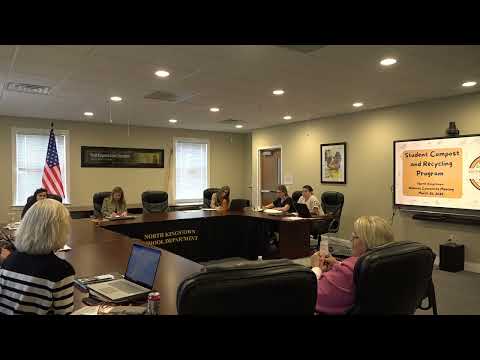
At the March 26 Wellness Subcommittee meeting, North Kingstown's sustainability specialist described a student-driven composting and recycling pilot that district staff said has reduced cafeteria landfill waste substantially in participating elementary schools.
Eva Tuohy, the district sustainability specialist, presented the program design, which trains student leaders to run lunch-period sorting, installs a branded share cart and glass-front share refrigerator at each participating school, and replaces many single-use items with compostable serviceware. The district is working with the Rhode Island Schools Recycling Project for implementation and Black Earth Compost as a commercial compost hauler.
Four elementary schools began the program in early March: Forest Park, Stony Lane, Quidnessett and Fishing Cove. Tuohy said the program pairs student "compost crews" with adult supervisors during the initial launch; the crews sort liquid waste, recycling, compostable items and landfill waste and encourage correct tray sorting.
Trish Cawley, Child Nutrition Services, told the committee the participating schools are diverting roughly 80% of what had previously been sent to the landfill: "Overall the schools that are participating right now, we are still at 80%." The presentation included a single-day audit at Forest Park that found 76 pounds of potential cafeteria waste and an estimated 70 pounds were diverted, a 94% diversion rate for that audit day.
District staff said the program has produced both educational benefits and operational gains. Staff track pre- and post-implementation audits and said the district spends about $7,000 per month on waste hauling; early data and purchase changes to compostable materials could reduce dumpster pickups and create savings, though the district noted compostable serviceware currently carries higher unit costs. The pilot includes a stipend of $1,900 per school for a sustainability coordinator to support the program.
Other operational details: students are asked to pour liquids from containers into a liquid bucket to keep recyclables clean; the district uses share carts/refrigerators to capture unopened or unused purchased food for later use; and the district compacts trays and uses liners to maximize compost-hauler capacity. The pilot also includes bilingual custodial materials and outreach.
Next steps identified by staff include continuing monthly audits, adjusting pickup frequency for dumpsters where diversion justifies change, expanding to additional schools (middle and high school approaches will differ) and creating a playbook of best practices to support replication across the district and other Rhode Island districts.