Get Full Government Meeting Transcripts, Videos, & Alerts Forever!
Get email alerts on the Child Welfare Dcyf topic
No spam. Unsubscribe anytime.
House committee re-refers DCYF agency bill with EBT contract exemption and child-welfare changes to judiciary
Summary
A Minnesota House committee voted to re‑refer House File 1918, an agency bill for the Department of Children, Youth and Families (DCYF), to the Judiciary Committee. The measure includes a provision to allow the state EBT contract to extend up to 10 years, changes to truancy responses and foster‑care timelines, and statutory transfers into DCYF.
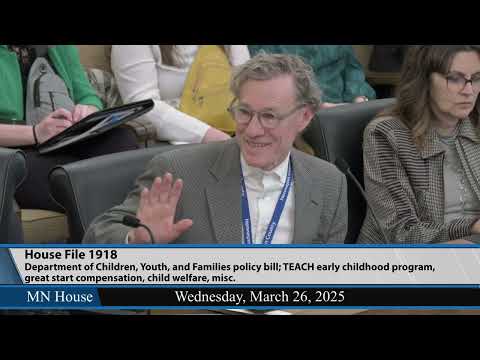
The Minnesota House Children and Families Committee voted to re‑refer House File 1918, an agency bill for the Department of Children, Youth and Families (DCYF), to the House Judiciary Committee after a committee discussion on contract terms, truancy responses and foster‑care timelines.
The measure includes several separate articles. Article 1 would create an exemption to the state's five‑year term limit on state contracts for the EBT (electronic benefits transfer) contract, allowing an initial five‑year extension for a total possible 10‑year term. Representative Hansen, vice chair, described that change as intended to reduce the frequency of reprocurement and give agencies a longer runway to manage complex procurements.
Article 2 would update the Great Start Compensation Support payment program to clarify which data collected in administering the program is public and which is not public. Committee members asked staff to consult the packet for details on data handling.
Article 3 contains multiple child welfare provisions. It would add clarifying statutory language related to the Minnesota African American Family Preservation and Child Welfare Disproportionality Act and require that inquiry into American Indian heritage be asked for all children and families in child welfare settings. The article also aligns cross references and the statutory language regarding reestablishment of parental rights to allow reunification in certain cases where an adoption did not finalize or dissolved.
That article also changes how counties and tribes may respond to reports of educational neglect. Current statute requires a child protection response when a child accrues seven unexcused absences; the bill would allow counties and tribes to provide a conventional, preventive response focused on supports and engagement before initiating a child protection maltreatment response. Representative Hansen and other members framed the change as a way to reduce unnecessary child protection interactions when absences stem from poverty or unmet family needs while preserving the child protection response if absences persist.
Several foster care provisions in Article 3 would align state timelines with federal requirements by changing the statutory deadline for an out‑of‑home placement plan from 30 days to 60 days in order to match federal rules, while preserving the policy goal of completing plans earlier when possible. The article would also require a court review and report 90 days prior to a youth turning 18 to inform the court of the youth's intentions and service needs.
Article 4 would finish statutory transfers that move powers, duties and responsibilities from the Department of Human Services into DCYF for uncodified sections of law, a technical recodification tied to implementation of the new department.
Committee members pressed for implementation details and for assurances that caseworkers would still begin work promptly when a case required it. Nonpartisan staff noted certain legal alignments, including references in chapter 260C that are used to match evidentiary standards.
The committee approved a voice motion to re‑refer House File 1918 to the Judiciary Committee. The motion was made by Representative Hansen and carried by voice vote.