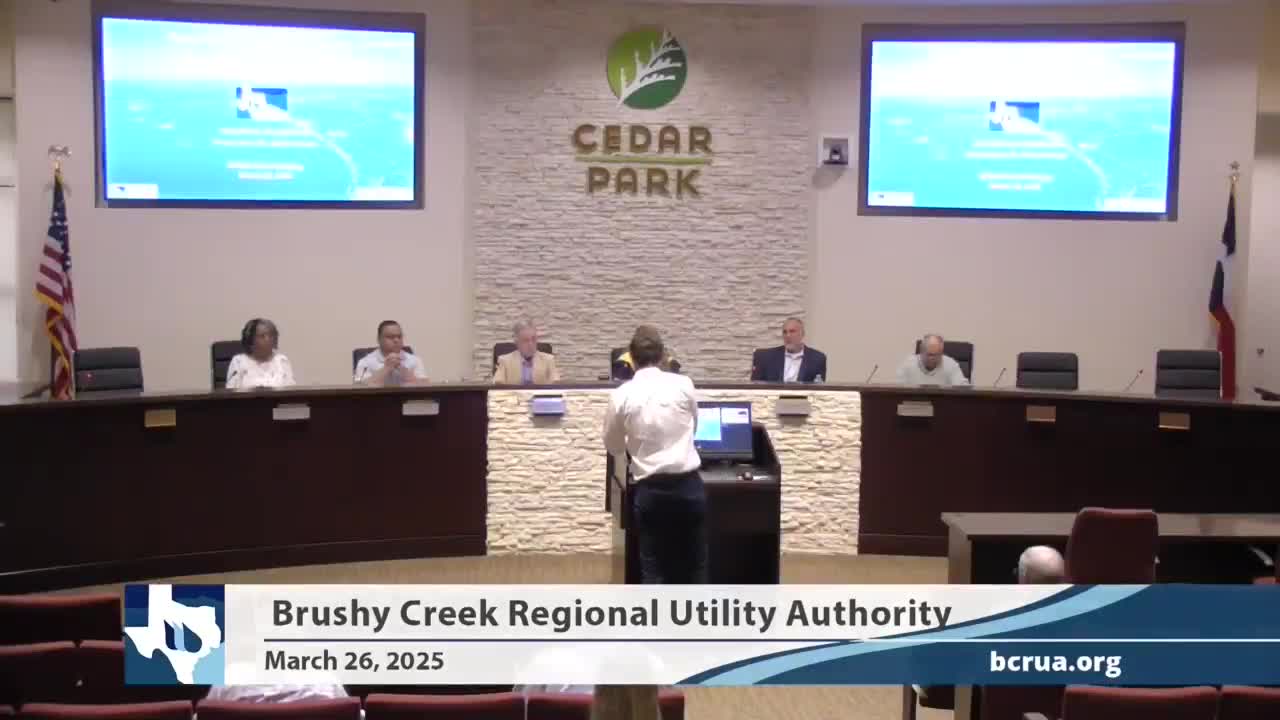
Brushy Creek utility authority hears progress on multimillion-dollar water projects; drought trigger highlighted
Loading...
Summary
Authority staff reported schedule and budget updates on Phase 2 raw water delivery, Phase 1D treatment expansion and delivery-point improvements, and recommended extending the Phase 2A timeline to May 2028 as contractors cite regional congestion. Staff also reviewed drought forecasts and the intake-decommissioning trigger for Lake Travis.
Brushy Creek Regional Utility Authority members heard an update Wednesday on major water projects, from a $125 million Phase 2 raw-water delivery contract to the Phase 1D treatment-plant expansion, and were briefed on drought forecasts that could force changes to intake operations at Lake Travis.
Aaron Archer, a project engineer with Walker Partners, told the board the Phase 2 raw-water delivery contract is about 60% complete on a calendar-days basis and about 55% complete on a cost basis. He said contractors are working through a jointly reviewed recovery schedule and that recent iterations show the work trending back toward on-time completion. "The contractor has prepared a recovery schedule ... and it's working on weekends and additional work to bring the project up to speed," Archer said.
Archer reported work continues on an 8,800-foot cast-in-place concrete tunnel liner, pump-shaft casings (with one shaft left to drill and roughly three casings remaining to install and grout), and preparations for the pump-station building foundation. He said casing installation and grouting are expected to be complete around May under the current schedule.
On the Phase 1D water-treatment expansion, Archer said the authority issued a notice to proceed in May 2023 and the construction contract, valued at $17,000,000, ran past its original completion date. The contractor, Excel Construction, has submitted one change order for about $190,000; invoices to date total approximately $14,100,000 (about 83% of the contract). Archer said structural work and most equipment installation are complete and the remaining work is largely chemical-feed upgrades, a few minor equipment installations, and commissioning. The contractor estimates substantial completion roughly mid-May.
Archer said the Phase 1 delivery-point improvements contract is substantially complete after the contractor addressed punch-list items. A late change order will add a replacement flow meter at the Round Rock delivery point; Archer said the meter should be online by April 2. The Phase 2 delivery-point improvements contract, he said, has a contractual substantial-completion date in early April but is tracking to late May because of control-panel testing delays; remaining work is primarily testing and commissioning. Archer gave the Phase 2 delivery-point contract amount as $612,000.
Looking ahead, Archer described the Phase 2A water-treatment expansion that will raise plant capacity from 42 million gallons per day (MGD) — the projected capacity after Phase 1D — to 67 MGD. He said 100% design is expected in mid-April, after which the authority must complete regulatory reviews with the Texas Commission on Environmental Quality and site permitting with the City of Cedar Park, and submit materials to the Texas Water Development Board before advertising. Archer said the authority anticipates advertising the project in May 2025, issuing a construction notice to proceed around September 2025, and achieving substantial completion in May 2028. He said staff has recommended pushing the previously desired summer 2027 target to May 2028 because contractors reported heavy workloads and supply/market pressures across Central Texas.
"We have been recommending ... we push that completion date out to May of 2028 to avoid having to pay a lot of cost escalations to accelerate that project," Archer told the board.
Archer said the authority has begun outreach with prospective contractors to ensure the project is on bidders' tracking logs. He also reported an abridged SWIFT application has been submitted to the Texas Water Development Board on behalf of the cities of Leander and Round Rock; those cities were evaluating whether and at what dollar amounts they will participate. Archer said a final application, if invited by TWDB, would require roughly a 30-day, involved process that will include actions by the BCRUA board and by individual city councils.
On drought conditions, Archer said Lake Travis inflows have been minimal this winter and spring. He reminded the board that the authority's plan calls for decommissioning the floating intake if Lake Travis reaches an elevation of 623 feet. Archer said the engineering team prepared a change order to allow the contractor to implement that work if needed, but "we would not intend to pull the trigger on that work until the last minute, until the lake essentially is reaching 623 feet." He said the current Lake Travis elevation is about 636 feet, versus a conservation or normal pool elevation of about 680 feet. Archer also said the deep-water intake under construction has multiple intake elevations, with the lowest able to withdraw to about 560 feet.
Board members asked a handful of clarifying questions, including whether upstream reservoirs such as Lake Buchanan are currently higher; Archer said Lake Buchanan had received inflows that did not pass through to Lake Travis and that the Lower Colorado River Authority tends to retain inflows in upstream reservoirs unless conditions require releases.
The authority's next steps on projects include completing Phase 2A design reviews and regulatory submittals in April, coordinating with Leander and Round Rock on TWDB participation and final application steps, continuing contractor recovery oversight on Phase 2, and completing commissioning work on Phase 1D and delivery-point improvements. Archer said staff will coordinate to place required city-council items on participating cities' agendas.
Votes at a glance: the board approved the BCRUA meeting minutes for Feb. 26, 2025; authorized the general manager to execute a Sourcewell cooperative purchasing participation agreement; authorized the general manager to execute an Omnia Partners interlocal participation agreement; and approved a proposed settlement agreement in BCRUA v. W. L. Haley & Company and Jacobs Engineering Group following an executive session. For each motion the board recorded voice votes and "ayes," but the transcript does not provide a roll-call tally for individual members.